
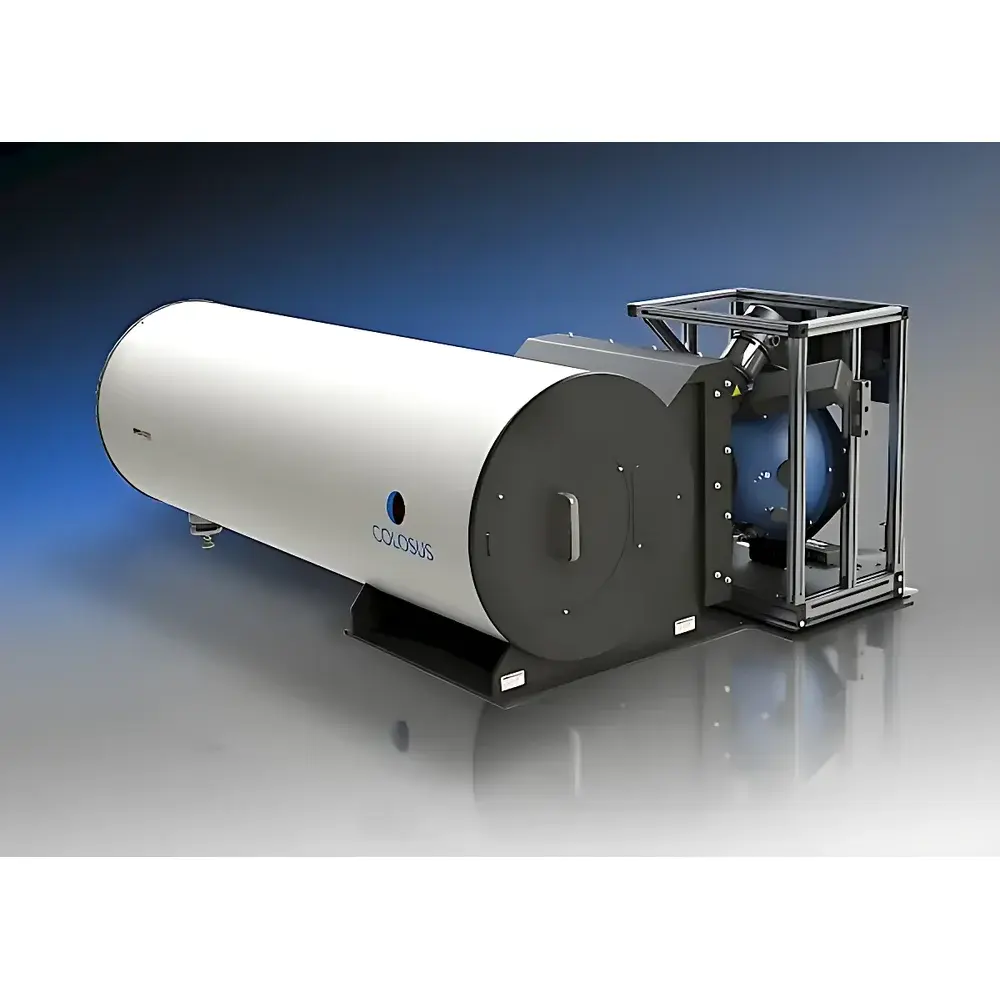
Labsphere COLOSUS Radiometric Calibration System with Integrating Sphere and Collimated Uniform Source
| Brand | Labsphere |
|---|---|
| Origin | USA |
| Manufacturer Type | Authorized Distributor |
| Origin Category | Imported |
| Model | COLOSUS System |
| Price Range | USD $65,000 – $105,000 |
| Spectral Range | 0.3–14 µm |
| Calibration Traceability | NIST-traceable radiance/irradiance |
| Dynamic Range | >1×10¹⁰ |
| Uniformity | >98% (spatial) |
| Blackbody Temperature Range | −40 °C to +175 °C |
| Blackbody Emissivity | >0.998 |
| Temperature Stability | ±0.01 °C |
| Aperture Size | 4 in (102 mm) |
| Software Platform | IRWindows™ 4 |
Overview
The Labsphere COLOSUS Radiometric Calibration System is a turnkey, NIST-traceable solution engineered for the absolute radiometric calibration and performance validation of remote sensing cameras, multispectral and hyperspectral imagers, and electro-optical systems across the full 0.3–14 µm spectral range—from ultraviolet (UV) and visible (VIS) through short-wave infrared (SWIR), mid-wave infrared (MWIR), and long-wave infrared (LWIR). Unlike conventional uniform source systems limited to narrow spectral bands or static output levels, COLOSUS integrates modular, spectrally complementary light sources—including plasma arc, xenon, tunable LED arrays, and high-stability blackbodies—within a thermally controlled integrating sphere architecture. Its core measurement principle relies on calibrated, spatially uniform radiance generation under precisely defined geometric and spectral conditions, enabling traceable determination of system-level parameters including responsivity, dynamic range, linearity, SNR, MTF, and absolute photometric accuracy. Designed specifically for satellite sensor pre-launch characterization, climate monitoring instrument validation, defense-grade ISR system qualification, and laboratory-based EO/IR sensor development, COLOSUS satisfies stringent requirements for ISO/IEC 17025-compliant calibration workflows and supports full auditability per FDA 21 CFR Part 11 and GLP/GMP data integrity standards.
Key Features
- Full-spectrum coverage from 300 nm to 14 µm via hybrid source architecture: plasma/xenon lamps (UV–VIS–NIR), tunable LED modules (VIS–SWIR), and precision blackbodies (MWIR–LWIR)
- NIST-traceable radiance and irradiance calibration with uncertainty budgets documented per ISO/IEC 17025 and ASTM E259
- Dynamic range exceeding 1×10¹⁰ enables seamless transition between daytime solar-equivalent brightness (up to 1.3×10⁵ W·sr⁻¹·m⁻²) and night-sky radiance levels (down to ~1×10⁻⁴ W·sr⁻¹·m⁻²)
- HELIOS-series integrating sphere with >99.8% emissivity blackbody cavity, thermal stability ±0.01 °C, and spatial uniformity >98% over full aperture
- Collimated optical path using off-axis Newtonian design with configurable apertures (6″, 8″, 12″) and focal lengths optimized for VIS–LWIR collimation
- Motorized 6-/12-/16-position target wheel with CNC-laser-cut precision targets—including reflective, transmissive, divergent, and spectral calibration standards
- Modular expandability: integration-ready interfaces for external filters, monochromators, polarization optics, and laser injection paths
Sample Compatibility & Compliance
COLOSUS accommodates imaging sensors of all form factors—including frame-transfer CCDs, scientific CMOS, InGaAs, HgCdTe, and microbolometer arrays—with native support for analog, GigE Vision, Camera Link, CoaXPress, USB3 Vision, and SMPTE-compliant HD/4K video inputs. The system complies with key international standards governing radiometric testing: ASTM E1377 (calibration of imaging radiometers), ISO 15739 (noise measurement), ISO 12233 (spatial frequency response), USP (optical system verification), and ECSS-E-ST-70-01C (spacecraft EO sensor calibration). All calibration artifacts—including sphere coatings, blackbody cavities, and reference detectors—are certified to ISO 17025-accredited laboratories, ensuring full metrological traceability to NIST and PTB primary standards. System operation adheres to GLP and GMP data governance protocols, with IRWindows™ 4 enforcing electronic signatures, audit trails, and role-based access control.
Software & Data Management
IRWindows™ 4 serves as the unified software platform for instrument orchestration, test sequencing, data acquisition, and report generation. It provides three operational modes: Operator (guided workflow with pass/fail thresholds), Developer (API-driven scripting in Python/C++), and Engineer (low-level hardware control and custom algorithm integration). The software natively supports over 100 standardized test procedures—including MTF via slanted-edge analysis, photoresponse nonuniformity (PRNU), dark current mapping, gain/offset linearity, and spectral responsivity sweep—and exports results to SQL databases with configurable metadata schemas. All raw image data, calibration coefficients, environmental logs (temperature, humidity, pressure), and operator annotations are stored in vendor-neutral formats (TIFF, HDF5, CSV) with SHA-256 checksums. Full 21 CFR Part 11 compliance is enabled via electronic signature capture, immutable audit logs, and secure user authentication (LDAP/Active Directory).
Applications
- Pre-launch calibration and verification of Earth observation satellite imagers (e.g., Landsat, Sentinel, VIIRS, MODIS heritage systems)
- Performance validation of airborne multispectral scanners used in precision agriculture and environmental monitoring
- Defense applications: targeting pod qualification, missile seeker testing, and low-light surveillance system certification
- Climate science instrumentation: cross-calibration of atmospheric lidar, sun photometers, and spectral radiometers
- R&D labs developing next-generation SWIR and LWIR quantum-well infrared photodetectors (QWIPs) and type-II superlattice focal plane arrays
- Automotive ADAS camera validation against ISO 26262 functional safety requirements for luminance response and color fidelity
FAQ
What spectral ranges does COLOSUS cover, and how is traceability maintained across bands?
COLOSUS spans 0.3–14 µm using physically distinct but metrologically linked source modules. UV–VIS–NIR traceability originates from NIST-calibrated reference lamps and spectroradiometers; MWIR–LWIR traceability derives from cavity blackbodies calibrated against primary fixed-point cells (e.g., Cu, Ag, Au freezing points) at NIST or PTB. Cross-band consistency is verified via overlapping spectral measurements using transfer standard detectors.
Can COLOSUS simulate real-world illumination conditions such as solar spectra or night-sky radiance?
Yes. The system includes plasma/xenon sources with adjustable filters to replicate AM0, AM1.5G, and CIE daylight spectra. For low-light validation, it integrates calibrated night-sky spectral models (e.g., Dark Sky Standard) with sub-nW·sr⁻¹·m⁻² radiance capability using cooled blackbodies and attenuated LED arrays.
Is the system compatible with custom camera interfaces or proprietary image acquisition hardware?
IRWindows™ 4 provides SDKs for C++, Python, and MATLAB, supporting custom driver integration via GenICam, DCAM, or vendor-specific APIs. All major commercial frame grabbers (e.g., BitFlow, Teledyne DALSA, FLIR) are pre-certified.
How is spatial uniformity validated and maintained during long-duration tests?
Uniformity is measured in situ using a NIST-traceable scanning radiometer prior to each calibration campaign. Real-time monitoring employs embedded photodiode arrays positioned at the exit port; deviations >0.5% trigger automatic recalibration or thermal stabilization hold.
Does COLOSUS support automated test sequences compliant with MIL-STD-810 or ECSS calibration plans?
Yes. Preconfigured test templates align with ECSS-E-ST-70-01C Annex A and MIL-STD-810H Method 512.2 (radiometric performance). Users may import XML-based test plans or generate custom sequences with conditional branching, environmental logging, and auto-reporting to PDF/HTML with digital signatures.




