
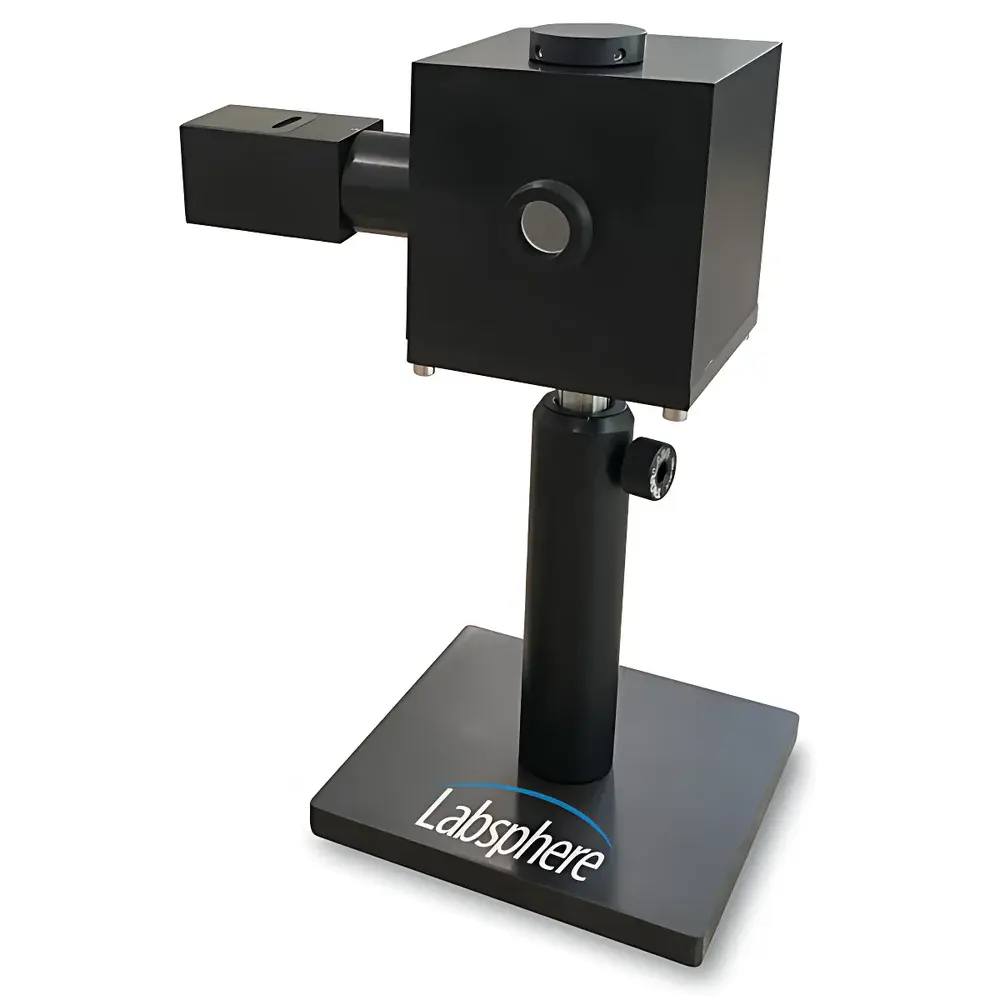
Labsphere LPMS-1 Laser Power Measurement Integrating Sphere System
| Brand | Labsphere |
|---|---|
| Origin | USA |
| Model | LPMS-1 |
| Detector Type | Calibrated Photodiode or Thermopile Sensor |
| Spectral Range | Customizable (e.g., 190–1100 nm or 800–1800 nm) |
| Power Range | 100 µW to 100 W (CW), up to 1 kW peak (pulsed, with appropriate attenuation) |
| Input Port Diameter | 25 mm, 50 mm, or 100 mm (configurable) |
| Coating | Spectralon® or custom diffuse reflectance coating (≥99% uniform reflectance) |
| Calibration Traceability | NIST-traceable |
| Compliance | ISO/IEC 17025 accredited calibration available |
| Software Interface | USB 2.0, compatible with Windows-based LPMS Control & Analysis Suite |
Overview
The Labsphere LPMS-1 Laser Power Measurement Integrating Sphere System is an engineered solution for traceable, high-fidelity radiometric characterization of laser sources across continuous-wave (CW) and pulsed operation modes. Based on the fundamental principle of spatial integration—where incident laser radiation undergoes multiple diffuse reflections within a highly uniform, spectrally neutral integrating sphere cavity—the LPMS-1 ensures near-ideal collection efficiency (>98% for beams with divergence angles up to ±60°) independent of beam profile, polarization state, or pointing stability. This architecture eliminates measurement bias introduced by detector angular response non-uniformity or spatial nonlinearity—critical when evaluating VCSEL arrays, edge-emitting diodes, fiber-coupled lasers, or free-space collimated beams used in LiDAR, facial recognition, optical sensing, and industrial processing applications. The system’s core compliance foundation rests on NIST-traceable spectral responsivity calibration and adherence to ISO 11554 (laser beam parameter measurements) and ISO 13694 (optical power measurement of lasers), supporting GLP/GMP-aligned validation workflows.
Key Features
- Modular integrating sphere platform with interchangeable input ports (25 mm, 50 mm, 100 mm) and customizable internal coatings—including high-reflectance Spectralon® (≥99% @ 400–1500 nm) or extended-NIR variants—for optimal signal-to-noise ratio across UV-VIS-NIR-SWIR bands.
- Dual-detector configuration: primary calibrated sensor (photodiode or thermopile) for absolute power measurement + secondary port for real-time spectral monitoring (e.g., via fiber-coupled spectrometer) or auxiliary diagnostics without interrupting primary acquisition.
- Integrated optical attenuation design: built-in neutral-density filter stages or reflective beam dumps enable safe, linear measurement of high-power lasers (up to 100 W CW, 1 kW pulsed peak) while preserving detector linearity and minimizing thermal drift.
- Active area uniformity correction: factory-applied spatial responsivity mapping compensates for pixel-to-pixel variations across the detector active surface—reducing measurement uncertainty to <±1.5% (k=2) for beams with diameters ≥1 mm.
- Real-time synchronization interface: TTL-triggered acquisition mode supports precise alignment with laser pulse trains (repetition rates from 1 Hz to 10 MHz), enabling accurate determination of pulse energy, peak power, pulse width (FWHM), and temporal stability metrics.
Sample Compatibility & Compliance
The LPMS-1 accommodates divergent, collimated, multimode, and structured laser outputs—including single-emitter diodes, VCSEL arrays, Q-switched solid-state lasers, and supercontinuum sources—without requiring beam conditioning optics. Its open-port geometry accepts beams with full divergence angles up to ±60°, making it suitable for near-field characterization of uncollimated emitters. All calibration certificates are issued under ISO/IEC 17025-accredited processes and include spectral irradiance responsivity data referenced to NIST Standard Reference Materials (SRMs). The system meets requirements for FDA 21 CFR Part 11-compliant audit trails when operated with validated software configurations, and supports IQ/OQ/PQ documentation packages for regulated manufacturing environments (e.g., medical laser device production per IEC 60601-2-22).
Software & Data Management
The LPMS Control & Analysis Suite (v3.2+) provides native support for automated measurement sequencing, statistical reporting, and export to CSV, XML, or HDF5 formats. Key functionalities include: real-time plotting of instantaneous power vs. time; calculation of mean CW power, peak pulse power, pulse energy, RMS power stability, and pulse-to-pulse deviation; wavelength-specific normalization using user-defined spectral correction factors; and batch-mode analysis of multi-wavelength datasets. Software logs all instrument settings, calibration expiration dates, operator IDs, and environmental metadata (temperature, humidity)—enabling full traceability in accordance with ISO 17025 Clause 7.7 and ASTM E2918 standards for uncertainty reporting.
Applications
- Quantitative verification of VCSEL array output uniformity and total radiant flux in 3D sensing modules.
- Production-line power screening of laser diodes prior to packaging (AEC-Q102 qualified test protocols supported).
- Optical power stability assessment during accelerated life testing (ALT) under thermal cycling conditions.
- Beam quality benchmarking for laser-based metrology tools (e.g., interferometers, confocal microscopes).
- Calibration transfer between reference standards and field-deployable laser power meters.
- Validation of laser safety classifications (IEC 60825-1) through repeatable radiant exposure measurements.
FAQ
What spectral ranges are supported by the LPMS-1 system?
Standard configurations cover 190–1100 nm (silicon photodiode) or 800–1800 nm (InGaAs thermopile); extended ranges (e.g., 250–2500 nm) are available with custom detector and coating selection.
Can the LPMS-1 measure both CW and pulsed lasers simultaneously?
No—measurement mode must be selected per acquisition sequence; however, the same hardware setup supports both regimes via software-configurable sampling rate, integration time, and trigger logic.
Is NIST-traceable calibration included with purchase?
Yes—each detector is supplied with a certificate of calibration valid for 12 months, including uncertainty budgets and spectral responsivity curves.
How is detector linearity verified across the full power range?
Linearity is validated per ANSI Z540.3 and ISO 17025 using calibrated attenuators and reference standards at ≥5 power levels spanning 3 decades.
Does the system support automated pass/fail testing in manufacturing environments?
Yes—customizable limit templates, statistical process control (SPC) charts, and PLC-compatible digital I/O enable seamless integration into automated test stands.




