
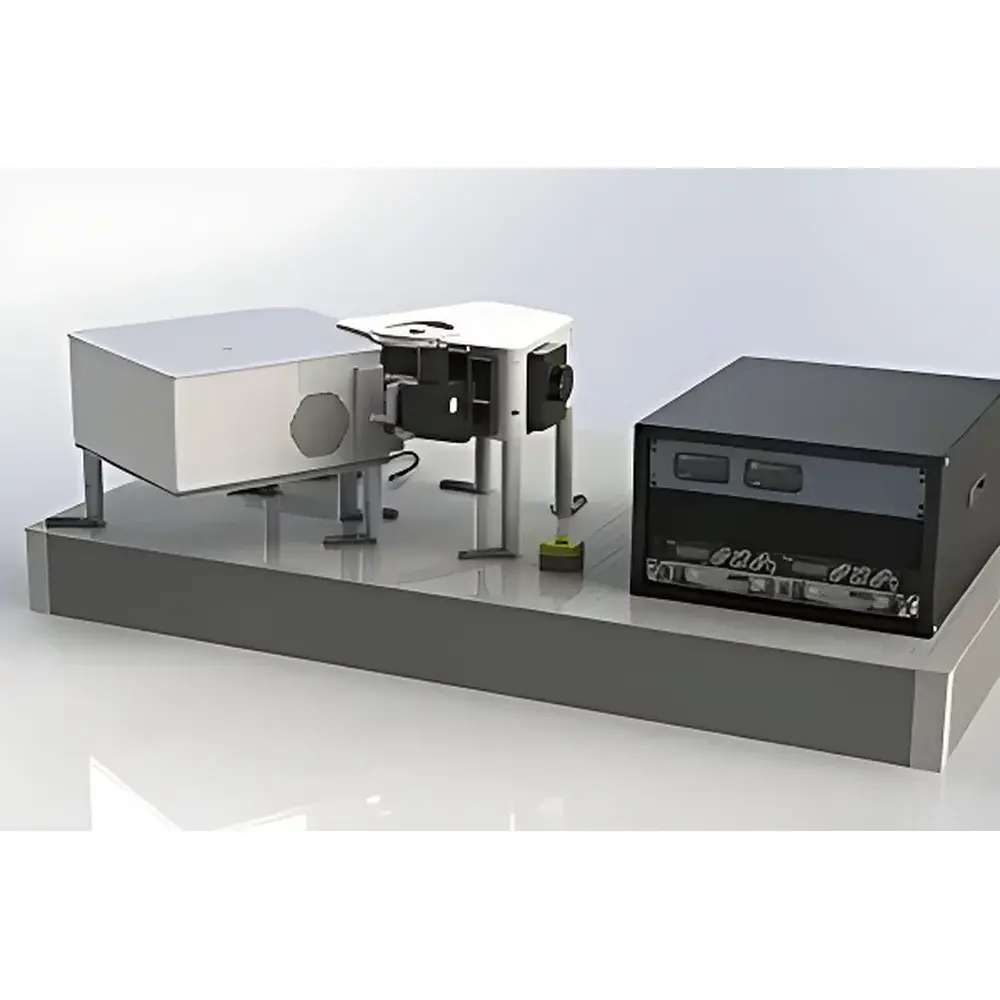
LabSphere QES-1000 Quantum Efficiency Test Source for Image Sensors
| Brand | LabSphere |
|---|---|
| Origin | USA |
| Manufacturer Type | Authorized Distributor |
| Import Status | Imported |
| Model | QES-1000 |
| Price Range | USD 14,000 – 28,000 |
Overview
The LabSphere QES-1000 Quantum Efficiency Test Source is a precision-calibrated, NIST-traceable broadband illumination system engineered specifically for spectral quantum efficiency (QE) and spectral responsivity characterization of image sensors—including CMOS, CCD, sCMOS, and scientific-grade focal plane arrays. It operates on the principle of calibrated monochromatic irradiance generation across the visible to near-infrared spectrum (typically 350–1100 nm), enabling absolute photon-to-electron conversion efficiency measurement per wavelength. Unlike generic light sources, the QES-1000 integrates a stabilized halogen or xenon-based continuum source with a high-resolution monochromator, precision aperture control, and uniform integrating sphere output—ensuring spatially homogeneous irradiance (< ±0.5% spatial non-uniformity over 50 mm Ø field) and spectrally stable output (drift < 0.1% per hour). This architecture supports traceable, repeatable QE determination in accordance with ISO 15739:2013 (Electronic still-picture imaging — Noise measurements) and ASTM E2848-22 (Standard Practice for Calibration of Spectral Responsivity of Photodetectors).
Key Features
- NIST-traceable spectral irradiance and radiance calibration across 350–1100 nm, with full uncertainty budgets provided per wavelength step
- High-dynamic-range output (up to 10⁶ photons/s/µm²/nm at 550 nm), enabling QE measurement from 95% without sensor saturation or signal-to-noise compromise
- Uniform integrating sphere output port (50 mm diameter) delivering < ±0.3% spatial irradiance uniformity (measured per ISO 9050)
- Real-time spectral power monitoring via integrated reference photodiode with temperature-stabilized readout
- Motorized monochromator with ≤1 nm bandwidth resolution and wavelength repeatability < ±0.05 nm
- Integrated shutter and neutral density filter wheel for precise irradiance attenuation (OD 0–6 in 0.1-step increments)
- Rugged, vibration-isolated optical bench design suitable for Class 1000 cleanroom integration
Sample Compatibility & Compliance
The QES-1000 accommodates bare die, wafer-level sensors, packaged modules (including lens-integrated units), and multi-spectral filter array (MSFA) devices. Mounting interfaces support standard sensor carriers (e.g., Kinetica, Thorlabs SM1-threaded stages) and custom fixtures via M6 tapped holes. All calibrations comply with ISO/IEC 17025:2017 requirements for testing laboratories, and spectral data files are delivered in SI-traceable HDF5 format with embedded metadata (wavelength, irradiance, uncertainty, date, NIST certificate ID). The system meets electromagnetic compatibility (EMC) standards per FCC Part 15 Subpart B and CE Directive 2014/30/EU. For regulated environments, optional audit trail logging and user access controls align with FDA 21 CFR Part 11 and EU Annex 11 requirements when paired with validated software.
Software & Data Management
The QES-1000 ships with LabSphere’s QES Control Suite—a modular Windows-based application supporting automated wavelength sweep, irradiance ramping, and synchronized frame capture via GenICam-compliant camera interfaces (USB3 Vision, GigE Vision). A comprehensive Software Development Kit (SDK) is included, providing C++, Python (via PyQES), and MATLAB APIs for integration into existing test platforms (e.g., NI TestStand, Keysight PathWave). All raw spectral irradiance data, sensor response frames, and derived QE curves are stored in vendor-neutral formats (HDF5, CSV, TIFF) with embedded EXIF-like metadata. Data provenance is maintained through timestamped logs, operator ID tagging, and version-controlled calibration file linking—enabling full GLP/GMP compliance in quality assurance workflows.
Applications
- Quantum efficiency mapping of front-side and back-side illuminated CMOS image sensors
- Spectral responsivity validation for automotive ADAS cameras (ISO 20870:2020 compliant)
- Linearity and dynamic range assessment per ISO 17850:2015
- Pixel-level QE uniformity analysis for astronomy-grade detectors
- Filter transmission verification and crosstalk quantification in multi-spectral imaging systems
- Calibration transfer between metrology labs and sensor fabrication fabs
FAQ
Is the QES-1000 compatible with back-illuminated sensors requiring deep UV or NIR extension?
Yes—the base configuration covers 350–1100 nm; optional upgrades include a deuterium lamp module (extending to 200 nm) and InGaAs-enhanced detector calibration (to 1700 nm), both with full NIST traceability.
Can the system be integrated into an automated production test line?
Absolutely—the SDK supports deterministic trigger timing (< 10 µs jitter), hardware TTL I/O for external sequencers, and SCPI command set for PLC interoperability.
How often does the system require recalibration?
LabSphere recommends annual recalibration against NIST SRM 2065 or SRM 2066; drift monitoring is enabled via built-in reference diode trending tools.
Does the QES-1000 support hyperspectral sensor characterization?
Yes—its monochromator stepping resolution and spectral stability enable point-scanning methods for push-broom and snapshot hyperspectral sensor QE validation.
Are calibration certificates included with shipment?
Yes—each unit ships with a full NIST-traceable calibration report, including spectral irradiance values at 5-nm intervals, spatial uniformity maps, and expanded uncertainties (k=2).




