
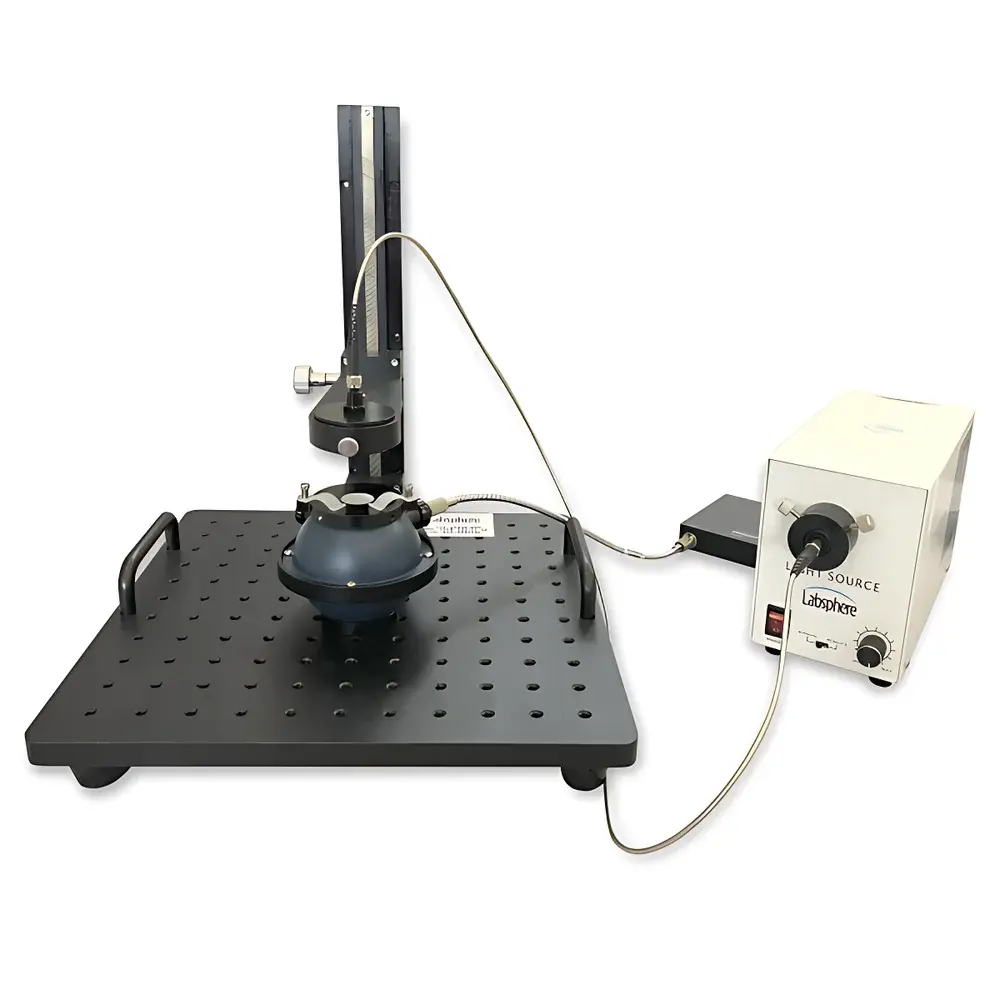
Labsphere RSA-FO-150-800-S Dual-Beam Reflectance and Transmittance Measurement Kit
| Brand | Labsphere |
|---|---|
| Model | RSA-FO-150-800-S |
| Wavelength Range | 360–1000 nm |
| Configuration | Dual-beam reflectance & transmittance measurement system with fiber-optic illumination and spectrometer integration |
| Integral Sphere Type | Dual-beam reflectance & transmittance sphere (150 mm diameter, barium sulfate coating, FO port configuration) |
| Compliance | ASTM E275, ASTM E903, ISO 9050, ISO 13468, ISO 14782, CIE S 014 |
Overview
The Labsphere RSA-FO-150-800-S Dual-Beam Reflectance and Transmittance Measurement Kit is an engineered optical metrology solution for quantitative spectral characterization of planar, semi-transparent, and opaque materials across the visible to near-infrared (VIS-NIR) spectrum (360–1000 nm). Based on dual-beam comparative photometry within a high-reflectance (≥98% @ 360–1000 nm), spectrally neutral barium sulfate-coated integrating sphere, the system enables simultaneous, traceable measurement of both directional-hemispherical reflectance (Rdh) and directional-hemispherical transmittance (Tdh) under identical illumination and detection geometry. The core architecture employs a stabilized broadband fiber-coupled light source feeding collimated illumination into the sphere’s input port, while a calibrated CCD-array spectrometer captures full-spectrum radiometric response from the sphere’s detector port. This configuration eliminates sequential measurement drift and supports high reproducibility (<0.2% RSD over 8-hour operation) essential for QC laboratories and R&D validation workflows.
Key Features
- Dual-beam optical path design: Enables real-time ratioing of sample and reference signals at the spectrometer level, minimizing lamp intensity drift and thermal baseline shift.
- 150 mm diameter integrating sphere with >98% diffuse reflectance (BaSO4 coating) optimized for 360–1000 nm; includes dedicated ports for sample, reference, source, detector, and auxiliary fiber access (FO configuration).
- Fiber-optic broadband illumination: Coupled to a stabilized tungsten-halogen or deuterium-tungsten source (user-supplied or optional), delivering uniform, near-collimated beam incidence at 8° ± 0.5° angle of incidence per ASTM E275 and ISO 9050.
- High-resolution VIS-NIR spectrometer: Typically configured with 0.5–2.0 nm optical resolution (FWHM), 2048-pixel linear CCD array, thermoelectric cooling (–5°C), and USB 3.0 interface for low-noise spectral acquisition.
- Modular sphere interchangeability: Compatible with Labsphere’s family of 150 mm spheres—including single-beam reflectance (RSA-150-R), dual-beam reflectance-only (RSA-150-DR), and dual-beam reflectance/transmittance (RSA-150-DRT)—enabling functional reconfiguration without hardware redesign.
- Pre-aligned mechanical interface: Precision-machined flanges and kinematic mounts ensure repeatable sphere-to-source and sphere-to-spectrometer alignment, reducing setup time and operator-induced variability.
Sample Compatibility & Compliance
The RSA-FO-150-800-S accommodates flat, rigid samples up to 50 mm × 50 mm × 10 mm thickness, including optical filters, coated glass substrates, polymer films, solar control coatings, display cover glasses, and thin-film photovoltaic absorbers. Sample mounting utilizes a spring-loaded, black-anodized aluminum holder with defined aperture (25 mm diameter) and edge-shadowing minimization geometry. The system meets requirements for ASTM E275 (Standard Practice for Calibration of Spectrophotometers), ASTM E903 (Standard Test Method for Solar Absorptance, Reflectance, and Transmittance of Materials Using Integrating Spheres), ISO 9050 (Glass in building — Determination of light transmittance, solar direct transmittance, total solar energy transmittance, ultraviolet transmittance and related glazing factors), and ISO 13468 (Plastics — Determination of total luminous transmittance of transparent materials). Data traceability aligns with GLP and GMP documentation practices when paired with validated software and certified reference standards (e.g., Labsphere STAN-010-REF, NIST-traceable reflectance standards).
Software & Data Management
The kit integrates with Labsphere’s TruScan™ Pro spectral analysis software (Windows 10/11, 64-bit), supporting automated wavelength calibration, dark-current subtraction, stray-light correction, and spectral ratio computation (sample/reference). Raw spectral data are exported in CSV, TXT, and XML formats compliant with ASTM E131 and ISO/IEC 17025 reporting requirements. Software features include batch processing, pass/fail thresholding against user-defined spectral limits, statistical process control (SPC) charting, and audit trail logging per FDA 21 CFR Part 11 (when deployed with electronic signature and role-based access controls). All calibration files (lamp spectral power distribution, sphere throughput, detector responsivity) are stored with timestamped metadata and version control.
Applications
- Optical coating development and verification: Quantifying anti-reflective (AR), high-reflective (HR), and bandpass filter performance across VIS-NIR bands.
- Solar energy materials testing: Measuring solar-weighted reflectance (ρsolar) and transmittance (τsolar) for architectural glazing and PV encapsulants per ISO 9050 and EN 410.
- Display and touch panel QA: Validating front-surface reflectance of cover glass and AR-treated touch sensors under standardized D65 illuminant conditions.
- Medical device optics: Characterizing transmittance uniformity and haze of ophthalmic lenses and endoscopic windows per ISO 11979-2 and ISO 10938.
- Automotive lighting and sensor covers: Assessing spectral transmission windows for LiDAR, camera, and ambient light sensors operating between 850 nm and 940 nm.
- Academic and government metrology labs: Serving as a primary or secondary standard platform for inter-laboratory comparison studies under CCPR key comparisons.
FAQ
What reference standards are required for calibration?
A NIST-traceable reflectance standard (e.g., Labsphere STAN-010-REF, 99% BaSO4-coated disk) and a certified transmittance standard (e.g., Labsphere TST-050-REF, fused silica disk with known τVIS) are mandatory for initial system validation and periodic recalibration.
Can the system measure diffuse vs. specular components separately?
No—the RSA-FO-150-800-S measures directional-hemispherical (total) reflectance and transmittance only. For goniometric separation (e.g., d/0 vs. d/d), a separate goniophotometer or bi-directional reflectance distribution function (BRDF) instrument is required.
Is the sphere compatible with external monochromators or lasers?
Yes—via the auxiliary FO port, the sphere accepts collimated monochromatic input from tunable lasers or monochromator systems, enabling discrete-wavelength validation and narrowband material characterization.
What is the typical measurement repeatability for reflectance at 550 nm?
Under controlled lab conditions (23 ± 1°C, <40% RH), repeatability is ≤±0.15% absolute reflectance (k = 2) for homogeneous samples measured over 10 consecutive cycles with automated sample repositioning.
Does the system support compliance with FDA 21 CFR Part 11?
Yes—when deployed with TruScan™ Pro v5.2+ under validated IT infrastructure, including electronic signatures, audit trail activation, and secure user authentication, it satisfies Part 11 requirements for regulated environments.



