
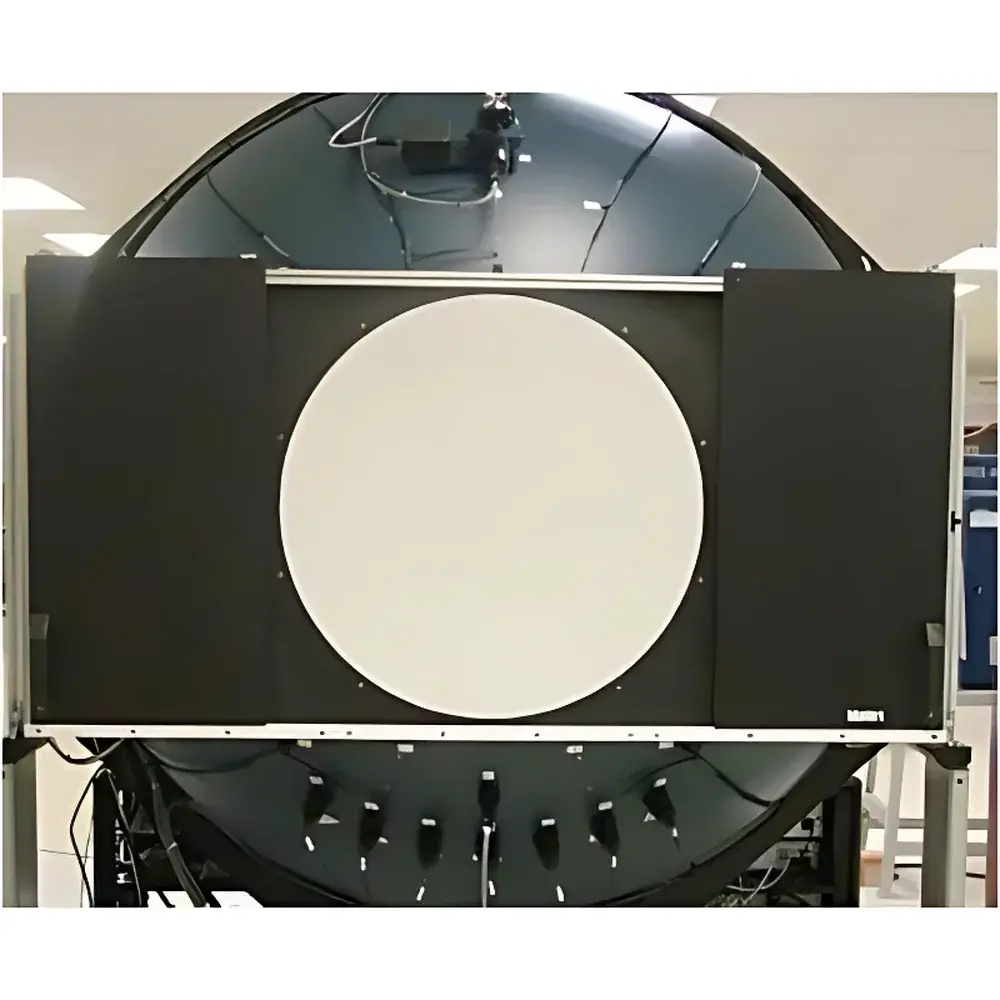
Labsphere USS-4000C Large-Area Uniform Source System
| Brand | Labsphere |
|---|---|
| Model | USS-4000C |
| Origin | USA |
| Configuration | Vertical integrating sphere-based continuous adjustable uniform source |
| Aperture Diameter | 14 in (35.6 cm) |
| Luminance Range | 0–40,000 cd/m² (nits) |
| Uniformity | >98% spatial radiance uniformity at output port |
| Calibration | NIST-traceable radiometric and photometric calibration |
| Optional Calibrations | USC-PM (point-to-point port uniformity), USC-SR (spectral radiance: 300–2400 nm, unit: mW·cm⁻²·sr⁻¹·µm⁻¹) |
| Compliance | ISO 9001:2000 certified quality management system |
| Detector Interface | Dual monitoring detector ports |
| Lamp Ramp | 20 s soft-start current ramp |
| Spectral Stability | Matched CCT lamps minimize color temperature drift across multi-lamp arrays |
| Mechanical Design | Rigid, repeatable aperture mounting structure |
| Software Control | PC-based GUI for lamp on/off, attenuator positioning, real-time luminance feedback, and user-defined parameter scripting |
Overview
The Labsphere USS-4000C Large-Area Uniform Source System is an engineered optical calibration reference designed for high-fidelity radiometric and photometric testing of imaging sensors, remote sensing instruments, and optical measurement devices. Built around a vertically oriented integrating sphere architecture, the system delivers spatially uniform radiance across its 14-inch (35.6 cm) output port with verified uniformity exceeding 98% — a critical performance threshold for satellite instrument validation, EO/IR sensor characterization, and camera MTF or responsivity mapping. The core principle relies on multiple precisely positioned broadband tungsten-halogen lamps coupled to a highly reflective (>97% diffuse reflectance, Spectralon® coating) spherical cavity, where multiple internal reflections homogenize angular and spatial intensity distribution prior to exit through the calibrated port. Real-time closed-loop control is enabled by an integrated silicon photodiode monitoring detector and a motorized variable neutral-density attenuator, allowing stable, repeatable luminance adjustment from 0 to 40,000 cd/m² (nits) without lamp repositioning or manual filter changes.
Key Features
- Vertical integrating sphere design optimized for gravity-stable lamp alignment and thermal management during extended operation
- Motor-driven precision attenuator enabling fine-resolution luminance control — especially critical below 100 cd/m² where conventional lamp dimming introduces spectral shift and instability
- NIST-traceable radiometric calibration delivered with each system; optional USC-PM (port uniformity mapping) and USC-SR (full-spectrum radiance data from 300–2400 nm) calibrations available
- Dual detector ports support simultaneous broadband and spectral monitoring — enabling in situ verification of spectral stability or integration with external spectroradiometers
- 20-second controlled lamp warm-up ramp minimizes thermal shock and extends lamp life while ensuring reproducible CCT and output stability
- Interchangeable lamp modules with matched correlated color temperature (CCT) reduce chromatic nonuniformity when scaling output via lamp count modulation
- Rigid, kinematically aligned port flange ensures mechanical repeatability for automated test stations requiring sub-millimeter positioning accuracy
Sample Compatibility & Compliance
The USS-4000C accommodates full-frame and large-format detectors including focal plane arrays (FPAs), push-broom scanners, and multispectral imagers up to 35 cm diagonal. Its 14-inch port provides sufficient étendue for collimated or near-collimated illumination when paired with auxiliary optics. The system meets requirements for laboratory-grade radiometric testing under ISO/IEC 17025-accredited environments and supports audit-ready documentation for GLP and GMP workflows. Calibration reports include full uncertainty budgets per ISO/IEC Guide 98-3 (GUM), and software logs maintain timestamped records of all attenuator positions, detector readings, and lamp status — compliant with FDA 21 CFR Part 11 electronic record integrity requirements when deployed with validated software configurations. All manufacturing and calibration procedures are executed under Labsphere’s ISO 9001:2000 certified quality management system.
Software & Data Management
The USS-4000C is operated via Labsphere’s proprietary Uniform Source Control (USC) software suite, a Windows-based application providing intuitive GUI control of lamp power states, attenuator position, and real-time luminance readback. The software supports script-driven automation using Python-compatible command-line interface (CLI) extensions, enabling integration into custom test sequences for ATE platforms or MATLAB-based calibration pipelines. All calibration coefficients — including port-specific spatial uniformity maps and spectral radiance curves — are embedded directly into the software and applied automatically during output calculations. Audit trails record every user action, system state change, and calibration event with digital signature and UTC timestamp. Export formats include CSV, HDF5, and XML-compliant metadata files suitable for traceability in enterprise LIMS environments.
Applications
- Pre-launch calibration and post-launch vicarious calibration of Earth observation sensors (e.g., VIIRS, OLI, MSI)
- Responsivity mapping and non-uniformity correction (NUC) of cooled and uncooled infrared focal plane arrays
- Dynamic range and linearity verification of scientific CMOS and CCD cameras used in astronomy and microscopy
- Validation of radiometric transfer standards in national metrology institutes
- Testing of optical radiation safety equipment and luminance meters per CIE S 026/E:2019
- Development and verification of BRDF/BTDF measurement systems requiring known, stable, uniform source characteristics
FAQ
What is the maximum spectral irradiance uncertainty across the 300–2400 nm range?
Uncertainty is specified per wavelength bin in the optional USC-SR calibration report and typically ranges from ±1.8% (k=2) at peak sensitivity (550 nm) to ±3.5% at spectral edges, inclusive of NIST reference standard uncertainty and sphere geometry effects.
Can the USS-4000C be integrated with a monochromator for spectral scanning?
Yes — the dual detector ports and open software API support synchronization with external monochromators and lock-in amplifiers for absolute spectral radiance measurements; Labsphere offers application notes for such configurations.
Is thermal drift compensated during long-duration uniformity tests?
The system includes active thermal stabilization of the monitoring detector and ambient-compensated lamp power regulation; measured luminance drift remains within ±0.15% over 8-hour continuous operation at 25°C ambient.
How is spatial uniformity verified across the output port?
Uniformity is mapped using a motorized XY scanning stage with a 1 mm² aperture detector, following ASTM E308-19 Annex A4 methodology; raw data and interpolated uniformity contour plots are included in the USC-PM report.
Are replacement lamps and attenuator modules field-serviceable?
All optical and mechanical subassemblies — including lamp housings, attenuator wheels, and detector modules — are modular and replaceable using standard Torx tools; no recalibration is required after module swap if original serial-number-matched components are used.




