
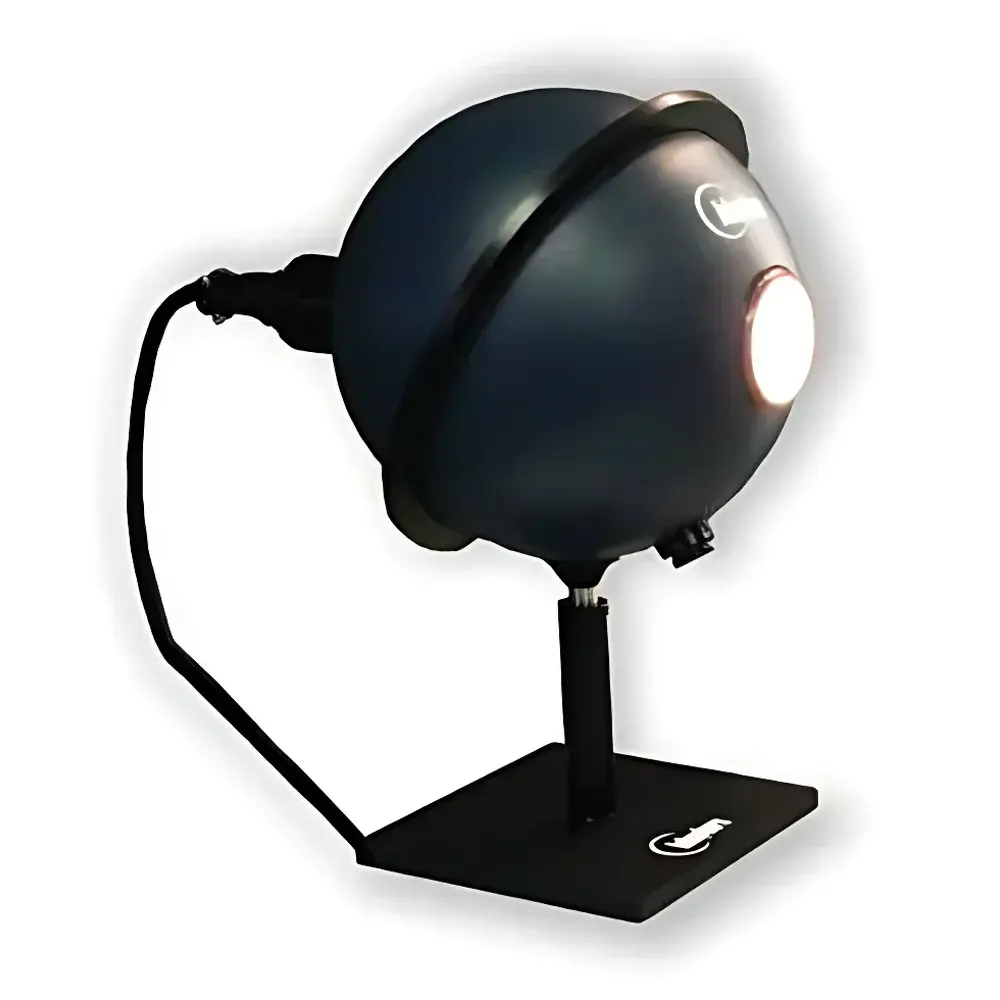
Labsphere USS2000 Small Uniform Source System
| Brand | Labsphere |
|---|---|
| Model | USS2000 |
| Origin | USA |
| Component Type | Uniform Light Source |
| Uniformity | >98% Radiance Uniformity |
| Coating | Spectraflect® Internal Diffuser |
| Calibration | NIST-traceable Radiometric and Photometric Certificates |
| Quality System | ISO 9001:2000 Certified |
Overview
The Labsphere USS2000 Small Uniform Source System is a precision-engineered optical calibration instrument designed to generate spatially uniform radiance and irradiance over defined spectral ranges—spanning ultraviolet (UV), visible (VIS), and near-infrared (NIR) wavelengths. Based on the fundamental principle of integrating sphere photometry, the USS2000 employs a high-reflectance Spectraflect® coating interior to achieve Lambertian emission characteristics and exceptional spatial uniformity (>98% radiance uniformity across the output port). This system serves as a primary or secondary transfer standard for radiometric and photometric calibration, enabling traceable, repeatable performance verification of imaging sensors, focal plane arrays, remote sensing instruments, and display measurement systems. Its compact footprint and modular architecture make it suitable for integration into controlled laboratory environments, cleanroom-based calibration workflows, and aerospace ground-support test facilities.
Key Features
- Compact integrating sphere design with 2-inch (50 mm) output port diameter, optimized for space-constrained optical benches and automated test stations.
- High-uniformity output (>98% radiance uniformity) validated per ASTM E275 and ISO/CIE 11664-3 standards, ensuring compliance with metrological requirements for sensor characterization.
- Spectraflect®-coated interior sphere wall providing diffuse reflectance >98% from 250 nm to 2500 nm, supporting broadband UV–VIS–NIR applications without spectral gaps.
- Stepwise or continuously variable radiance control via integrated power supply and calibrated dimming circuitry—enabling precise intensity stepping for linearity testing and dynamic range validation.
- Interchangeable lamp modules (e.g., tungsten-halogen, deuterium, or LED-based sources) allow spectral customization while maintaining geometric and radiometric consistency across configurations.
- Factory-provided NIST-traceable calibration certificates for both radiance (W·sr⁻¹·m⁻²) and illuminance (lux) at multiple output levels, including uncertainty budgets compliant with ISO/IEC 17025 guidelines.
Sample Compatibility & Compliance
The USS2000 supports calibration of a broad class of optoelectronic devices, including but not limited to CMOS and CCD imaging sensors, scientific cameras, push-broom and whisk-broom scanning radiometers, flat-panel display analyzers, and photopic/ scotopic luminance meters. Its output geometry and spectral stability meet the physical interface requirements of MIL-STD-810G (environmental testing), ECSS-E-ST-10-04C (spacecraft instrumentation), and NASA GSFC-STD-7000A (radiometric calibration protocols). All units are manufactured under an ISO 9001:2000-certified quality management system, and calibration documentation conforms to FDA 21 CFR Part 11 electronic record integrity requirements when used in regulated life-science or medical imaging QA/QC environments.
Software & Data Management
While the USS2000 operates as a standalone hardware source, its calibration data is delivered in standardized ASCII and CSV formats compatible with common metrology software platforms—including Labsphere’s own SPECTRA software suite, MATLAB-based radiometric analysis toolboxes, and LabVIEW-driven automated test systems. Each unit includes full spectral radiance data tables (3–5 nm resolution), spatial uniformity maps (measured via scanning photometer), and time-stamped calibration validity periods. Audit trails, revision history, and certificate versioning are maintained per GLP/GMP documentation practices, supporting audit readiness for ISO 17025-accredited laboratories.
Applications
- Radiometric and photometric calibration of Earth observation satellite imagers (e.g., VIIRS, OLI, MSI), including pre-launch MTF and SNR characterization.
- Linearity, gain, and dark current assessment of scientific-grade camera systems used in astronomy and microscopy.
- Uniformity mapping and gamma correction validation for OLED, LCD, and microLED displays during R&D and production screening.
- Validation of spectral radiance accuracy in field-deployable spectroradiometers and hyperspectral imagers.
- Reference source for inter-laboratory comparison exercises organized by NIST, PTB, or NPL under CCPR key comparisons.
FAQ
What spectral range does the USS2000 cover?
The standard configuration covers 250–2500 nm using a tungsten-halogen lamp and Spectraflect® coating; optional UV-enhanced or NIR-extended lamp modules extend coverage to 190 nm or 3500 nm.
Is the USS2000 suitable for absolute radiometric calibration?
Yes—each system ships with NIST-traceable radiance calibration certificates, including expanded uncertainties (k=2) and full spectral responsivity data.
Can the output port be customized for non-standard geometries?
Labsphere offers custom port sizes, baffling configurations, and fiber-coupled variants upon request; engineering consultation is required prior to order.
How often should recalibration be performed?
Annual recalibration is recommended for ISO 17025 compliance; frequency may be adjusted based on usage intensity and environmental conditions per internal quality procedures.
Does the USS2000 support automated integration with motion stages or shutter systems?
Yes—the unit provides TTL-compatible trigger I/O and RS-232/USB control interfaces for synchronization with external hardware in automated test sequences.




