
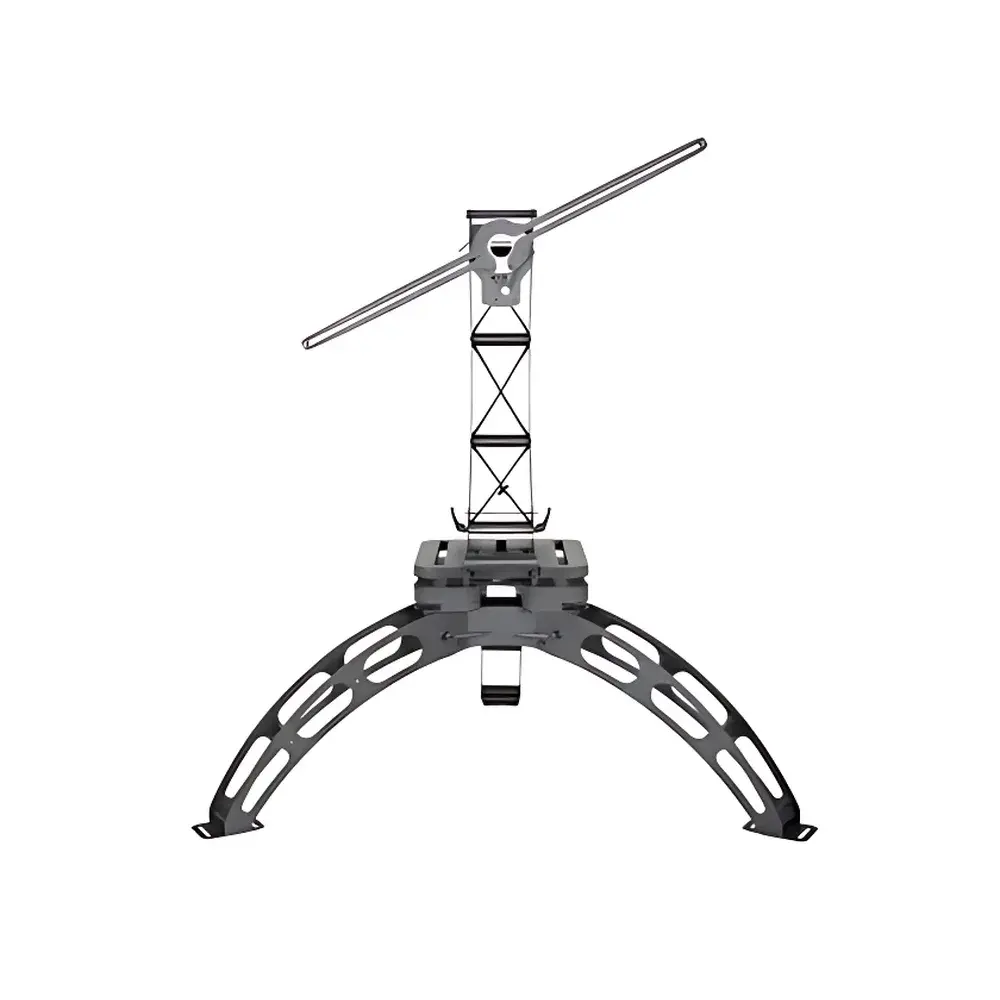
LabSpion Distributed Photometer
| Origin | Denmark |
|---|---|
| Manufacturer Type | Authorized Distributor |
| Origin Category | Imported |
| Model | LABSPION |
| Price | USD 35,000 (FOB Copenhagen) |
Overview
The LabSpion Distributed Photometer is a high-precision, two-axis goniophotometric system engineered for comprehensive spatial and photometric characterization of light sources across the full spectrum of solid-state lighting (SSL) applications. Operating on the fundamental principle of goniophotometry—where a light source rotates relative to a fixed, calibrated photodetector (or vice versa)—the LabSpion captures luminous intensity distribution in spherical coordinates (γ, C), enabling full 3D photometric modeling. Unlike integrating sphere-based systems limited to total flux, the LabSpion resolves directional luminous intensity (candelas), angular color uniformity, and spectral power distribution (SPD)-derived metrics—including correlated color temperature (CCT), color rendering index (CRI), and the newer Color Quality Scale (CQS)—at each measured angle. Designed for R&D labs, LED module manufacturers, and lighting design firms requiring traceable, standards-compliant data, the system meets the mechanical and metrological requirements of IES LM-79-19, CIE S 025/E:2015, and EN 13032-4 for luminaires and light engines.
Key Features
- Two-axis motorized goniometric architecture (vertical γ-axis ±180°, horizontal C-axis 0–360°) with <0.1° angular resolution and repeatability ±0.2°
- Integrated spectroradiometer with back-thinned CCD sensor, 380–780 nm spectral range, and FWHM ≤2.5 nm optical resolution
- Real-time acquisition of luminous intensity distribution (LID), enabling generation of industry-standard IESNA (.ies) and EULUMDAT (.ldt) files within ≤30 seconds per measurement sequence
- Simultaneous capture of photometric (luminous flux, efficacy [lm/W], power factor, active power), chromatic (CCT, CRI Ra, R1–R15, CQS), and geometric (beam angle, UGR estimation, candela plots) parameters
- Modular sample stage accommodating devices from bare LED dies (≥1 mm²) to streetlights (≤2 m height, ≤50 kg mass) via configurable mounting adapters and thermal stabilization options
- Compliance-ready firmware with audit trail logging, user access levels, and electronic signature support aligned with ISO/IEC 17025 and FDA 21 CFR Part 11 requirements
Sample Compatibility & Compliance
The LabSpion supports heterogeneous light source geometries without optical reconfiguration: chip-on-board (COB) LEDs, mid-power SMD packages, OLED panels, filament lamps, and Class IIIA/B roadway luminaires. Sample interfaces include vacuum chucks, threaded base holders (E26/E27, GU10, G13), and custom fixture clamps—all thermally decoupled to minimize self-heating artifacts during extended measurements. All photometric calibrations are traceable to DTU Fotonik’s primary standard lamp (NIST-traceable via PTB intercomparison), and spectral calibration is maintained using certified tungsten-halogen and deuterium reference sources. The system conforms to IEC 62612 (LED lamps), IEC 61347-2-13 (LED control gear), and EN 62471 (photobiological safety) test configurations when paired with optional UV-VIS-NIR extension modules.
Software & Data Management
LabSpion Control Suite v4.2 (Windows 10/11 64-bit) provides integrated instrument control, real-time visualization of polar and Cartesian candela plots, and automated report generation in PDF, CSV, and XML formats. The software implements GLP-compliant data handling: all raw spectra, angular positions, integration times, and environmental sensor readings (ambient temperature, humidity) are embedded in metadata. Export modules support direct import into DIALux evo, AGi32, and Photopia for photometric simulation. Audit logs record operator ID, timestamp, parameter changes, and file export events; encrypted database storage ensures integrity during regulatory inspections. Optional cloud synchronization enables multi-site calibration validation and remote QA review under controlled access protocols.
Applications
- LED package qualification: angular CCT shift analysis, near-field intensity mapping for secondary optics design
- Luminaire certification: IES LM-79-19 compliant reporting for ENERGY STAR, DesignLights Consortium (DLC), and EU Ecodesign submissions
- R&D of adaptive lighting systems: dynamic beam shaping validation via sequential angular SPD acquisition
- Manufacturing process control: batch-to-batch consistency monitoring of beam angle, efficacy, and color binning deviation
- Academic research in non-imaging optics: validation of ray-tracing models against empirical LID datasets
FAQ
What photometric standards does the LabSpion comply with for official testing reports?
The system meets the instrumental requirements of IES LM-79-19, CIE S 025/E:2015, and EN 13032-4. Full compliance for accredited testing requires site-specific validation per ISO/IEC 17025, including annual third-party verification of goniometer geometry and spectroradiometer linearity.
Can the LabSpion measure pulsed or dimmed LED sources?
Yes—synchronized triggering supports PWM frequencies from 100 Hz to 20 kHz and analog dimming down to 0.1% output, with adjustable integration gating to eliminate flicker-induced measurement error.
Is thermal management included for high-power LED testing?
Standard configuration includes passive thermal isolation; optional active cooling stages (Peltier-regulated to ±0.5°C) and junction temperature monitoring via integrated thermocouple ports are available for LM-80-style lifetime correlation studies.
How is spectral calibration maintained over time?
The system performs automated wavelength and irradiance recalibration before each session using onboard reference sources; NIST-traceable recalibration certificates are issued annually by DTU Fotonik’s accredited metrology lab.
Does the software support automated pass/fail evaluation against specification limits?
Yes—user-defined tolerances for beam angle, CCT deviation, CRI minimums, and efficacy thresholds can be programmed; results trigger visual alerts and export flagged reports to enterprise QA systems via REST API.
Related Products





