
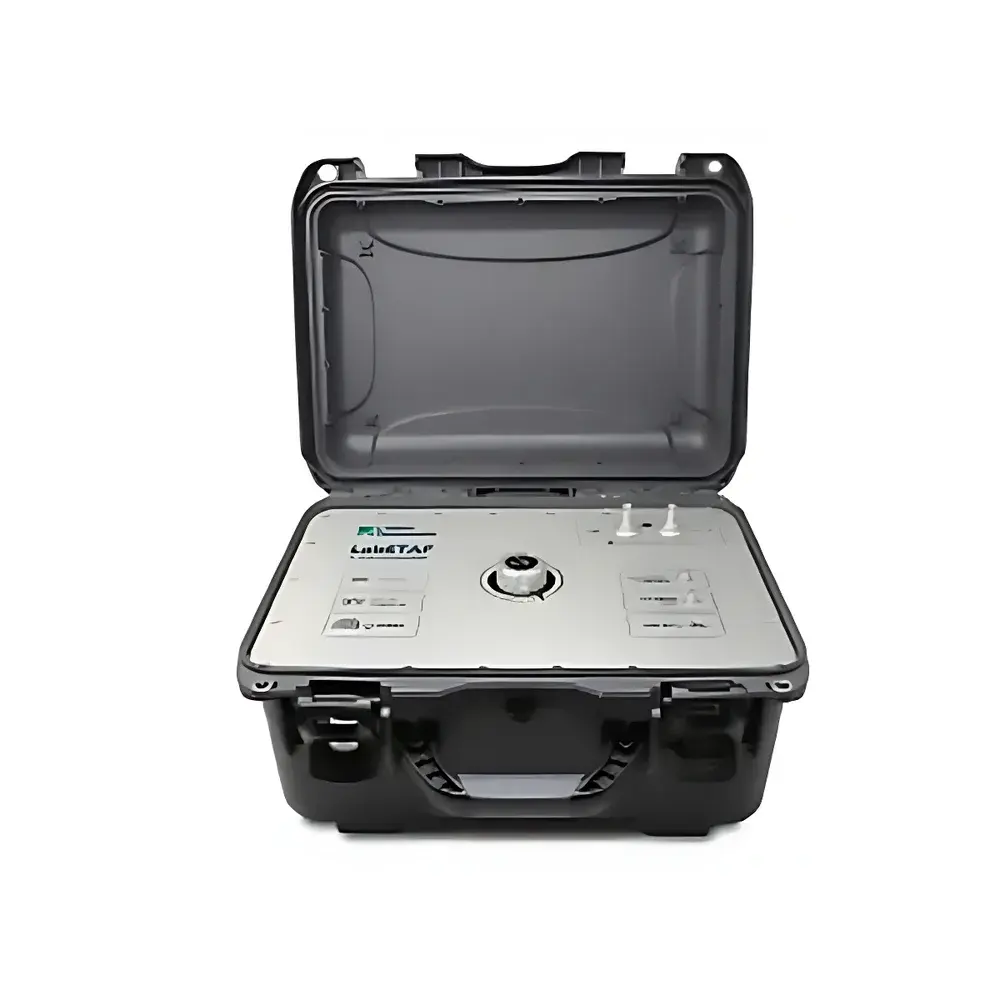
LabSTAF Single-Turnover Active Chlorophyll Fluorometer by Chelsea Technologies
| Brand | Chelsea |
|---|---|
| Origin | UK |
| Model | LabSTAF |
| Excitation Wavelengths | 417, 452, 472, 505, 534, 594, 622 nm |
| Actinic Light Range | 10–2400 µmol photons·m⁻²·s⁻¹ (12-bit resolution) |
| Detection Limit | 0.001 mg/m³ Chl-a |
| Sample Chamber | 20 mL quartz vertical cylinder with BK7 base |
| Power Supply | 24 VDC, 140–400 mA (3.4–9.7 W) |
| Dimensions (H×D×W) | 235 × 320 × 420 mm |
| IP Rating | IP65 |
| Weight | 8.1 kg |
Overview
The LabSTAF Single-Turnover Active Chlorophyll Fluorometer, engineered by Chelsea Technologies (UK), is a precision field-deployable instrument designed for non-invasive, quantitative assessment of phytoplankton photosynthetic performance in natural aquatic systems. It operates on the principle of Fast Repetition Rate fluorometry (FRRf), a well-established biophysical technique that resolves photochemical kinetics at Photosystem II (PSII) with microsecond temporal resolution. By delivering precisely timed, saturating single-turnover excitation pulses and measuring the resulting chlorophyll a fluorescence induction and relaxation dynamics, LabSTAF derives robust estimates of electron transport rates (ETR), functional absorption cross-section (σPSII), and quantum yield of PSII (ΦPSII). These parameters collectively inform volumetric primary productivity (PhytoPP) — a critical metric for carbon fixation, ecosystem metabolism, and biogeochemical modeling across freshwater, estuarine, and marine environments.
Key Features
- Seven-wavelength excitation array: Enables spectral characterization of pigment composition and correction of variable fluorescence (Fv) for absorption heterogeneity — essential for accurate cross-system comparisons and taxonomic inference.
- Dual narrow-band fluorescence detection: Simultaneous measurement at 685 nm (PSII core emission) and 730 nm (PSI-associated & phycobiliprotein background) allows real-time correction for inner-filter effects and package correction without empirical assumptions.
- High-intensity actinic illumination: Blue-enhanced white light source delivers up to 2400 µmol photons·m⁻²·s⁻¹ with 12-bit digital control, supporting full photosynthetic response curve (FLC) generation under ecologically relevant irradiance regimes.
- Single-turnover pulse relaxation kinetics: Dual-pulse protocol captures both fast (ns–µs) and slow (ms–s) components of fluorescence decay, enabling separation of photochemical quenching (qP), non-photochemical quenching (NPQ), and state transitions.
- Thermally stabilized, flow-through sample chamber: 20 mL quartz cylindrical cuvette with BK7 optical base ensures minimal thermal drift and optical path integrity; integrated water-jacketed circulation avoids interference with excitation/emission pathways.
- Field-hardened architecture: IP65-rated enclosure, 8.1 kg mass, and 24 VDC operation support extended autonomous deployment on buoys, CTD rosettes, or portable lab platforms in remote or harsh environments.
Sample Compatibility & Compliance
LabSTAF accepts unfiltered or size-fractionated water samples (0.2–2000 µm), including whole-community assemblages, cultured isolates, and preserved samples (with validation). Its low detection limit (0.001 mg/m³ Chl-a) permits reliable operation in ultra-oligotrophic systems such as subtropical gyres and deep chlorophyll maxima. The system complies with standard method frameworks for aquatic photosynthesis assessment (e.g., ASTM D5259-19, ISO 10260:2021) and supports GLP-aligned data capture through timestamped, metadata-embedded output files. While not FDA 21 CFR Part 11-certified out-of-the-box, its raw data structure (binary HDF5 + ASCII export) is fully compatible with validated laboratory information management systems (LIMS) used in environmental monitoring programs governed by EU Water Framework Directive (WFD) and US EPA National Aquatic Resource Surveys (NARS).
Software & Data Management
LabSTAF is controlled via Chelsea’s proprietary STAF Control Suite (v4.x), a Windows-based application providing real-time visualization of FLCs, automated parameter fitting (e.g., ETRmax, α, Ik), and batch processing of multi-sample datasets. All raw fluorescence transients are stored with full instrument configuration metadata (excitation spectra, actinic intensity, temperature, pulse timing). Export options include CSV (for Excel/Python/R integration), NetCDF (CF-compliant for oceanographic model coupling), and MATLAB .mat format. The software supports audit-trail logging and user-defined calibration protocols, facilitating traceability in regulatory or peer-reviewed research contexts.
Applications
- Quantification of PSII photochemical flux (JVPII) per unit volume — a direct proxy for maximum potential carbon fixation rate.
- Calibration and validation of satellite-derived ocean color products (e.g., MODIS, Sentinel-3 OLCI) via coincident in situ productivity profiles.
- Time-series monitoring of bloom initiation, succession, and collapse — particularly for harmful algal species exhibiting distinct FRRf signatures.
- Meso- to sub-mesoscale mapping of productivity gradients across fronts, eddies, and upwelling zones.
- Climate change impact studies: assessing thermal and nutrient stress responses in phytoplankton communities across latitudinal transects.
- Ecological risk assessment: evaluating sublethal photosynthetic inhibition from contaminants (e.g., herbicides, heavy metals) in compliance with OECD Test No. 201.
FAQ
How does LabSTAF differ from conventional PAM fluorometers?
LabSTAF uses true single-turnover pulses and FRRf analysis to resolve PSII reaction center kinetics directly, whereas PAM relies on saturation pulse approximations and assumes constant σPSII. This enables LabSTAF to quantify absolute electron transport rates without empirical scaling factors.
Can LabSTAF operate autonomously on a mooring?
Yes — with external power (24 VDC) and optional telemetry interface (RS-485/Ethernet), it supports unattended 30-day deployments; firmware includes programmable sampling schedules and onboard data buffering.
Is calibration required before each use?
Factory calibration is stable for >12 months under normal handling; however, daily dark-adaptation verification and reference standard (e.g., quinine sulfate) checks are recommended for high-precision intercomparison studies.
Does LabSTAF measure only chlorophyll a?
It measures chlorophyll a fluorescence yield and kinetics; accessory pigments (e.g., fucoxanthin, peridinin) are inferred indirectly via excitation spectral deconvolution, not quantified independently.
What sample preservation methods are compatible?
Flash-freezing in liquid nitrogen preserves kinetic fidelity; formaldehyde fixation (>1% final concentration) is acceptable for community-level screening but attenuates Fv/Fm by ~15–20% and should be reported explicitly.







