
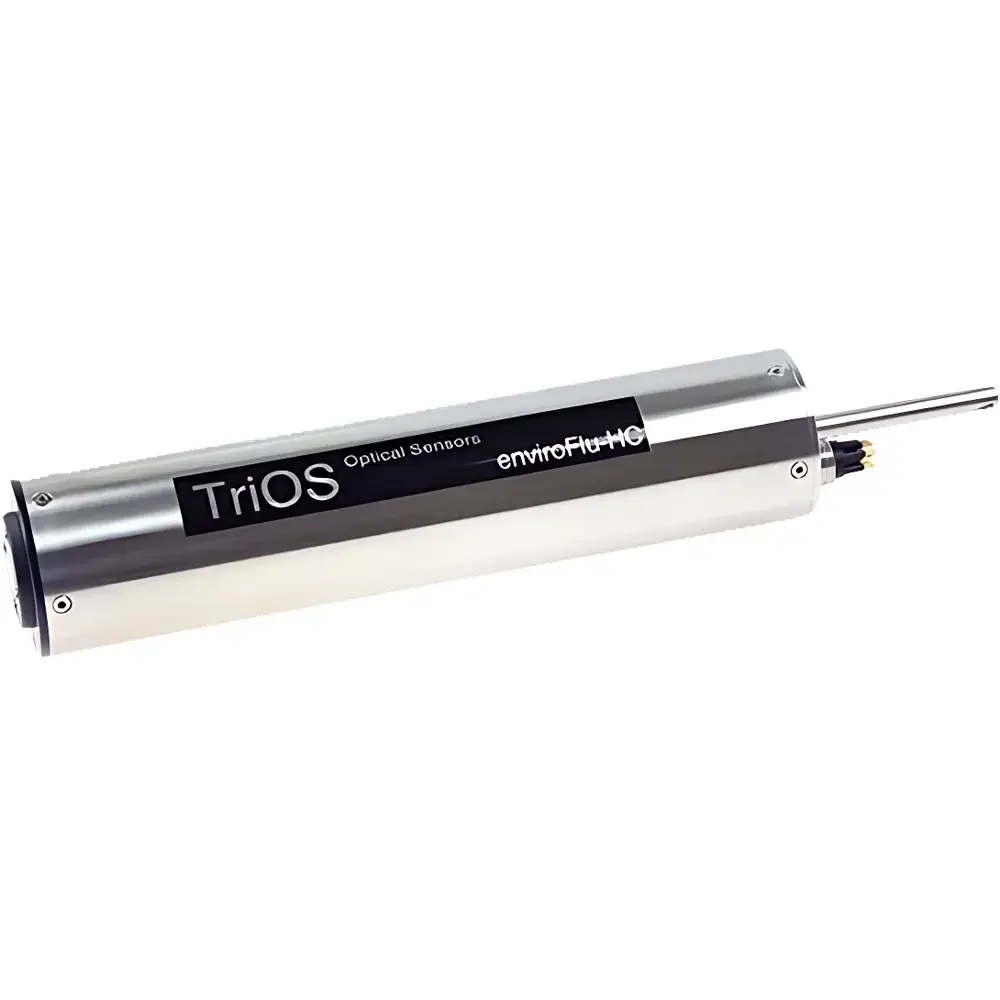
TriOS EnviroFlu-HC PAH Oil-in-Water Fluorometer
| Brand | TriOS |
|---|---|
| Origin | Germany |
| Model | EnviroFlu-HC |
| Instrument Type | Online |
| Measurement Principle | UV-Induced Fluorescence |
| Measurement Range | 0–5000 ppb (PAH) |
| Detection Limit | 0.3 ppb |
| Accuracy | ±1% of reading |
| Resolution | 0.1 ppb |
| Measurement Frequency | 1 Hz |
| Excitation Wavelength | 254 nm |
| Emission Wavelength | 360 nm |
| Housing Material | Stainless Steel 1.4571/1.4404 or Titanium Grade 3.7035 |
| Dimensions | 311 mm × 68 mm |
| Weight | 2.7 kg (stainless), 1.9 kg (titanium) |
| Pressure Rating | 30 bar (SubConn), 3 bar (fixed cable), 1 bar (flow cell) |
| Ingress Protection | IP68 |
| Operating Temperature | +2 °C to +40 °C (sample), –5 °C to +55 °C (ambient) |
| extended accuracy range | 0–40 °C |
| Flow Velocity | 0.1–10 m/s |
| Power Supply | 12–24 VDC (±10%) |
| Power Consumption | ≤3.5 W |
| Output Interfaces | RS-232 (TriOS protocol), 4–20 mA, 0–5 V |
| Response Time (T₁₀₀) | ≤10 s |
| Calibration Interval | 24 months |
Overview
The TriOS EnviroFlu-HC is a submersible, online fluorometric sensor engineered for continuous, real-time quantification of polycyclic aromatic hydrocarbons (PAHs) and total petroleum hydrocarbons (TPH) in aqueous matrices. It operates on the principle of ultraviolet-induced fluorescence (UVIF), where target aromatic compounds—excited at 254 nm—are detected via their characteristic emission at 360 nm. This selective optical detection mechanism delivers significantly higher sensitivity and compound specificity compared to non-specific methods such as infrared absorption or light scattering. Unlike extractive or laboratory-based techniques, the EnviroFlu-HC performs direct in-situ measurement without sample withdrawal, chemical reagents, or pre-concentration steps—enabling trace-level detection down to 0.3 ppb with high reproducibility and minimal drift over extended deployment periods.
Key Features
- True online operation with 1 Hz measurement frequency and ≤10 s T100 response time for rapid process feedback
- Nano-coated optical window surface engineered to resist oil fouling and biofilm adhesion—reducing maintenance intervals and sustaining signal stability in challenging environments
- Modular optical filter configuration supporting application-specific adaptations (e.g., EnviroFlu-BT variant for benzene/toluene/xylene detection)
- Dual-material housing options: corrosion-resistant stainless steel (1.4571/1.4404) or marine-grade titanium (3.7035) for high-pressure or saline service
- IP68-rated enclosure with pressure tolerance up to 30 bar (SubConn interface), validated for permanent submersion in raw water, effluent, or pressurized pipelines
- Low-power design (≤3.5 W) compatible with solar-powered telemetry systems and remote monitoring infrastructure
Sample Compatibility & Compliance
The EnviroFlu-HC is validated for use across diverse water types including potable water, condensate, seawater, industrial wastewater, bilge water, and scrubber washwater from exhaust gas cleaning (EGCS) systems. Its fluorescence-based methodology inherently mitigates interference from suspended solids when turbidity remains below optical saturation thresholds; however, no active turbidity compensation is implemented—users are advised to assess site-specific particulate load and consider optional inline filtration where necessary. The sensor meets IEC 61000-6-2/6-4 for electromagnetic compatibility and conforms to EN 61326-1 for industrial measurement equipment. While not intrinsically certified for hazardous areas, explosion-proof enclosures and ATEX-compliant variants are available upon request. Data integrity aligns with GLP/GMP principles through stable calibration retention (24-month interval) and deterministic analog/digital output protocols traceable to NIST-traceable reference standards.
Software & Data Management
The EnviroFlu-HC communicates via native RS-232 (TriOS ASCII protocol) for integration into SCADA, DCS, or custom data acquisition platforms. Analog outputs (4–20 mA, 0–5 V) provide plug-and-play compatibility with legacy PLCs and chart recorders. No onboard data logging is included—data handling is delegated to external systems, ensuring full auditability and compliance with FDA 21 CFR Part 11 requirements when paired with validated historian software. TriOS SensorControl software enables remote configuration, spectral diagnostics, zero/span verification, and firmware updates. All calibration events—including date, operator ID, and reference standard lot number—are recorded externally by the host system, supporting regulatory review and quality assurance documentation.
Applications
- Drinking water safety monitoring—early warning of PAH contamination from pipeline leaching or distribution network breaches
- Condensate return loop surveillance in power plants and HVAC systems to prevent boiler feedwater contamination
- Effluent compliance tracking at petrochemical facilities, refineries, and airports (deicing fluid runoff)
- Seawater intake protection at desalination plants and coastal thermal power stations
- Bilge water monitoring aboard commercial vessels and offshore platforms per MARPOL Annex I requirements
- Real-time EGCS washwater discharge verification under IMO 2020 sulfur cap enforcement protocols
- Process water quality control in pharmaceutical and semiconductor manufacturing where hydrocarbon purity is critical
FAQ
Does the EnviroFlu-HC require periodic cleaning or manual maintenance?
No routine optical cleaning is required due to its nanostructured anti-fouling lens coating. Under typical deployment conditions, maintenance intervals exceed 24 months—limited primarily to calibration verification and mechanical inspection.
Can it distinguish between different PAH compounds (e.g., naphthalene vs. benzo[a]pyrene)?
No. The EnviroFlu-HC measures total fluorescent PAH content based on broad-band excitation/emission. Compound-specific identification requires GC-MS or HPLC-FLD analysis.
Is temperature compensation applied automatically during measurement?
Yes. An integrated Pt100 RTD provides real-time temperature feedback, and internal algorithms correct for thermal effects on fluorescence quantum yield within the specified operating range (+2 to +40 °C).
What flow velocity range ensures optimal measurement stability?
The sensor is validated for laminar-to-turbulent flow regimes between 0.1 and 10 m/s. For low-flow applications (<0.3 m/s), mounting orientation and upstream flow conditioning should be evaluated to avoid boundary layer stagnation.
How is calibration traceability established for regulatory reporting?
Calibration uses certified PAH standard solutions traceable to NIST SRM 1647f (fluorescent hydrocarbon mixture). Certificates of calibration include uncertainty budgets per ISO/IEC 17025 guidelines, supporting auditable environmental compliance reporting.
Related Products







