
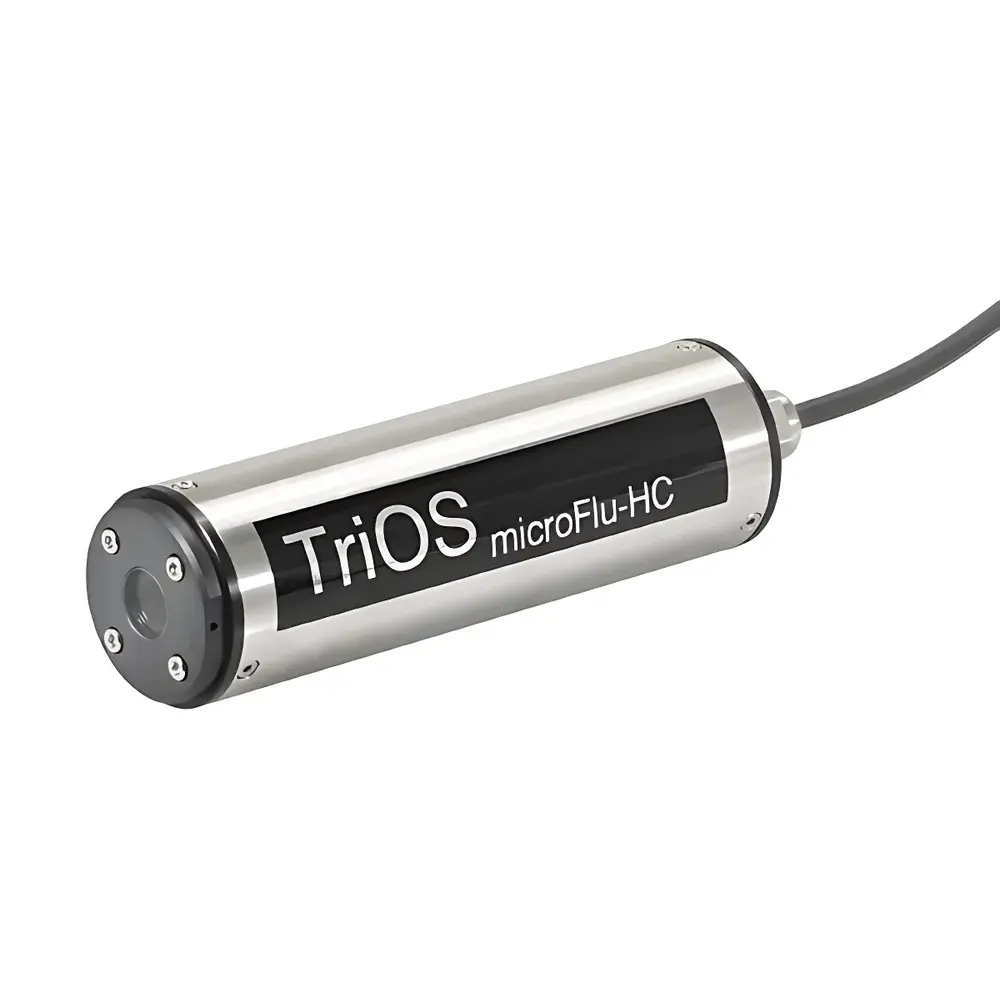
TriOS microFlu-HC Submersible Fluorometric Hydrocarbon Analyzer
| Brand | TriOS |
|---|---|
| Origin | Germany |
| Model | microFlu-HC |
| Measurement Principle | UV-induced fluorescence (255 nm excitation, 360 nm emission) |
| Target Analytes | Polycyclic Aromatic Hydrocarbons (PAHs) and total petroleum hydrocarbons (TPH) in water |
| Range | PAHs 0–5000 ppb, TPH 0–150 ppm |
| LOD | PAHs 5 ppb, TPH 0.15 ppm |
| Accuracy | ±10 % FS |
| Response Time (T90) | 6 s |
| Min. Measurement Interval | 3 s |
| Digital Interface | RS-485 / Modbus RTU |
| Analog Outputs | 4–20 mA (default), 0–5 V, 0–10 V |
| Power Supply | 12–24 VDC (±10 %) |
| Housing Material | Stainless Steel 1.4571/1.4404 or Titanium Grade 3.7035 |
| Dimensions | 162 mm × 48 mm |
| Weight | ~650 g (SS), ~510 g (Ti) |
| Max. Pressure Rating | 30 bar (SubConn), 3 bar (fixed cable), 1 bar (flow cell) |
| IP Rating | IP68 |
| Operating Temp. | +2 to +40 °C (sample & ambient) |
| Storage Temp. | −20 to +80 °C |
| Flow Rate Compatibility | 0.1–10 m/s |
| Optical Window | Nano-coated quartz |
| Turbidity Compensation | None |
| Data Logging | Internal storage not supported |
Overview
The TriOS microFlu-HC is a submersible, in-situ fluorometric analyzer engineered for continuous, real-time detection of hydrocarbon contamination in aqueous matrices. It operates on the principle of ultraviolet-induced fluorescence: a high-stability 255 nm LED excites polycyclic aromatic hydrocarbons (PAHs) and other aromatic components of petroleum-based oils, which subsequently emit characteristic fluorescence at ~360 nm. This optical method delivers significantly higher selectivity and sensitivity compared to conventional infrared absorption or light-scattering techniques—particularly critical for trace-level monitoring in low-concentration environments such as drinking water supplies, condensate streams, and process cooling loops. Unlike laboratory-based GC-FID or EPA Method 1664 extractions, the microFlu-HC eliminates sample transport, chemical reagents, and offline preparation, enabling true online process intelligence with sub-10-second response dynamics.
Key Features
- True in-situ operation: Direct immersion into water streams, manholes, flow cells, or pipelines—no sampling pumps or conditioning systems required.
- Nano-coated quartz optical window: Reduces biofouling and particulate adhesion, extending maintenance intervals and sustaining signal stability over extended deployment cycles.
- Dual-range calibrated output: Simultaneously quantifies both PAHs (0–5000 ppb) and total petroleum hydrocarbons (0–150 ppm), supporting compliance with multiple regulatory frameworks including EU WFD (Water Framework Directive) and US EPA Region 10 guidance for hydrocarbon release detection.
- Robust industrial interface suite: RS-485 with Modbus RTU protocol for configuration, diagnostics, and multi-sensor networking; configurable analog outputs (4–20 mA default, plus 0–5 V and 0–10 V options) for seamless integration into DCS, SCADA, or PLC-based control architectures.
- High-pressure and corrosion-resistant construction: Available in marine-grade stainless steel (1.4571 / 1.4404) or titanium alloy (3.7035), rated to 30 bar with SubConn wet-mateable connector—suitable for deep inspection chambers, offshore platforms, and pressurized utility tunnels.
- Low-power design: Typical consumption of 0.6 W enables battery- or solar-powered deployments in remote environmental monitoring stations where grid access is limited.
Sample Compatibility & Compliance
The microFlu-HC is validated for use across diverse water types—including potable water, surface water, seawater, wastewater effluent, cooling tower condensate, bilge water, and hydrocarbon-contaminated runoff. Its lack of turbidity compensation necessitates application awareness: while it performs reliably in optically clear to moderately turbid waters (<100 NTU), highly suspended solids may attenuate excitation/emission paths and require site-specific validation per ISO 15839:2012 (water quality — instruments for measuring biochemical oxygen demand). The device meets IEC 61000-6-2 (immunity) and IEC 61000-6-4 (emissions) standards and is CE-marked for EMC and RoHS compliance. Though not intrinsically safe certified, its low-energy operation and sealed housing support Class I, Division 2 hazardous location deployment when installed per local electrical codes.
Software & Data Management
Configuration and real-time diagnostics are performed via TriOS’s proprietary SensorControl software or any standard Modbus master (e.g., Ignition SCADA, Siemens Desigo CC). The device supports full register mapping for status flags (e.g., sensor health, temperature drift alert, window contamination warning), measurement values, and calibration metadata. While onboard data logging is not implemented, all analog and digital outputs are time-synchronized and compatible with third-party historian systems (e.g., OSIsoft PI, Canary Labs) that enforce audit trails compliant with FDA 21 CFR Part 11 when paired with appropriate system-level validation protocols. Firmware updates are delivered via Modbus write commands and retain user-defined scaling and alarm thresholds across revisions.
Applications
- Early-warning leak detection in refinery perimeter monitoring wells, fuel storage tank containment sumps, and airport apron drainage networks.
- Continuous compliance verification at wastewater treatment plant outfalls subject to NPDES permits requiring hydrocarbon reporting.
- Condensate purity assurance in steam-cycle power plants and district heating systems where oil ingress compromises heat exchanger integrity.
- Ballast water management system (BWMS) verification per IMO Resolution MEPC.279(70), detecting residual lubricants or fuel traces pre-discharge.
- Groundwater plume tracking at brownfield sites undergoing remediation, supporting ASTM D7575 (solvent-free extraction) correlation studies.
- Desalination plant intake protection—identifying upstream hydrocarbon spills before membrane fouling occurs.
FAQ
Does the microFlu-HC require periodic recalibration?
Yes—TriOS recommends field verification every 3–6 months using certified PAH standard solutions (e.g., naphthalene or phenanthrene in deionized water), especially after exposure to high-fouling environments or mechanical shock.
Can it distinguish between diesel, gasoline, and crude oil signatures?
No—the instrument reports total fluorescent hydrocarbon concentration (as PAH-equivalents or TPH); compound-specific identification requires GC-MS or spectral deconvolution tools not embedded in this platform.
Is temperature compensation applied automatically?
Yes—integrated Pt1000 sensor provides real-time thermal correction of fluorescence yield, referenced to NIST-traceable calibration curves across the +2 to +40 °C operating range.
What flow velocity range ensures optimal measurement stability?
The sensor maintains repeatability within ±5% across 0.1–10 m/s, though laminar flow conditions below 0.3 m/s may increase boundary layer effects—TriOS advises minimum 0.5 m/s for pipe-mounted installations.
How is window fouling detected and reported?
Signal attenuation relative to baseline intensity triggers a diagnostic flag (Register 40102) and optional analog alarm output; nano-coating extends mean time between cleanings to ≥6 months in typical municipal applications.







