
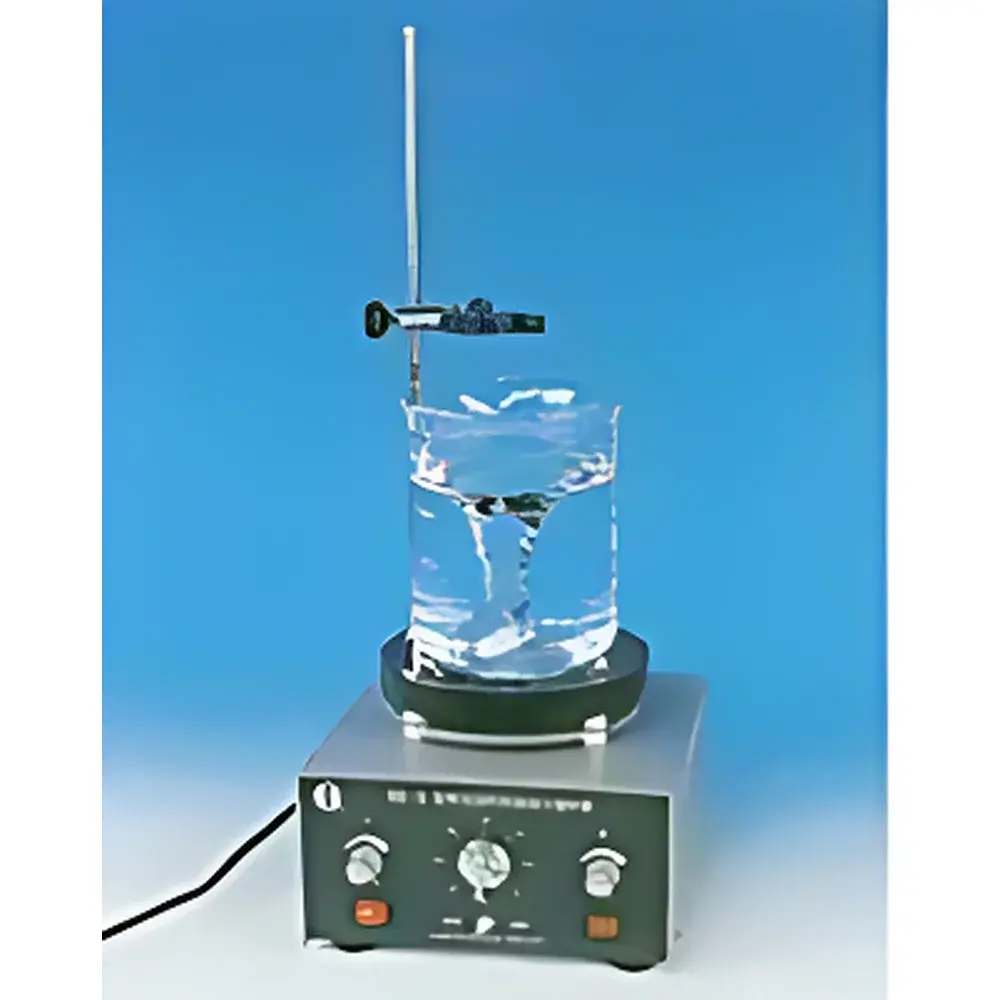
LabTech 90-Series Magnetic Stirrer
| Origin | Shanghai, China |
|---|---|
| Manufacturer Type | Authorized Distributor |
| Product Origin | Domestic (China) |
| Model | 90-Series |
| Price | USD 76.50 (FOB Shanghai) |
| Dimensions | 185 × 185 × 130 mm |
| Max. Stirring Volume | 3000 mL |
| Speed Range | 0–1250 rpm (infinitely variable) |
| Stir Bar Material Compatibility | Standard stainless-steel rods (e.g., PTFE-coated, ceramic-core) |
| Display | LED digital speed readout |
| Construction | Die-cast aluminum housing with thermal insulation |
| Compliance | CE, RoHS, ISO 9001-manufactured supply chain |
Overview
The LabTech 90-Series Magnetic Stirrer is an entry-level yet robust benchtop mixing instrument engineered for precision and reliability in routine laboratory workflows. It operates on the principle of magnetic coupling: a rotating permanent magnet beneath the work surface induces synchronous rotation of a magnetic stir bar immersed in the sample vessel. Driven by a brushless DC motor, the unit delivers consistent torque across its full speed range—enabling stable agitation of low- to medium-viscosity liquids without mechanical wear or electromagnetic interference. Unlike gear-driven or overhead stirrers, this design eliminates shaft seals and moving parts exposed to the sample environment, thereby reducing contamination risk and maintenance requirements. Its die-cast aluminum chassis provides structural rigidity, effective heat dissipation, and resistance to incidental chemical splashes—making it suitable for shared instrumentation environments in academic teaching labs, QC testing facilities, and preparatory chemistry workspaces.
Key Features
- Brushless DC motor ensures long service life (>10,000 hours MTBF), low acoustic noise (<45 dB at 1 m), and zero carbon dust generation—critical in cleanroom-adjacent or particulate-sensitive applications.
- Digital LED speed display with real-time rpm feedback enables reproducible method transfer between operators and shifts; resolution: ±1 rpm within 0–1250 rpm range.
- Infinitely variable speed control via rotary encoder allows fine-tuned adjustment for shear-sensitive suspensions (e.g., cell cultures, polymer emulsions) or high-density slurries (e.g., catalyst slurries in catalysis screening).
- Die-cast aluminum housing offers superior thermal stability versus plastic-bodied units, minimizing drift during extended operation and supporting ambient temperature resilience from 5 °C to 40 °C.
- Stainless-steel stir bar compatibility (including PTFE-encapsulated and Alnico-core variants) supports use with corrosive reagents (e.g., dilute HCl, NaOH solutions) and elevated temperatures up to 150 °C when paired with appropriate glassware.
Sample Compatibility & Compliance
The 90-Series accommodates standard laboratory glassware including beakers (50–2000 mL), Erlenmeyer flasks, and round-bottom flasks up to 3 L volume—provided internal diameter permits adequate stir bar clearance (minimum 15 mm gap between bar tip and vessel bottom). It complies with IEC 61010-1:2010 for electrical safety in laboratory equipment and meets RoHS Directive 2011/65/EU restrictions on hazardous substances. While not certified for GMP production environments, its construction and traceable manufacturing align with GLP documentation requirements for method validation in environmental testing (EPA Method 300.0), pharmaceutical excipient blending (USP ), and educational lab curricula under ASTM E2500-13 guidelines.
Software & Data Management
This analog-digital hybrid instrument does not incorporate embedded firmware or network connectivity. All operational parameters—including speed setpoint and runtime—are manually configured and visually verified via front-panel LED indicators. For laboratories requiring audit trails, integration into electronic lab notebooks (ELNs) is achieved through manual entry or optional third-party USB data loggers (e.g., LabJack U3-HV) interfaced via analog voltage output (0–5 V proportional to rpm). No proprietary software or drivers are required. The absence of firmware eliminates cybersecurity vulnerabilities associated with IoT-enabled instruments and simplifies regulatory validation in FDA-regulated settings where software verification per 21 CFR Part 11 is not mandated for standalone stirring functions.
Applications
The 90-Series serves as a foundational tool across disciplines: in analytical chemistry, it homogenizes calibration standards prior to ICP-OES analysis; in microbiology, it maintains aerobic suspension of bacterial cultures during OD600 monitoring; in materials science, it disperses nanomaterials (e.g., TiO2, graphene oxide) in aqueous or organic media for colloidal stability assessment; and in food science labs, it facilitates uniform dissolution of hydrocolloids (e.g., carrageenan, xanthan gum) during viscosity profiling. Its 3 L capacity and 1250 rpm ceiling make it particularly suited for scale-up trials—from microscale reaction optimization to pilot-batch formulation development—where consistency across vessel sizes must be preserved without recalibration.
FAQ
Is the 90-Series compatible with temperature-controlled hotplates?
No—the base unit lacks integrated heating elements. For combined heating/stirring functionality, refer to the 90-1 Series (heating range: ambient to 150 °C) or 90-2 Series (with 0–120 min mechanical timer).
What is the maximum recommended viscosity for stable operation?
Optimal performance is maintained for Newtonian fluids up to ~1000 mPa·s (e.g., 40% glycerol/water at 25 °C); above this, torque limitation may cause stir bar slippage—use larger-diameter or dual-magnet stir bars for higher loads.
Can the unit be operated inside a fume hood?
Yes—its sealed aluminum enclosure and lack of ventilation grilles permit safe installation in Class I or II biosafety cabinets and chemical fume hoods, provided ambient airflow does not exceed 0.5 m/s directly over the unit.
Does LabTech provide calibration certificates?
Factory calibration is performed against NIST-traceable tachometers; formal ISO/IEC 17025 calibration reports are available upon request at additional cost and require return shipment to authorized service centers.
What stir bar dimensions are recommended for 3 L vessels?
A 60 mm × 12 mm PTFE-coated stir bar with dual magnetic poles ensures laminar flow and minimizes vortexing in tall-form containers; avoid bar lengths exceeding 70% of vessel inner diameter.
Related Products



