
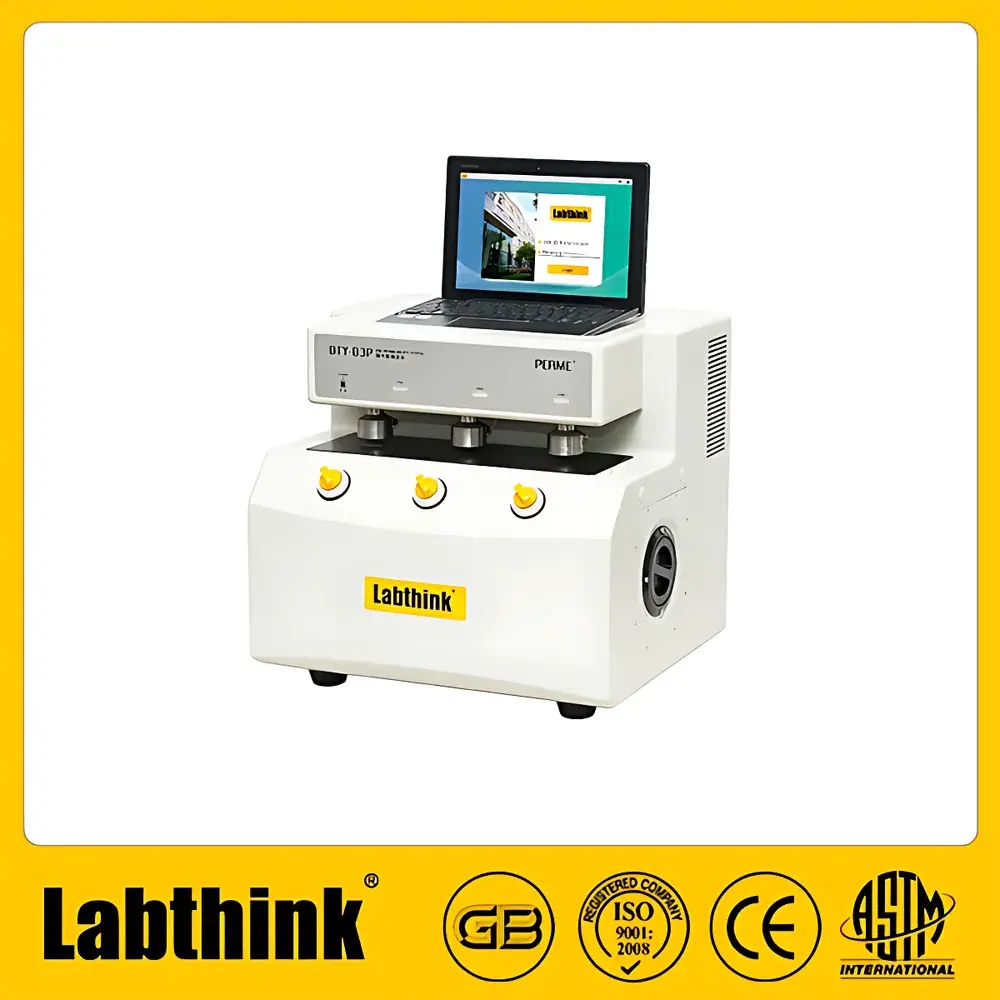
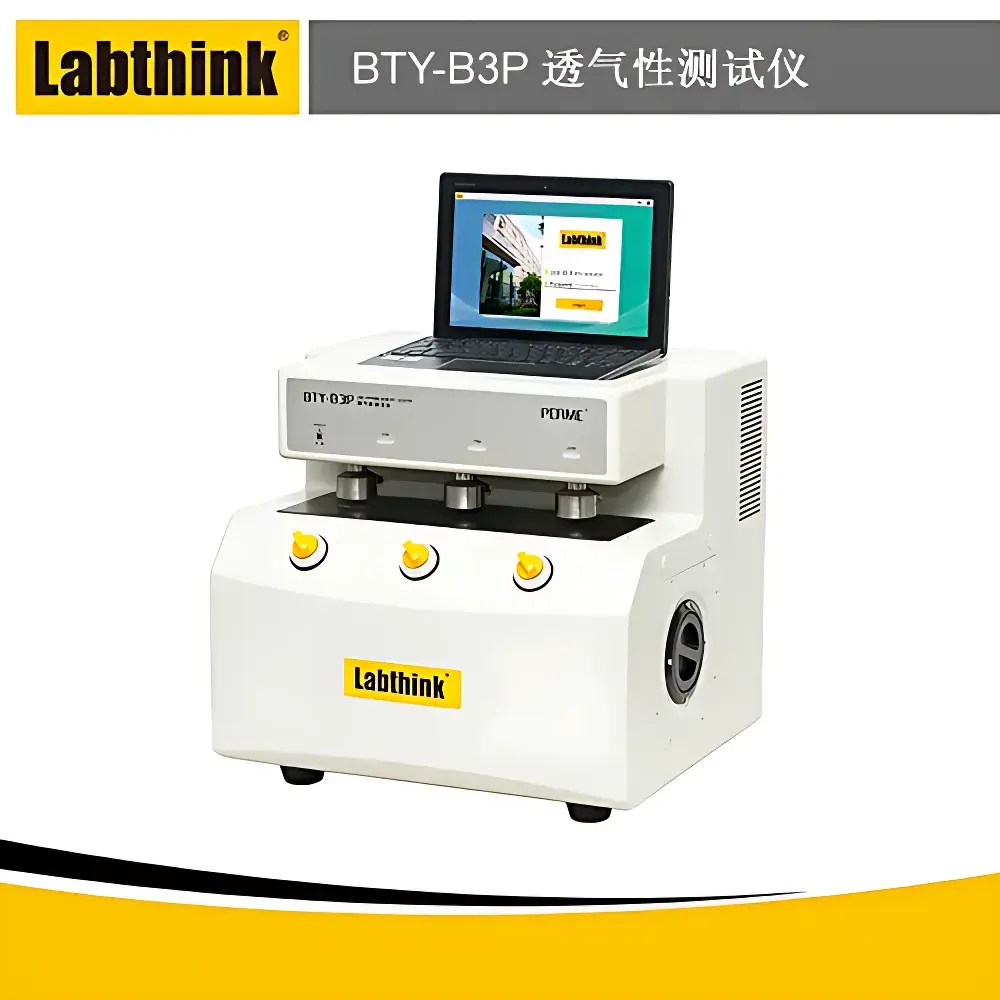
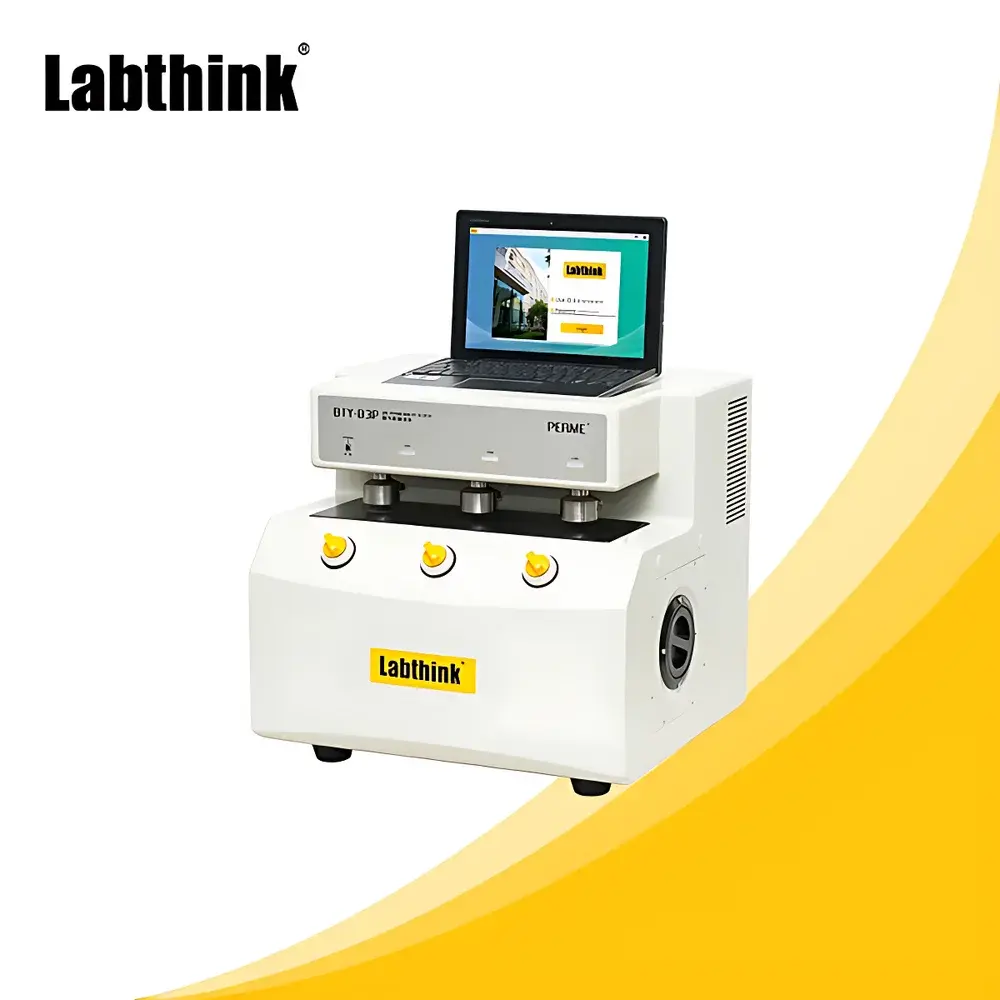
Labthink BTY-B3P Gas Permeability Tester for Polyolefin Battery Separators (Compliant with GB/T 36363-2018)
| Brand | Labthink |
|---|---|
| Origin | Shandong, China |
| Manufacturer Type | Direct Manufacturer |
| Country of Origin | China |
| Model | BTY-B3P |
| Price Range | USD 14,000 – 70,000 |
| Test Principle | Differential Pressure Method (ISO 5636, SJT 1071.9, GB/T 36363-2018) |
| Measurement Range | 10–10,000 s/in²·100 mL·1.21 kPa |
| Pressure Differential Range | 0–20 kPa (customizable) |
| High-Pressure Resolution | 0.01 kPa |
| High-Pressure Accuracy | ±0.05 kPa |
| Low-Pressure Resolution | 0.1 Pa |
| Low-Pressure Accuracy | ±0.3 Pa |
| Specimen Area | 12.56 mm² (0.019 in², customizable) |
| Specimen Dimensions | ≥12 mm × 12 mm |
| Sample Capacity | 1–3 specimens per test |
| Test Gases | N₂, O₂, CO₂, dry air (≥99.9% purity, user-supplied) |
| Gas Inlet Pressure | 0.6 MPa (87 psi) |
| Tubing Interface | Φ4 mm polyurethane |
| Power Supply | 220 VAC ±10%, 50 Hz or 120 VAC ±10%, 60 Hz |
| Dimensions (L×W×H) | 390 × 433 × 410 mm |
| Net Weight | 27 kg |
Overview
The Labthink BTY-B3P Gas Permeability Tester is an engineered solution for quantitative evaluation of gas transmission behavior in highly permeable polymeric thin films—specifically designed for lithium-ion battery separators, breathable medical membranes, and functional packaging substrates. It operates on the differential pressure (manometric) principle defined in ISO 5636-3, SJT 1071.9, and fully compliant with GB/T 36363-2018 for polyolefin-based battery separator characterization. In this method, a conditioned specimen is sealed between two chambers; a controlled pressure differential is applied across the film, and the rate of pressure increase in the low-pressure chamber is measured over time using high-stability piezoresistive transducers. From this temporal pressure profile, the Gurley value (in seconds per 100 mL of air at 1.21 kPa differential), air resistance, and relative permeability indices are derived—parameters directly correlated to ionic conductivity, dendrite suppression efficacy, and thermal shutdown performance in electrochemical cells.
Key Features
- Triple-test-chamber architecture enabling concurrent measurement of up to three specimens under identical environmental conditions—delivering statistically robust mean values per test cycle
- Integrated environmental monitoring system continuously logging temperature and relative humidity within the test zone, ensuring compliance with standardized conditioning requirements per ISO 291 and ASTM D618
- Pneumatic clamping mechanism with calibrated actuation force eliminates operator-induced variability and ensures uniform seal integrity across diverse film thicknesses (5–50 µm typical for microporous PE/PP separators)
- Dual-range pressure sensing: high-precision 0.01 kPa resolution at the upstream side and sub-Pa sensitivity (0.1 Pa) on the downstream side—critical for resolving minute pressure drifts during low-flux measurements
- Modular test parameter configuration: specimen area (standard 12.56 mm², optional 25.13 mm² or custom), test pressure (0–20 kPa default, extended range available), and test duration are programmable via software interface
- Real-time pressure curve visualization with timestamped data export in CSV and XML formats—supporting post-acquisition kinetic modeling of transient permeation behavior
Sample Compatibility & Compliance
The BTY-B3P accommodates rigid and flexible sheet materials with minimum dimensions of 12 mm × 12 mm and thicknesses ranging from 5 µm to 200 µm. It is routinely deployed for quality control of biaxially oriented polypropylene (BOPP), polyethylene (PE), and ceramic-coated composite separators used in EV traction batteries and consumer electronics cells. All hardware and firmware adhere to electromagnetic compatibility (EMC) directives IEC 61326-1 and safety standard IEC 61010-1. Data acquisition and reporting workflows support audit-ready documentation aligned with GLP and GMP frameworks—including electronic signature capability, user access levels, and full audit trail per FDA 21 CFR Part 11 when operated with validated software configurations.
Software & Data Management
The proprietary Labthink PermeTest™ software provides intuitive workflow navigation, automated calibration validation, and configurable report templates meeting internal SOP and external regulatory submission needs. It supports multi-language UI (English, Chinese, Japanese, Korean), unit conversion across SI, imperial, and industry-specific conventions (e.g., Gurley seconds, cm³/m²·24h·kPa), and batch-level statistical analysis (mean, SD, CV%, outlier detection per Grubbs’ test). Raw sensor logs and processed results are stored in encrypted SQLite databases with immutable timestamps; backup exports include metadata tags for instrument ID, operator ID, environmental logs, and calibration certificate traceability.
Applications
- Quality assurance of microporous polyolefin separators prior to electrode lamination—ensuring consistency in pore tortuosity and interfacial wetting behavior
- R&D screening of novel polymer blends, nanocomposite coatings, and surface-modified membranes for improved oxygen barrier or controlled vapor transmission
- Stability assessment of separator performance after thermal aging, electrolyte soaking, or mechanical compression cycling
- Comparative benchmarking against reference materials per ASTM D726 (air resistance of paper) and ISO 5636-5 (porous plastics)
- Supporting failure analysis investigations where abnormal Gurley values correlate with cell impedance rise or capacity fade in accelerated life testing
FAQ
What gases can be used for testing?
N₂, O₂, CO₂, and dry compressed air (≥99.9% purity, dew point ≤ −40 °C) are supported. Users must supply certified gas cylinders with regulated output pressure of 0.6 MPa.
Is temperature and humidity control built into the instrument?
Yes—the BTY-B3P features embedded sensors that monitor ambient chamber T/RH in real time and log values alongside permeation data. For precise climate control, integration with external environmental chambers is supported via analog I/O.
Can test parameters be modified for non-standard specimen areas?
Absolutely. The software allows user-defined test areas (minimum 5 mm², maximum 100 mm²) and corresponding pressure differentials, with automatic recalibration of flow-rate algorithms.
Does the system meet international regulatory requirements for lab documentation?
When deployed with PermeTest™ v3.2+ and configured with role-based authentication, electronic signatures, and audit trail logging, it satisfies data integrity criteria outlined in ISO/IEC 17025, FDA 21 CFR Part 11, and EU Annex 11 for computerized systems.
What maintenance is required for long-term accuracy?
Annual verification using NIST-traceable pressure standards is recommended. The pneumatic control module requires no routine lubrication; seal integrity checks are performed automatically during startup self-test sequences.






