
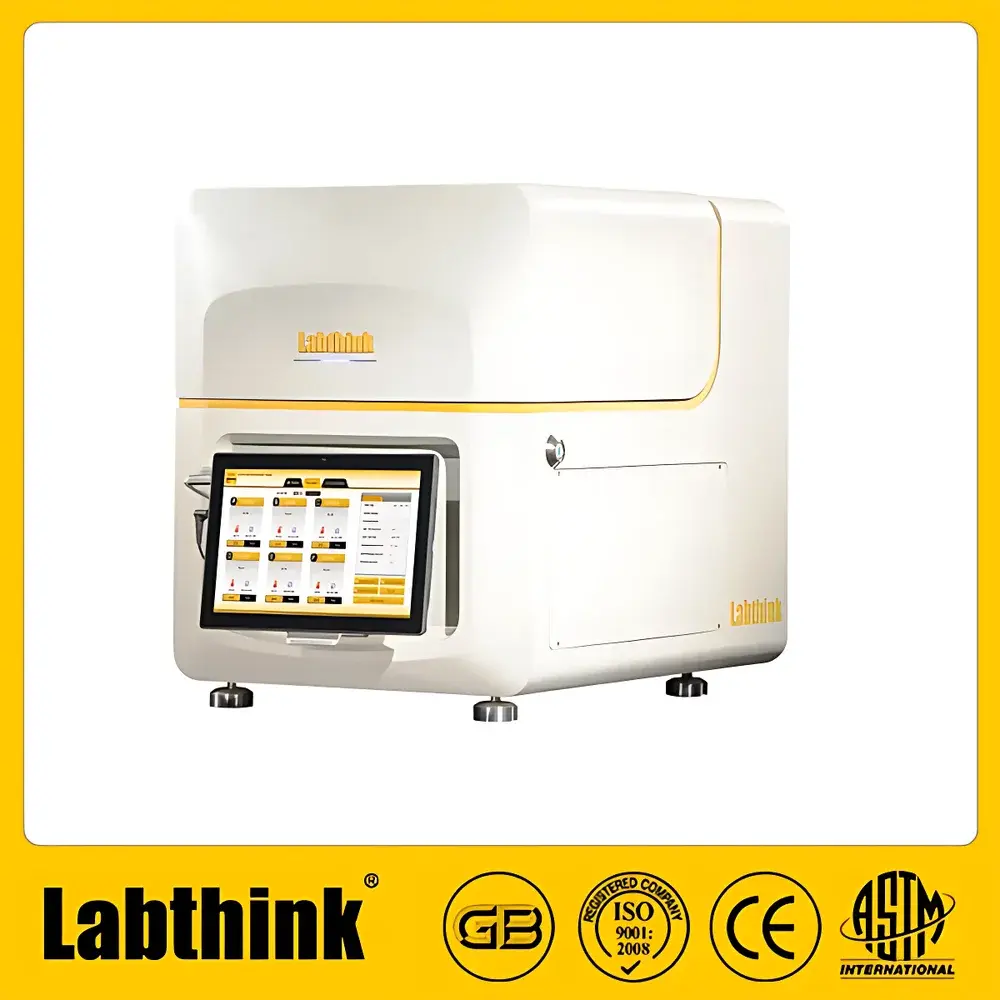
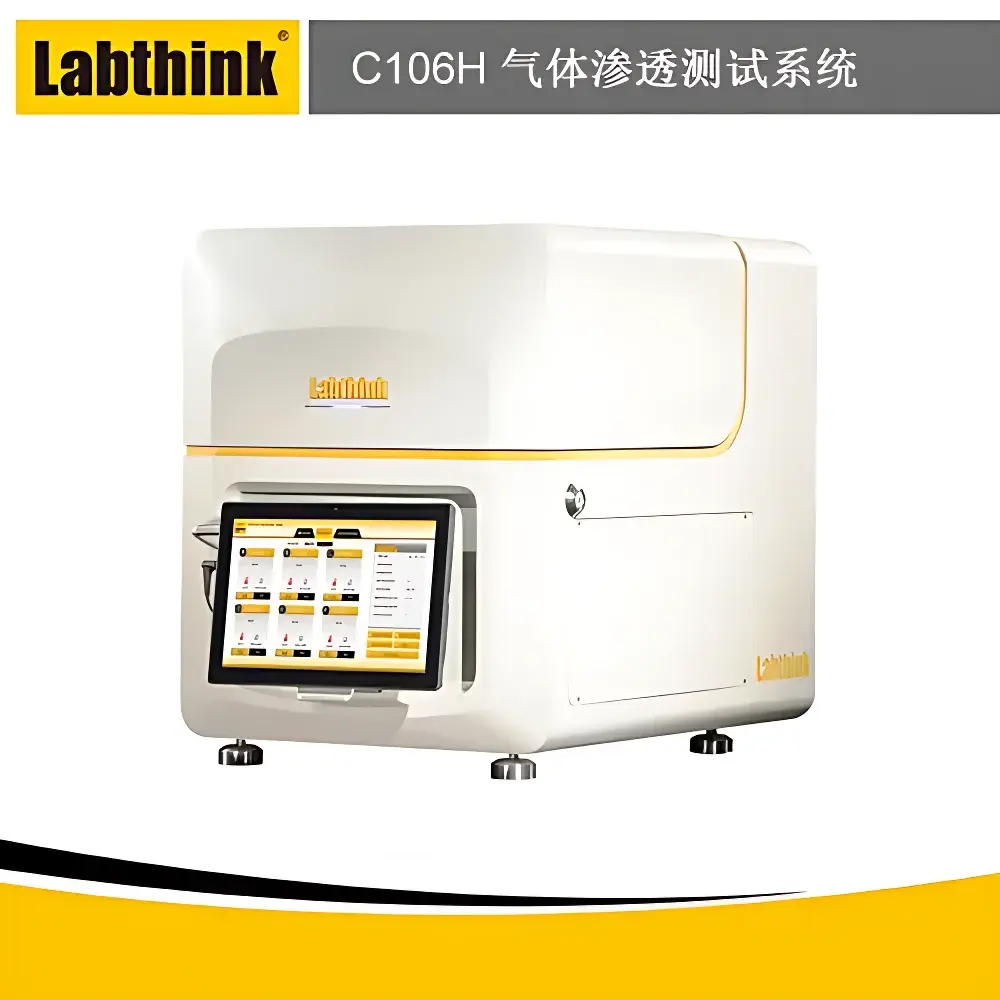
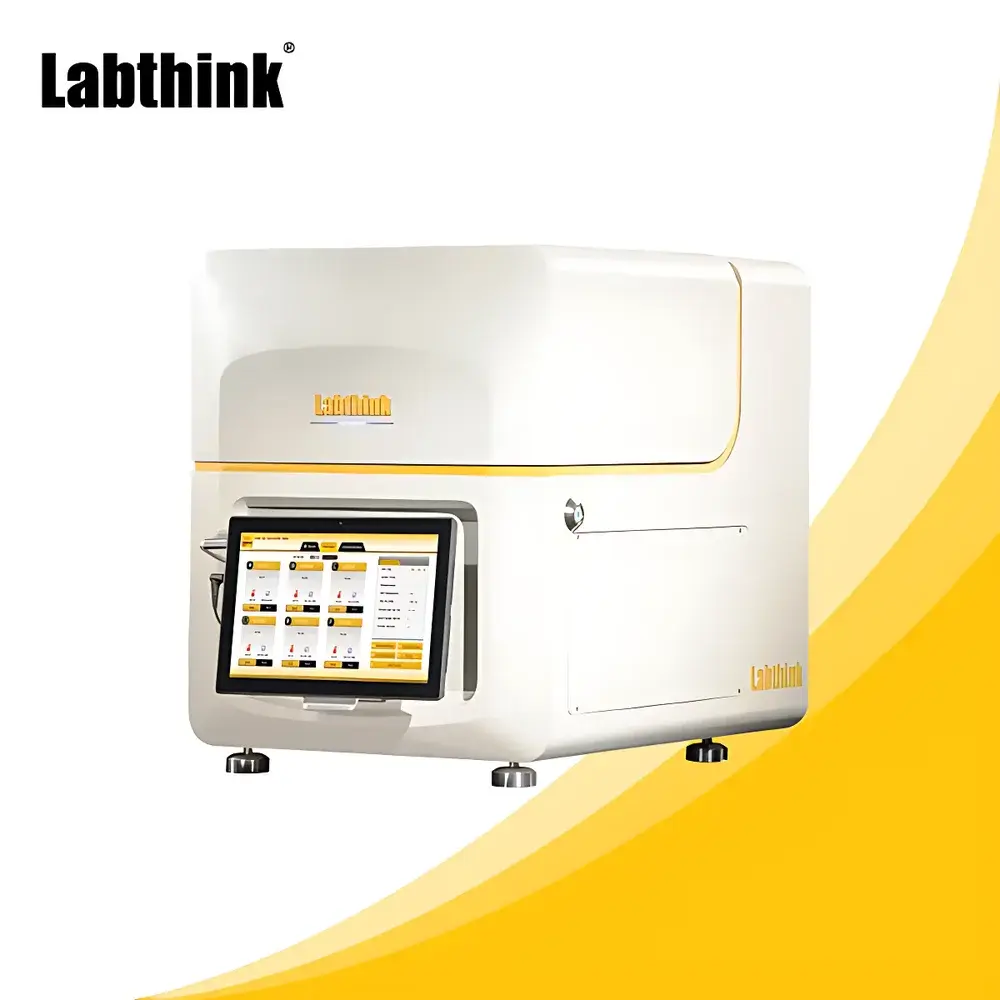
Labthink C106H Gas Permeability Tester (Differential Pressure Method)
| Brand | Labthink |
|---|---|
| Origin | Shandong, China |
| Manufacturer Type | Direct Manufacturer |
| Country of Origin | China |
| Model | C106H |
| Price Range | USD 14,000 – 98,000 |
| Test Principle | Differential Pressure (Manometric) Method |
| Test Gases | O₂, N₂, CO₂ (H₂, CH₄ optional on customization) |
| Test Range | 0.01–50,000 cm³/m²·24h·0.1MPa |
| Resolution | 0.001 cm³/m²·24h·0.1MPa |
| Temperature Range | 15–50 °C (5–60 °C optional) |
| Temp. Stability | ±0.15 °C |
| Vacuum Resolution | 0.01 Pa |
| Vacuum Accuracy | ±0.2% of reading (1–100% of sensor span) |
| Min. Chamber Vacuum | ≤10 Pa |
| Test Area | 38.48 cm² (11.2 cm × 11.2 cm sample) |
| Max. Sample Thickness | 3 mm |
| Test Pressure Range | 10–150 kPa (adjustable, ΔP stability <0.2 kPa) |
| Chamber Count | 6 independent test stations |
| Power Supply | 120 VAC ±10%, 60 Hz OR 220 VAC ±10%, 50 Hz |
| Net Weight | 100 kg |
| Dimensions | 600 × 490 × 660 mm |
Overview
The Labthink C106H Gas Permeability Tester is an engineered differential pressure (manometric) system designed for precise, traceable, and repeatable measurement of gas transmission rates through polymeric films, laminates, foils, and rigid sheets. It operates on the fundamental principle of Fick’s first law of diffusion: under a controlled transmembrane partial pressure gradient, gas molecules permeate through a barrier material at a rate proportional to its intrinsic permeability. The instrument establishes a stable pressure differential across the specimen—high-pressure upstream (test gas) versus low-pressure downstream (vacuum)—and continuously monitors the pressure rise in the evacuated downstream chamber using high-accuracy vacuum transducers. From this real-time pressure-time profile, the system calculates gas permeability coefficient (P), diffusion coefficient (D), solubility coefficient (S), and gas transmission rate (GTR or OTR/NTR/COTR) per ISO 15105-1, ASTM D1434, and GB/T 1038-2000. Its architecture supports regulatory compliance workflows, including audit-ready data integrity for GLP and GMP environments when configured with CFR 21 Part 11-compliant software modules.
Key Features
- Six independent, parallel test chambers—triple the throughput of conventional single- or dual-chamber instruments—enabling statistically robust multi-sample evaluation under identical thermal and pressure conditions.
- Rainbow-bridge test cavity design with 360° circumferential air circulation ensures uniform temperature distribution and minimizes axial thermal gradients; temperature stability maintained within ±0.15 °C across the full 15–50 °C operating range (5–60 °C optional).
- Imported high-resolution vacuum sensors (0.01 Pa resolution) and ultra-low-leakage pneumatic actuation system guarantee long-term seal integrity and measurement fidelity, especially critical for ultra-high-barrier materials (e.g., SiOₓ-coated PET, AlOₓ vapor-deposited films) with GTR values as low as 0.01 cm³/m²·24h·0.1MPa.
- Automated pressure compensation algorithm actively maintains constant upstream pressure (10–150 kPa adjustable) with dynamic correction to suppress drift below ±0.2 kPa—eliminating manual intervention and reducing operator-induced variability.
- Integrated 12-inch Windows-based touch tablet interface with intuitive workflow navigation; supports both fully automated mode (temperature input → start) and advanced manual control for method development and failure analysis.
- Motorized clamping mechanism delivers consistent compressive force across all six stations, ensuring reproducible gasket sealing without user-dependent torque application—critical for minimizing edge leakage artifacts.
Sample Compatibility & Compliance
The C106H accommodates flat, non-porous, and semi-crystalline sheet materials up to 3 mm thick and 11.2 cm × 11.2 cm in dimension—including biaxially oriented polypropylene (BOPP), ethylene-vinyl alcohol (EVOH) coextrusions, metallized polyester (MPET), aluminum foil laminates, PVDC-coated paperboard, silicone rubber sheets, and thin-gauge metal foils. It complies with international standard test methods including ISO 15105-1 (plastics—determination of gas transmission rate—part 1: differential pressure method), ISO 2556 (plastics—determination of gas transmission rate—manometric method), ASTM D1434 (standard test method for determining gas permeability characteristics of plastic film and sheeting), JIS K7126-1, and YBB 00082003 (Chinese pharmaceutical packaging standards). Optional configurations support hazardous gas testing (H₂, CH₄) under IEC 60079-certified safety protocols and humidity-controlled testing (5–90% RH ±2%) for hygroscopic barrier assessment.
Software & Data Management
The embedded Windows OS platform runs Labthink’s proprietary PermeationSuite™ software, delivering real-time visualization of pressure vs. time curves, derived permeability kinetics, and Arrhenius temperature-dependence plots. All raw sensor data—including vacuum transducer output, thermocouple readings, pressure setpoints, and valve actuation timestamps—are logged at ≥10 Hz with immutable file hashing. When equipped with DataShield™ and CFR 21 Part 11 add-ons, the system enforces electronic signatures, role-based access control, audit trail generation (per ALCOA+ principles), and secure data export in CSV, PDF, and XML formats compatible with LIMS integration. Calibration history, maintenance logs, and user activity records are retained for FDA, EMA, and NMPA inspection readiness.
Applications
This instrument serves as a primary metrology tool in R&D laboratories, quality control departments, and contract testing facilities across food packaging, pharmaceutical primary packaging, medical device barrier validation, and battery separator development. Typical use cases include: comparative screening of oxygen barrier performance for retort pouch formulations; accelerated aging studies correlating permeability shift with thermal history; validation of plasma-enhanced chemical vapor deposition (PECVD) SiOₓ coatings on flexible substrates; determination of nitrogen permeation through cold-form blister lidding foils; and diffusion modeling of CO₂ through multilayer PET/PE thermoformed trays used in modified atmosphere packaging (MAP). Its extended pressure range also enables characterization of pressure-dependent permeation behavior in elastomeric seals and fuel cell membranes.
FAQ
What gases can be tested on the C106H?
Standard configurations support O₂, N₂, and CO₂. H₂ and CH₄ testing is available via customized gas-handling modules with explosion-proof components and dedicated leak detection protocols.
Is humidity control integrated or optional?
Relative humidity control (5–90% RH ±2%) is an optional module; the base system operates at 0% RH (dry condition) by default.
How does the six-chamber design improve data reliability?
Independent chambers eliminate cross-talk, enable intra-batch repeatability assessment, and allow simultaneous testing of reference standards alongside unknowns—reducing systematic bias from sequential measurement drift.
Can the C106H meet FDA 21 CFR Part 11 requirements?
Yes—when configured with the CFR 21 Part 11 software package, electronic signature module, and DataShield™ audit trail engine, it satisfies electronic record and signature compliance for regulated industries.
What vacuum level does the system achieve, and how is it sustained?
The imported oil-free vacuum pump achieves ≤0.2 Pa ultimate vacuum; active pressure regulation and auto-compensation maintain ≤10 Pa in the test chamber during measurement, verified by dual-stage vacuum monitoring.



