
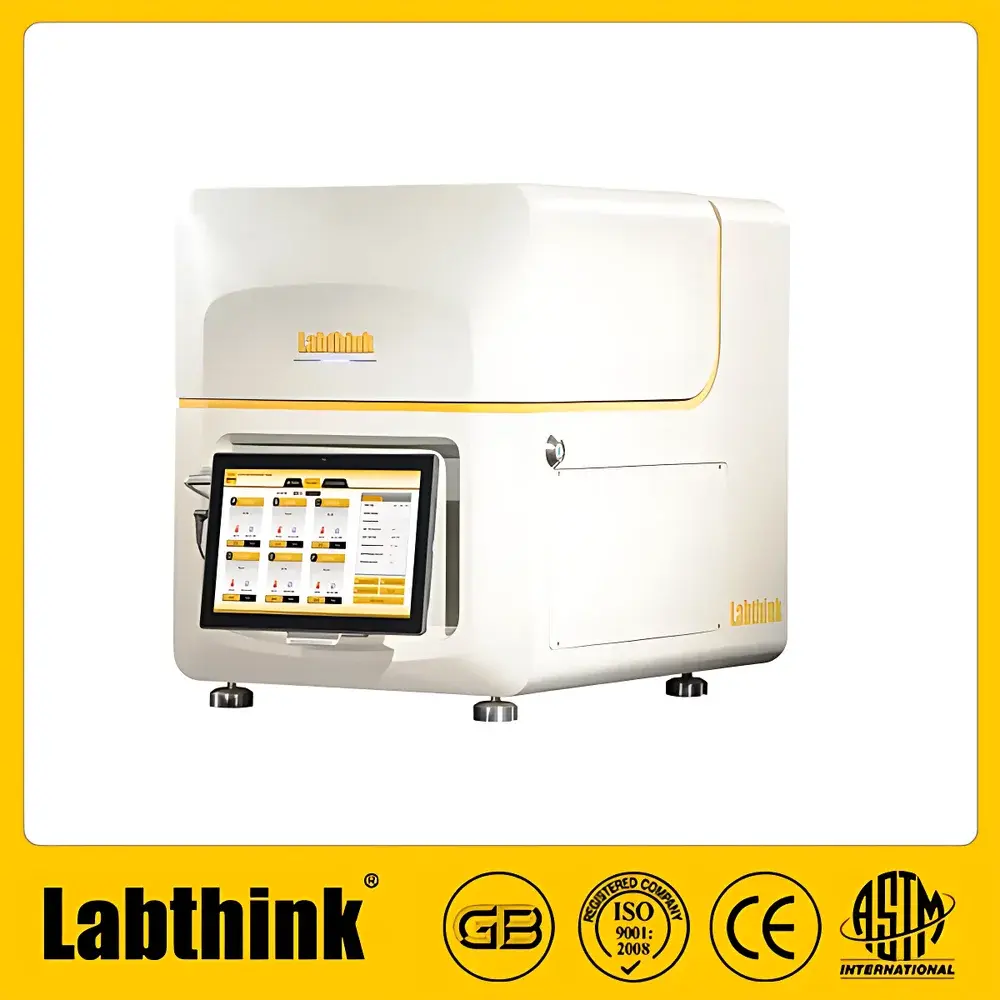
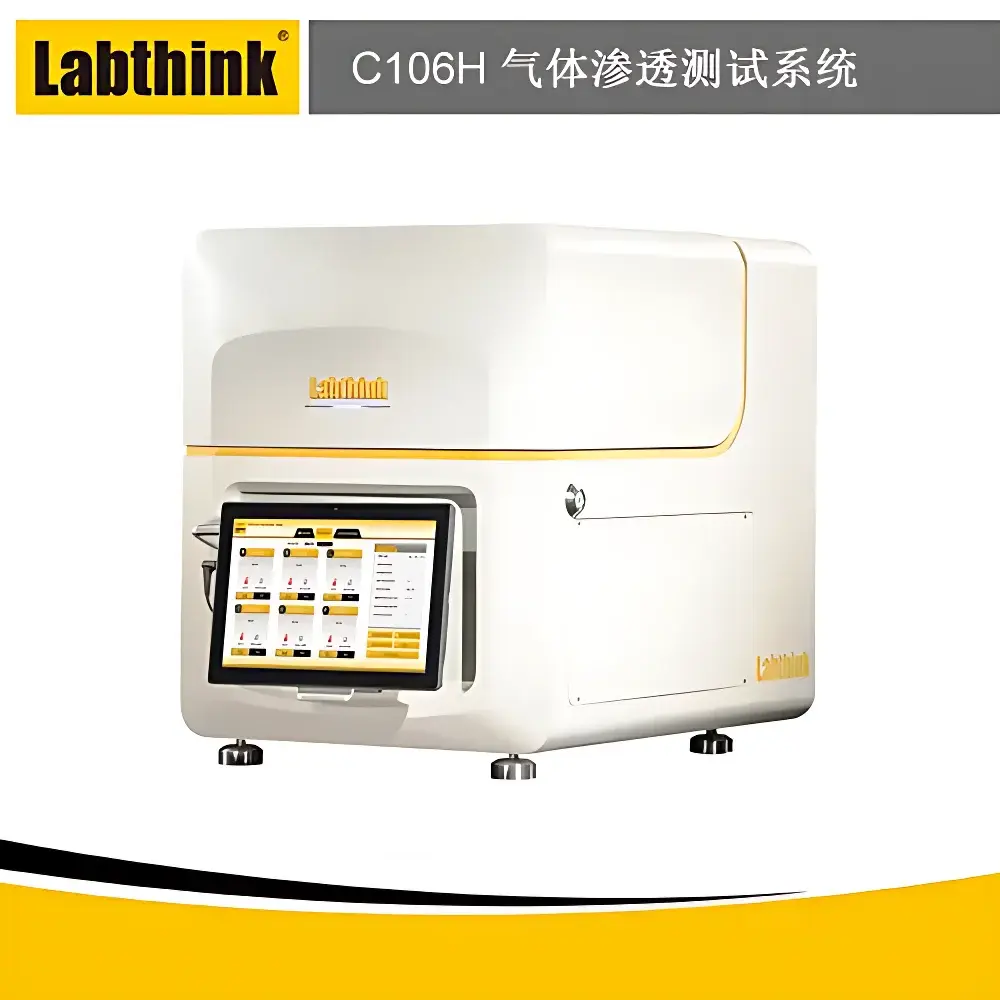
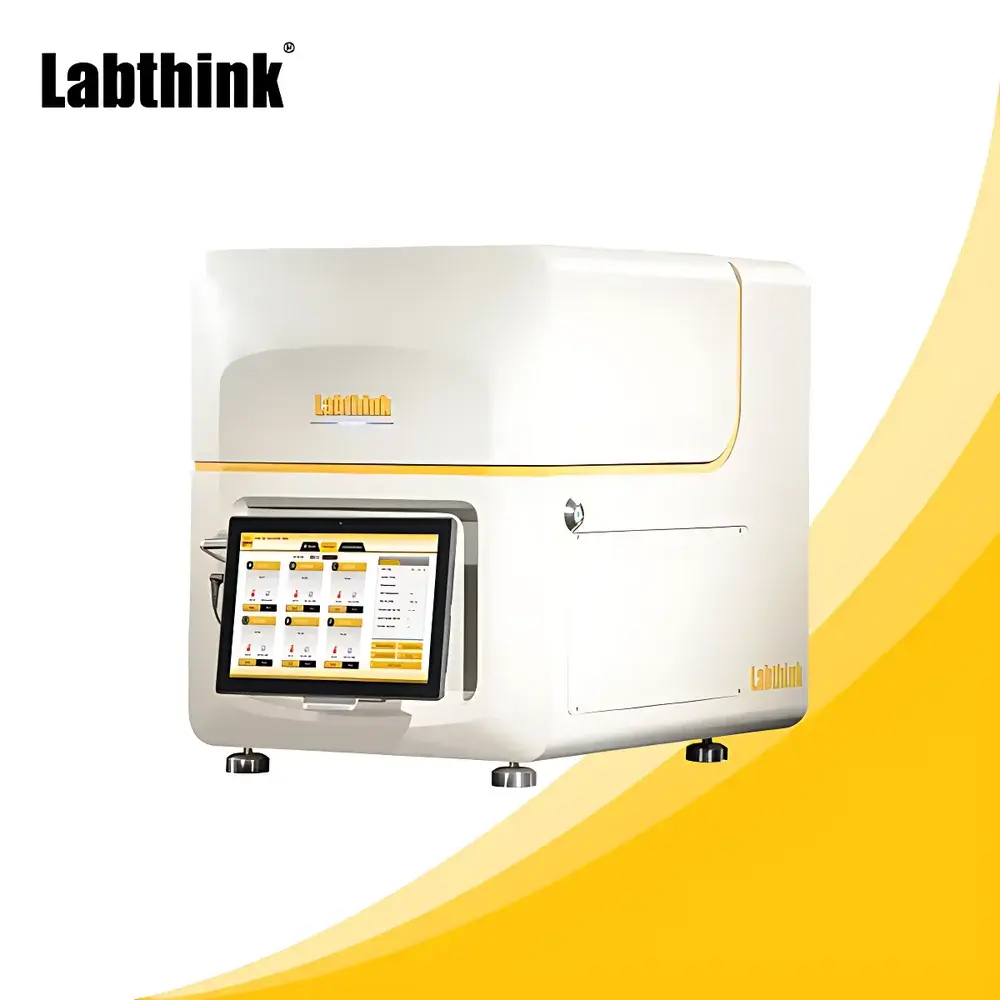
Labthink C106H Gas Permeability Tester for Tires, Rubber, and Flexible Packaging Films
| Brand | Labthink |
|---|---|
| Model | C106H |
| Test Range | 0.01–50,000 cm³/m²·24h·0.1MPa |
| Resolution | 0.001 cm³/m²·24h·0.1MPa |
| Temperature Range | 15–50 °C (standard), 5–60 °C (optional) |
| Temp. Resolution | 0.01 °C |
| Temp. Stability | ±0.15 °C |
| Humidity Range | 0% RH, or 5–90% ±2% RH (customizable) |
| Vacuum Resolution | 0.01 Pa |
| Vacuum Accuracy | ±0.2% of reading (1–100% of sensor span) |
| Test Chamber Vacuum Level | ≤10 Pa |
| Test Cells | 6 independent chambers |
| Sample Size | 11.2 cm × 11.2 cm (4.4″ × 4.4″) |
| Max. Sample Thickness | 3 mm (120 mil) |
| Standard Test Area | 38.48 cm² |
| Test Gases | O₂, N₂, CO₂ (gas supply not included) |
| Test Pressure | 10–150 kPa (adjustable) |
| Pressure Stability | ±0.2 kPa |
| Gas Inlet Pressure | 550 kPa (79.7 PSI) |
| Tubing Interface | Φ6 mm polyurethane |
| Dimensions | 600 mm × 490 mm × 660 mm |
| Power Supply | 120 VAC ±10%, 60 Hz OR 220 VAC ±10%, 50 Hz (user-selectable) |
| Net Weight | 100 kg (220 lbs) |
Overview
The Labthink C106H Gas Permeability Tester is an ASTM- and ISO-compliant differential pressure-based instrument engineered for precise, high-reproducibility measurement of gas transmission rates (GTR) through elastomeric, rubbery, and flexible polymeric materials. It operates on the principle of constant differential pressure (manometric) method—per ASTM D1434, ISO 2556, ISO 15105-1, GB/T 7755-2003, and GB 1038—where a regulated pressure gradient is maintained across a conditioned specimen, and the accumulation rate of permeant gas in a sealed low-pressure chamber is quantified via high-resolution pressure transducers. This architecture ensures traceable, gravimetrically validated performance for quality control and R&D applications in tire manufacturing, automotive safety systems (e.g., airbag bladders), medical elastomers, and barrier packaging development.
Key Features
- Six independent test chambers enable parallel, statistically robust multi-sample evaluation under identical environmental conditions—critical for batch validation and comparative material screening.
- High-stability temperature control (±0.15 °C) with 0.01 °C resolution supports testing across physiologically and industrially relevant ranges (15–50 °C standard; 5–60 °C optional), ensuring compliance with accelerated aging and real-world service condition simulations.
- Ultra-low vacuum capability (≤10 Pa base pressure) and 0.01 Pa vacuum resolution minimize background drift and enhance detection sensitivity for ultra-low-permeability materials such as butyl rubber inner liners or fluorinated barrier films.
- Modular gas handling system accommodates O₂, N₂, and CO₂ without hardware modification; pressure regulation (10–150 kPa, ±0.2 kPa stability) enables controlled gradient studies per ISO 15105-1 Annex A.
- Robust mechanical clamping mechanism ensures consistent sample sealing integrity across thicknesses up to 3 mm—even for highly elastic or low-modulus substrates like uncured tire inner tubes or silicone elastomer sheets.
- Dual-voltage power architecture (120 V/60 Hz or 220 V/50 Hz) facilitates global deployment without external transformers or voltage converters.
Sample Compatibility & Compliance
The C106H accepts rigid and flexible sheet specimens up to 11.2 cm × 11.2 cm and 3 mm thick—including vulcanized rubber compounds, thermoplastic elastomers (TPEs), laminated tire inner liners, polyisobutylene (PIB)-based films, and coated fabrics. Its standardized 38.48 cm² test area aligns with ISO 2556 and ASTM D1434 requirements for normalized reporting. All operational parameters—including temperature setpoint, pressure differential, and vacuum hold time—are logged with timestamped metadata to support GLP/GMP audit readiness. The system is compatible with 21 CFR Part 11-compliant software extensions for electronic signatures and audit trail generation (available upon request).
Software & Data Management
Labthink’s proprietary PermeationWare™ software provides real-time graphical monitoring of chamber pressure rise curves, automatic calculation of steady-state gas transmission rate (GTR), permeability coefficient (P), and diffusion coefficient (D) per ISO 15105-1 methodology. Raw pressure vs. time datasets are exportable in CSV and XML formats for third-party statistical analysis (e.g., JMP, Minitab). Calibration verification routines include zero-drift compensation and reference film validation protocols traceable to NIST-traceable standards. Data integrity safeguards include user-level access control, immutable audit logs, and encrypted local storage compliant with ISO/IEC 17025 documentation requirements.
Applications
- Quality assurance of butyl rubber inner tubes for passenger and commercial vehicle tires—verifying compliance with SAE J1882 and ISO 4040 gas retention specifications.
- Development and validation of airbag inflation bladder materials—quantifying nitrogen permeation rates under simulated deployment pressure gradients.
- Barrier performance benchmarking of multilayer coextruded films used in medical device pouches and pharmaceutical blister lidding.
- Accelerated permeation studies on elastomeric seals and gaskets exposed to elevated temperatures and humidity (5–90% RH optional configuration).
- Regulatory submission support for FDA 510(k) or CE-marked medical devices requiring documented gas permeability characterization per ISO 10993-12.
FAQ
What gases can be tested with the C106H?
Standard configurations support O₂, N₂, and CO₂. Other inert or non-corrosive gases may be evaluated subject to compatibility verification with wetted components (e.g., stainless steel valves, Viton® seals).
Is vacuum calibration required before each test?
No. The system performs automated zero-point compensation during initial pump-down. Annual verification against a certified reference pressure standard is recommended per ISO/IEC 17025.
Can the instrument measure water vapor transmission (WVTR)?
No. The C106H is optimized for permanent gases only. For moisture permeation, Labthink’s W3/030 Water Vapor Transmission Rate Tester is recommended.
How many samples can be tested simultaneously?
Six specimens may be loaded and tested concurrently—one per chamber—with fully independent parameter control and data acquisition.
Does the system meet FDA or EU regulatory requirements for medical packaging validation?
Yes. When operated with 21 CFR Part 11-compliant software modules and documented calibration records, it satisfies Annex 11 and ISO 11607-1 evidence-generation requirements for barrier validation dossiers.






