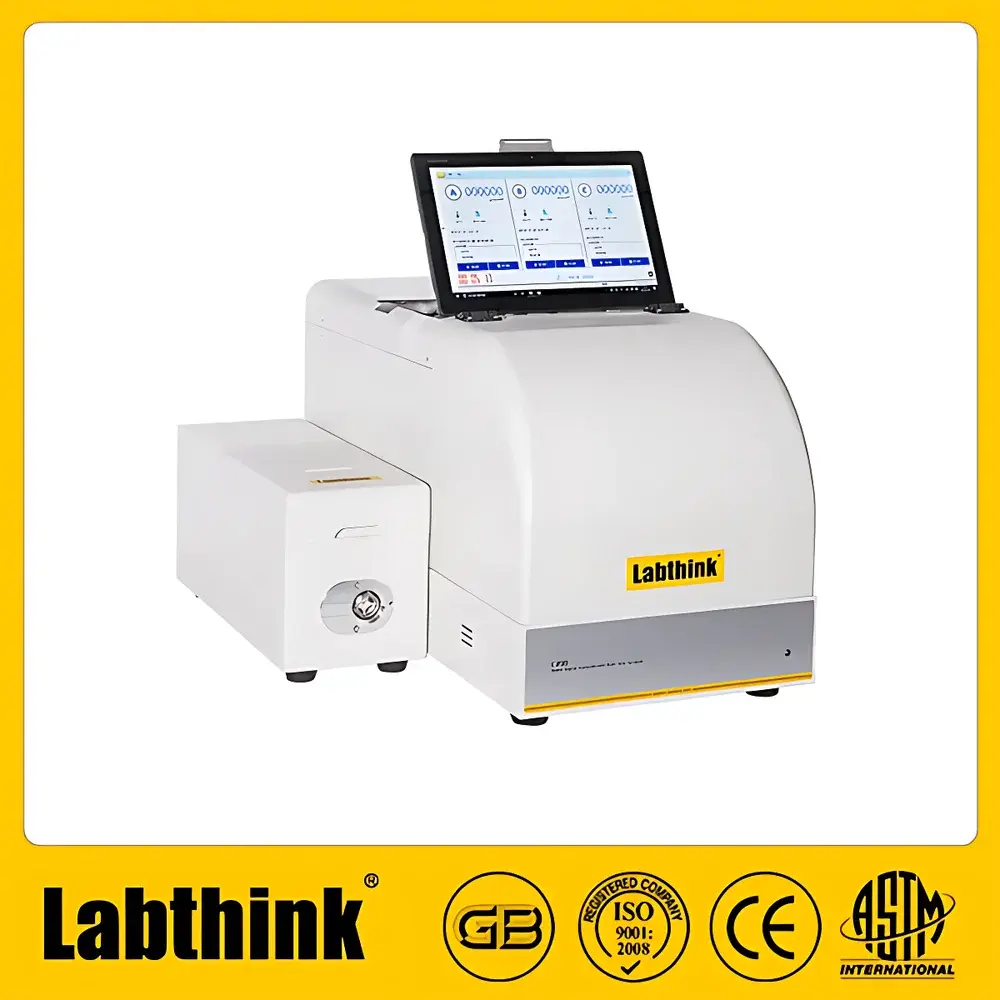
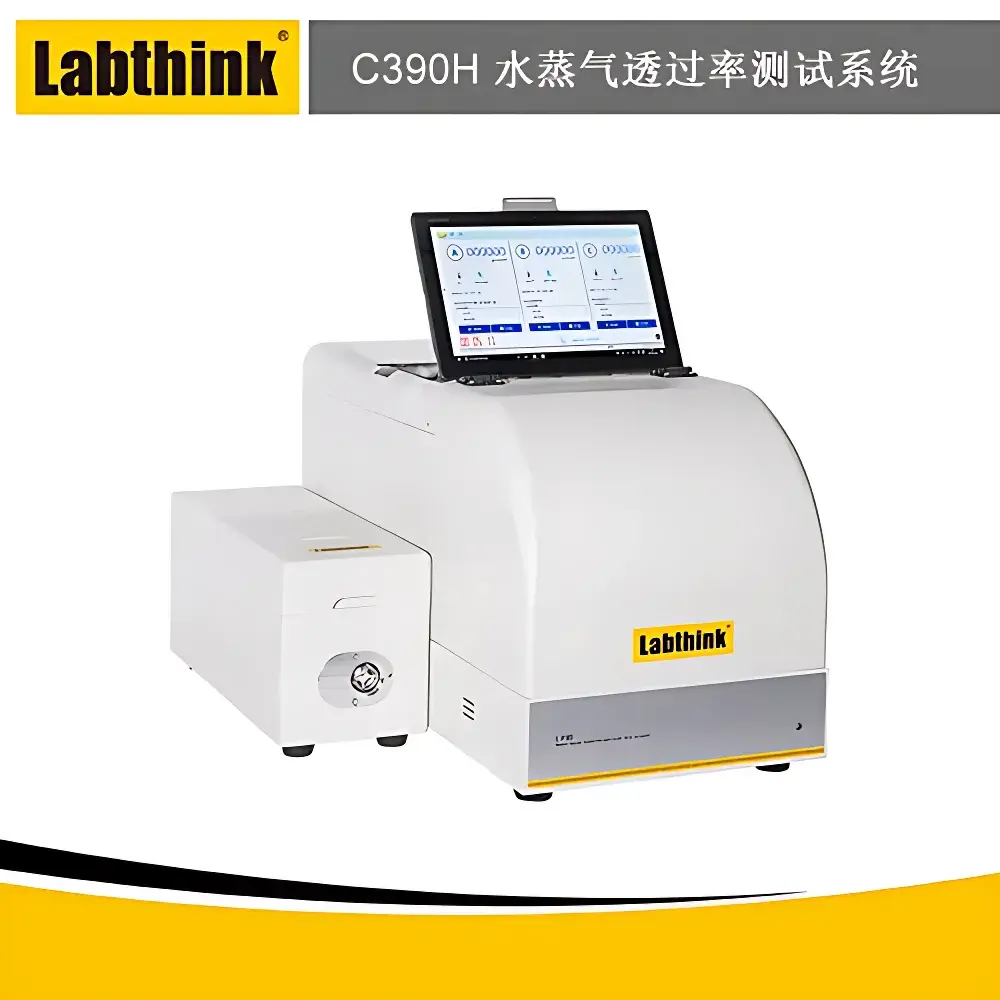
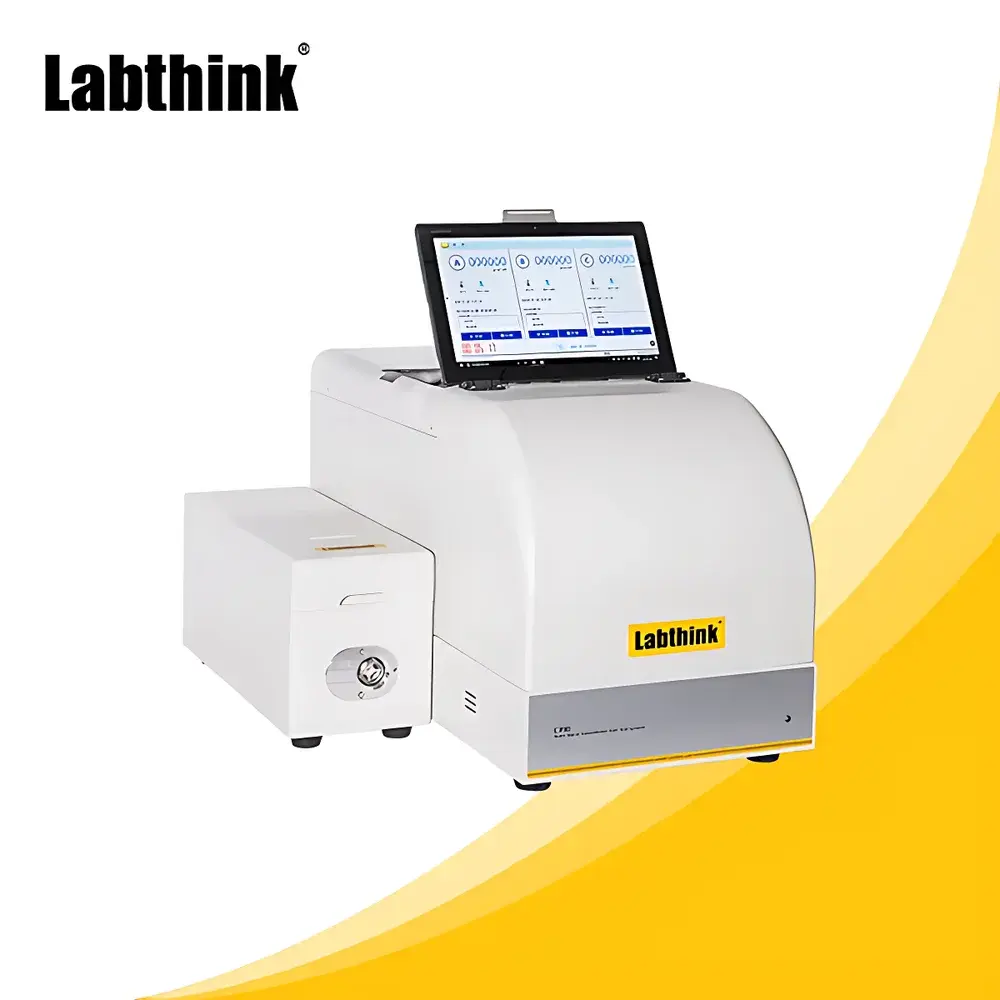
Labthink C390H Infrared Sensor-Based Water Vapor Transmission Rate (WVTR) Tester
| Brand | Labthink |
|---|---|
| Model | C390H |
| Measurement Principle | Infrared Absorption Spectroscopy (ASTM F1249, ISO 15106-2) |
| Test Chambers | 3 independent, integrated cavities |
| Standard Test Area | 50 cm² |
| Sample Size | 108 mm × 108 mm |
| Max Sample Thickness | ≤3 mm |
| WVTR Range | 0.005–40 g/(m²·day) |
| Resolution | 0.0001 g/(m²·day) |
| Repeatability | ±0.005 g/(m²·day) or ±2% (whichever is greater) |
| Temperature Control | 10–55 °C ±0.2 °C |
| Humidity Control | 5–90 %RH ±1 %RH |
| Carrier Gas | Ultra-high-purity N₂ (≥99.999%), inlet pressure ≥0.28 MPa |
| Gas Interface | 1/8″ stainless steel tubing |
| Packaging Test Capability | Up to 3 L containers (optional) |
| Compliance Options | FDA 21 CFR Part 11, GMP-compliant computer system, DataShield™ audit-trail data management (optional) |
Overview
The Labthink C390H Infrared Sensor-Based Water Vapor Transmission Rate (WVTR) Tester is a precision-engineered instrument designed for quantitative determination of water vapor permeation through polymeric films, laminates, coated papers, pharmaceutical blister foils, medical packaging, photovoltaic encapsulants, and rigid or flexible packaging containers. It operates on the principle of infrared absorption spectroscopy—where water vapor molecules traversing a test specimen are carried by dry nitrogen carrier gas to a highly stable, proprietary infrared moisture sensor. The sensor detects concentration-dependent absorbance at characteristic wavelengths (e.g., ~2.7 µm), enabling real-time, non-destructive quantification of transmitted water vapor mass flux. This method eliminates reliance on gravimetric equilibrium or electrolytic detection, delivering superior sensitivity, linearity, and long-term baseline stability. The C390H complies with internationally recognized standards including ASTM F1249 (standard test method for WVTR using modulated infrared sensor), ISO 15106-2 (infrared detection), GB/T 26253, JIS K7129, and YBB00092003–2015—ensuring regulatory acceptability across global pharmaceutical, food, and medical device quality systems.
Key Features
- Tri-cavity integrated test block: Patented monolithic aluminum manifold with thermally isolated flow paths minimizes inter-chamber thermal and humidity gradients (<±0.1 °C, <±0.5 %RH), enabling true parallel testing under identical environmental conditions.
- Proprietary IR moisture sensor: Labthink-developed dual-beam infrared detector with temperature-compensated optical path and auto-ranging signal processing—eliminates manual range selection, reference membrane calibration, and frequent recalibration (calibration interval extended to ≥6 months under routine use).
- Independent cavity environmental monitoring: Each chamber equipped with calibrated Pt100 temperature and capacitive RH sensors, feeding closed-loop PID control algorithms for simultaneous regulation of temperature (10–55 °C ±0.2 °C) and relative humidity (5–90 %RH ±1 %RH).
- Dynamic gas flow stabilization: Mass flow controllers maintain constant dry nitrogen purge rate (±0.5 % accuracy) across all chambers, ensuring consistent boundary layer conditions and eliminating flow-induced measurement drift.
- Modular compliance architecture: Optional validation packages include IQ/OQ documentation, 21 CFR Part 11-compliant electronic signatures, audit trail logging, role-based access control, and DataShield™ encrypted database with automated backup and export (CSV, PDF, XML, SQL).
Sample Compatibility & Compliance
The C390H accommodates flat specimens (films, sheets, foils, papers) up to 108 mm × 108 mm and ≤3 mm thick, with standardized test area of 50 cm². For package-level evaluation, optional 3 L chamber fixtures enable testing of bottles, pouches, trays, and blister cards under controlled external humidity (up to 100 %RH) and internal dry purge—directly supporting ASTM F2622 and ISO 15106-3 methodologies. All hardware and firmware comply with IEC 61000-4 electromagnetic compatibility requirements and UL/CSA safety standards. When configured with GMP-compliant software and validated peripherals, the system meets ALCOA+ data integrity criteria and supports full lifecycle traceability—from raw material qualification to stability protocol execution in regulated environments.
Software & Data Management
Controlled via an embedded Windows 10 IoT Enterprise OS running Labthink’s proprietary WinWVTR software on a 12″ industrial touch panel, the C390H offers two operational modes: AutoTest (fully guided workflow with preset SOPs) and ExpertMode (granular parameter override for method development). All test sequences generate timestamped, digitally signed records with metadata (operator ID, instrument ID, calibration status, environmental logs). DataShield™ provides AES-256 encryption, configurable retention policies, automated report generation (including uncertainty budgets per GUM), and seamless integration with LIMS or ERP via OPC UA or RESTful API. Audit trails record every user action—including data modification, deletion, or export—with immutable hash verification.
Applications
- Barrier performance validation of pharmaceutical blister lidding foils and cold-form foil laminates per USP <671> and Ph. Eur. 5.3.
- Accelerated stability studies of moisture-sensitive APIs in HDPE/PP containers per ICH Q1A(R2) and Q5C guidelines.
- Quality control of food packaging films (e.g., PET/AL/PE laminates) against shelf-life modeling inputs.
- Characterization of encapsulant materials for PV modules per IEC 61215 and UL 1703 accelerated damp heat protocols.
- Comparative WVTR screening of biodegradable polymers (PLA, PHA, starch blends) under variable T/RH conditions.
FAQ
What standards does the C390H directly support?
ASTM F1249, ISO 15106-2, GB/T 26253, JIS K7129, and YBB00092003–2015. Optional configurations extend compliance to ASTM F2622 (packages) and ISO 15106-3.
Can the C390H test both flat films and filled packages simultaneously?
No—flat film and package testing require separate fixture configurations. However, three identical packages or three distinct film samples can be tested in parallel within the same run.
Is external gas purification required for nitrogen supply?
Yes. While the instrument includes internal particulate and hydrocarbon filters, users must supply ≥99.999% purity N₂ with dew point ≤–70 °C to prevent sensor saturation and baseline drift.
How is sensor calibration verified during routine operation?
Calibration is verified using certified reference standards traceable to NIST SRM 2810 (polyethylene film); system self-diagnostics continuously monitor sensor zero/stability and flag deviations exceeding ±1.5% of full scale.
Does the DataShield™ module satisfy FDA 21 CFR Part 11 requirements out-of-the-box?
Yes—when deployed with validated GMP software, electronic signature workflows, and enabled audit trail logging, DataShield™ meets all technical and procedural requirements for Part 11 compliance, including secure login, operation logging, and electronic record retention.
Related Products