
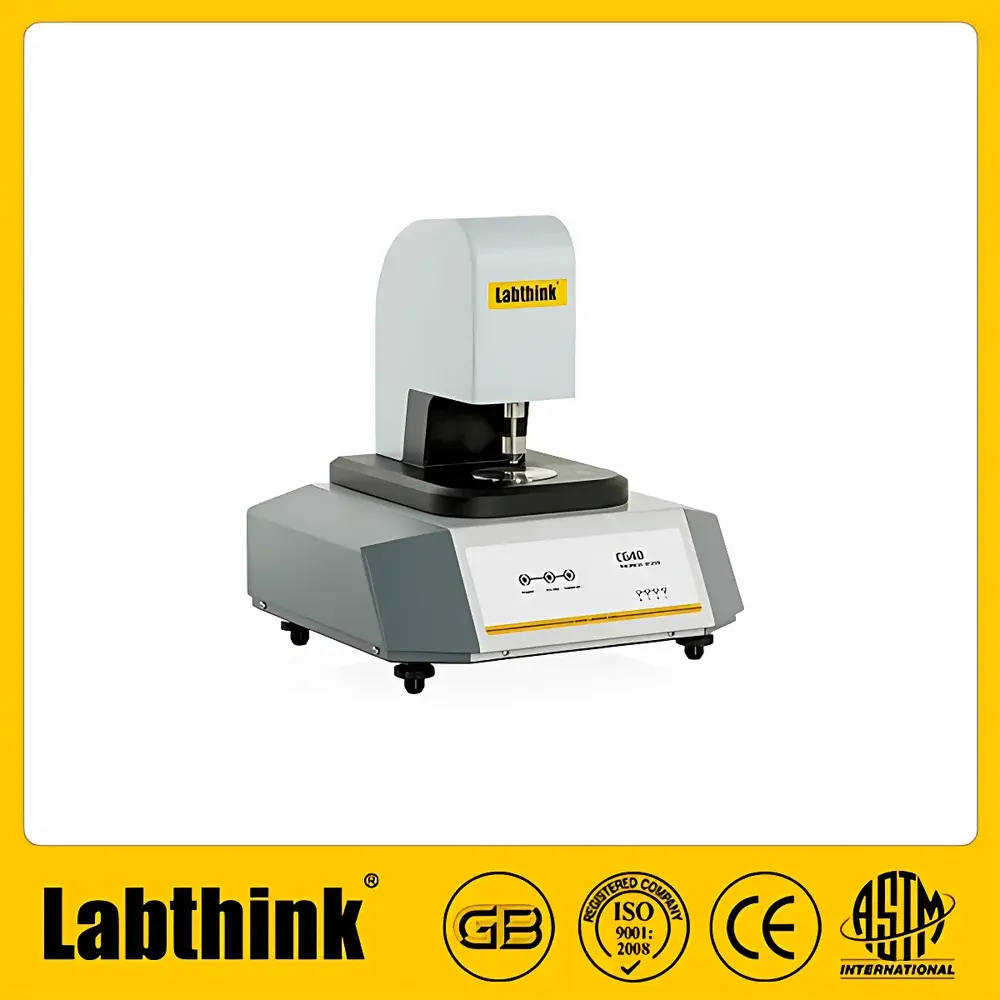
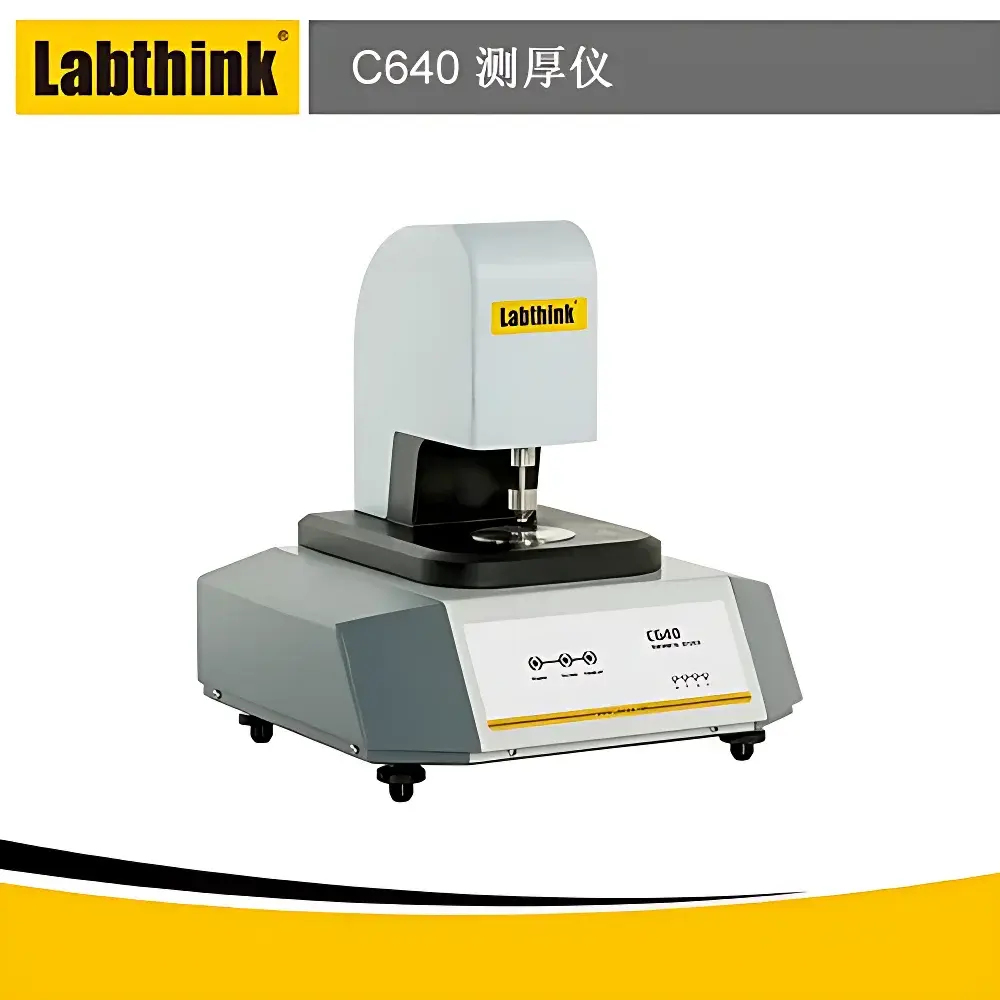
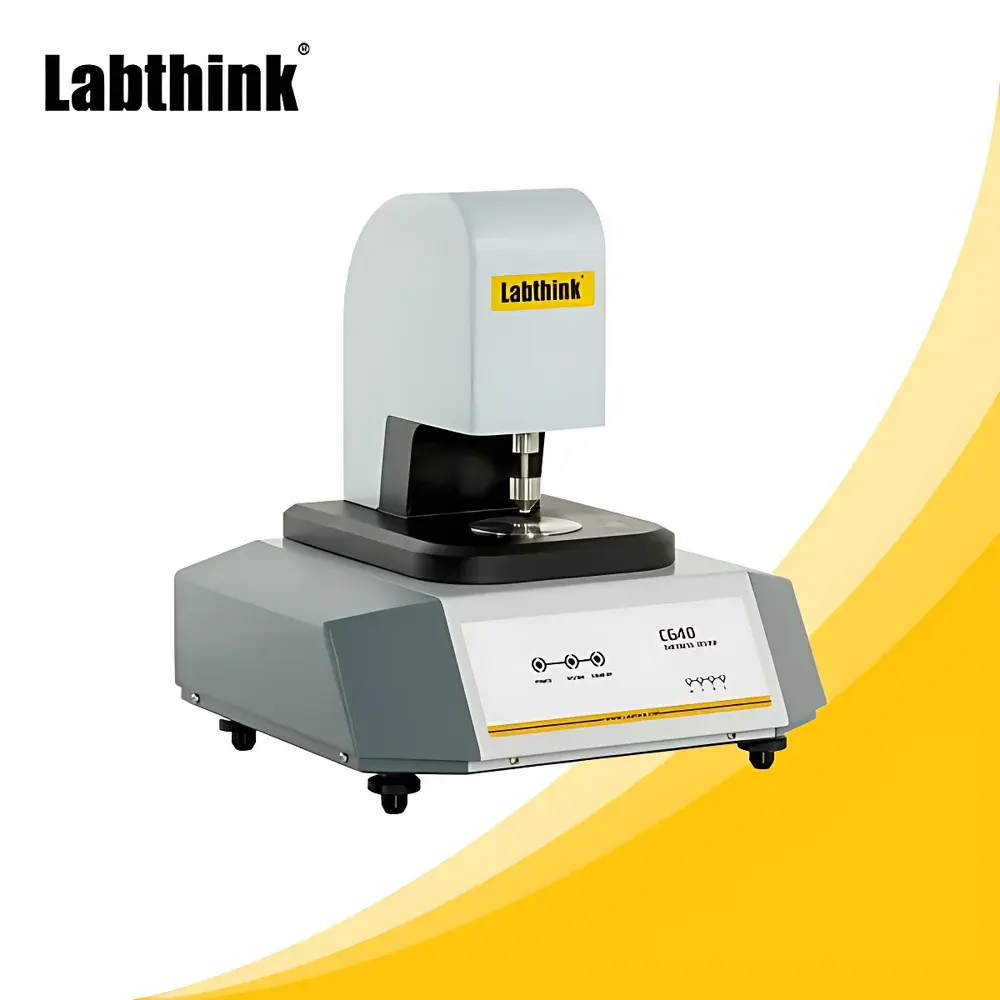
Labthink C640 Precision Mechanical Contact Thickness Gauge for Paper, Board, and Thin Materials
| Brand | Labthink |
|---|---|
| Model | C640M / C640H |
| Origin | Shandong, China |
| Manufacturer | Labthink Instruments Co., Ltd. |
| Measurement Principle | Mechanical contact with controlled pressure (ISO 534, ASTM D6988 compliant) |
| Test Range (Standard) | 0–2 mm |
| Resolution | 0.1 µm |
| Repeatability | ≤0.8 µm (C640M) / ≤0.4 µm (C640H) |
| Applied Pressure | 100 ±1 kPa (paper, 200 mm²), 17.5 ±1 kPa (film, 50 mm²) |
| Adjustable Measurement Spacing | 0–1000 mm |
| Sample Feed Speed | 1.5–80 mm/s |
| Optional Accessories | Automated Sample Feeder, DataShield™ Secure Data Management System, GMP-Compliant Software Module (21 CFR Part 11 Audit Trail & User Permission Controls) |
| Power Supply | 220–240 VAC, 50 Hz / 120 VAC, 60 Hz |
| Dimensions (L×W×H) | 370 × 350 × 410 mm |
| Net Weight | 26 kg |
Overview
The Labthink C640 Precision Mechanical Contact Thickness Gauge is an ISO- and ASTM-compliant laboratory instrument engineered for high-accuracy, high-reproducibility thickness measurement of planar, compressible, and semi-rigid sheet materials. It operates on the fundamental principle of controlled-force mechanical contact measurement: a precision-ground upper anvil, driven by a calibrated pneumatic or electromechanical actuator, applies standardized pressure to the specimen surface while a high-resolution linear variable differential transformer (LVDT) or capacitive displacement sensor measures the vertical separation between upper and lower parallel anvils. This method ensures traceable, repeatable results aligned with international standards including ISO 534 (paper and board), ISO 4593 (plastic film), ASTM D6988 (polymeric film), ASTM D374 (electrical insulating materials), and TAPPI T411 (paper thickness). Unlike optical or ultrasonic alternatives, the C640 eliminates refractive index dependency and air-gap interference—critical for heterogeneous, porous, or multi-layered substrates such as corrugated board, nonwovens, coated papers, and laminated films.
Key Features
- Two performance tiers: C640M (repeatability ≤0.8 µm) and C640H (repeatability ≤0.4 µm), differentiated by sensor grade and thermal stability optimization.
- Modular pressure application system with dual-standard configurations: 100 ±1 kPa over 200 mm² for paper/board per ISO 534, and 17.5 ±1 kPa over 50 mm² for thin films per ISO 4593—both independently validated and mechanically locked.
- Rigid granite base and kinematic anvil mounting minimize thermal drift and mechanical hysteresis, supporting long-term calibration stability under ambient lab conditions (20–25°C, <65% RH).
- Motorized Z-axis positioning with programmable approach speed (1.5–80 mm/s) and dwell time (0.1–10 s), enabling consistent compression dynamics across variable material compressibility.
- Integrated environmental compensation algorithm adjusts for minor temperature-induced dimensional changes in the frame and anvils, referenced against internal PT100 sensors.
Sample Compatibility & Compliance
The C640 accommodates specimens up to 300 mm × 300 mm in footprint and supports thickness measurement across diverse material classes without recalibration. Standard applications include uncoated and coated papers (e.g., offset, newsprint, packaging board), corrugated fiberboard (FEFCO No. 3 compliant), nonwovens (medical gowns, hygiene absorbents per ISO 12625-3), technical textiles (woven/knitted fabrics per ISO 9073-2), polymer films (BOPP, PET, PE per ASTM D6988), and solid electrical insulators (per IEC 60674-2). All measurement protocols adhere to GLP-aligned documentation practices. Optional GMP software configuration provides full 21 CFR Part 11 compliance—including electronic signatures, role-based access control, immutable audit trails, and data integrity validation—enabling use in regulated pharmaceutical and medical device quality control laboratories.
Software & Data Management
The C640 is operated via Labthink’s proprietary ThicknessMaster™ v4.x software, built on a deterministic real-time kernel for sub-millisecond sensor synchronization. The interface supports customizable test templates (e.g., “TAPPI T411 – 10-point board profile”), automated pass/fail evaluation against user-defined specification limits, and statistical process control (SPC) charting (X̄/R, Cp/Cpk). Raw displacement data, pressure profiles, and environmental logs are stored in encrypted SQLite databases with SHA-256 hashing. The optional DataShield™ module adds AES-256 encryption at rest and in transit, digital watermarking of PDF reports, and blockchain-anchored hash verification for regulatory submission packages. Export formats include CSV (for LIMS integration), XML (ASTM E1382-compliant), and PDF/A-2b (archival-grade).
Applications
- Quality assurance of paper caliper in pulp & paper mills, verifying conformance to ISO 451.3 and EN 1942 specifications.
- Corrugated board R&D: measuring flute height and linerboard thickness independently to optimize stacking strength (ECT) models.
- Medical nonwoven validation: quantifying thickness uniformity of spunbond-meltblown-spunbond (SMS) structures used in surgical drapes and respirators (ASTM F2100, ISO 13485 environments).
- Flexible packaging development: correlating film thickness distribution with barrier performance (OTR, WVTR) and seal integrity.
- Electronics manufacturing: verifying thickness consistency of polyimide flex circuits and silicon wafers (where mechanical contact is preferred over laser interferometry due to surface reflectivity constraints).
FAQ
What international standards does the C640 directly support?
The instrument’s mechanical design, pressure calibration, and software test methods comply with ISO 534, ISO 4593, ASTM D6988, ASTM D374, TAPPI T411, GB/T 451.3, and JIS Z1702—each implemented as preconfigured test protocols within ThicknessMaster™.
Can the C640 measure corrugated board without crushing the flutes?
Yes. The 100 kPa pressure is applied uniformly across the 200 mm² anvil area, distributing force to minimize localized deformation. Optional low-pressure mode (50 ±1 kPa) is available for highly compressible grades.
Is calibration traceable to national metrology institutes?
All factory calibrations are performed using NIST-traceable gauge blocks and certified pressure transducers; a full calibration certificate (ISO/IEC 17025 accredited) is provided with each unit.
How does the automated feeder integrate with statistical sampling plans?
The feeder supports ANSI/ASQ Z1.4 Level II sampling logic, auto-indexing positions per MIL-STD-105E tables, and exporting raw point-data with timestamp, position ID, and operator tag for Minitab or JMP ingestion.
Does the GMP software option satisfy FDA requirements for electronic records?
Yes—the optional GMP module implements full 21 CFR Part 11 controls: audit trail with immutable timestamps, electronic signatures with biometric or PKI authentication, and system validation documentation (IQ/OQ/PQ protocols included).



