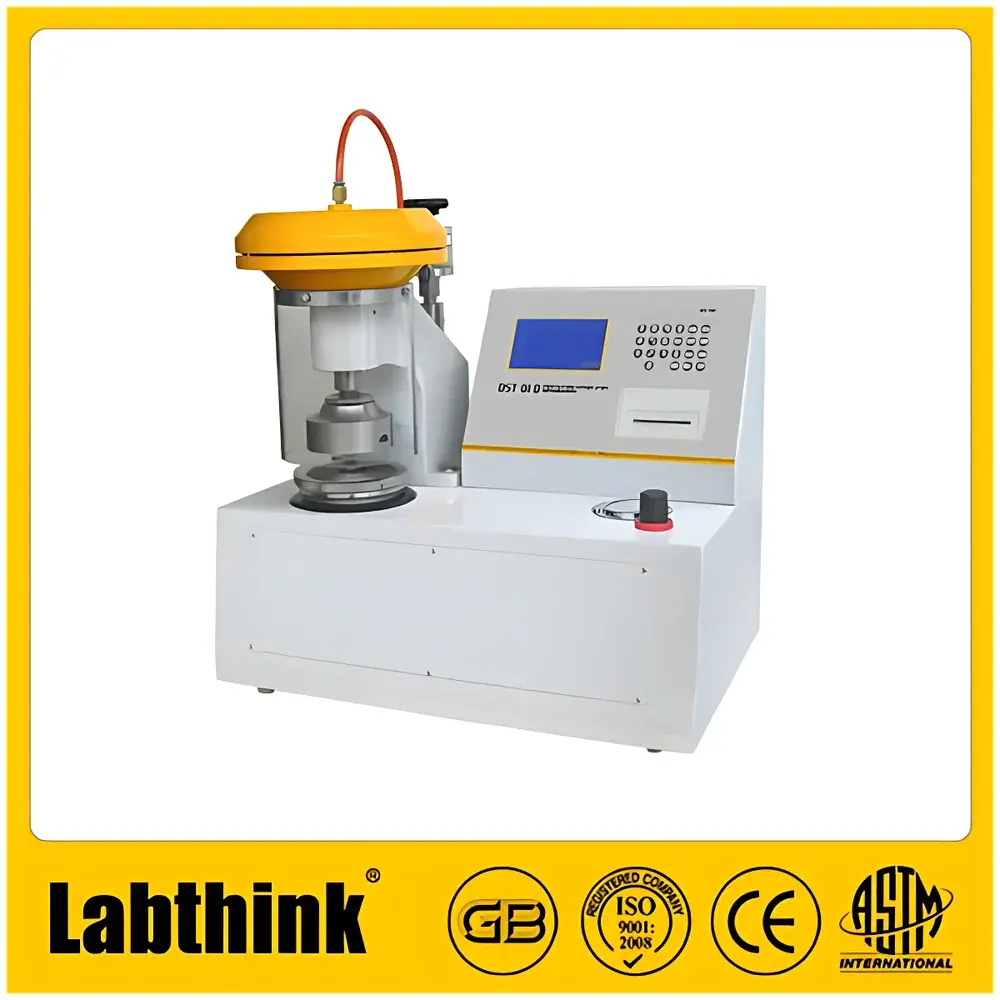
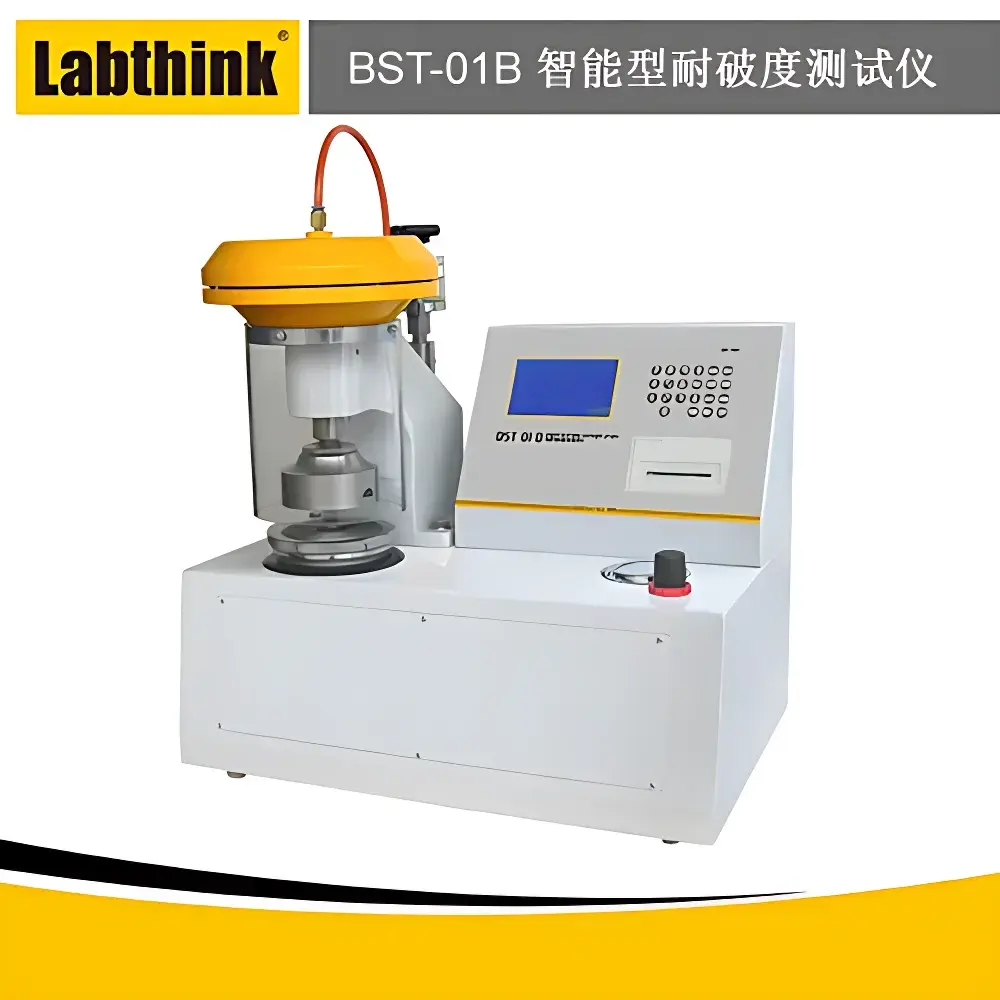
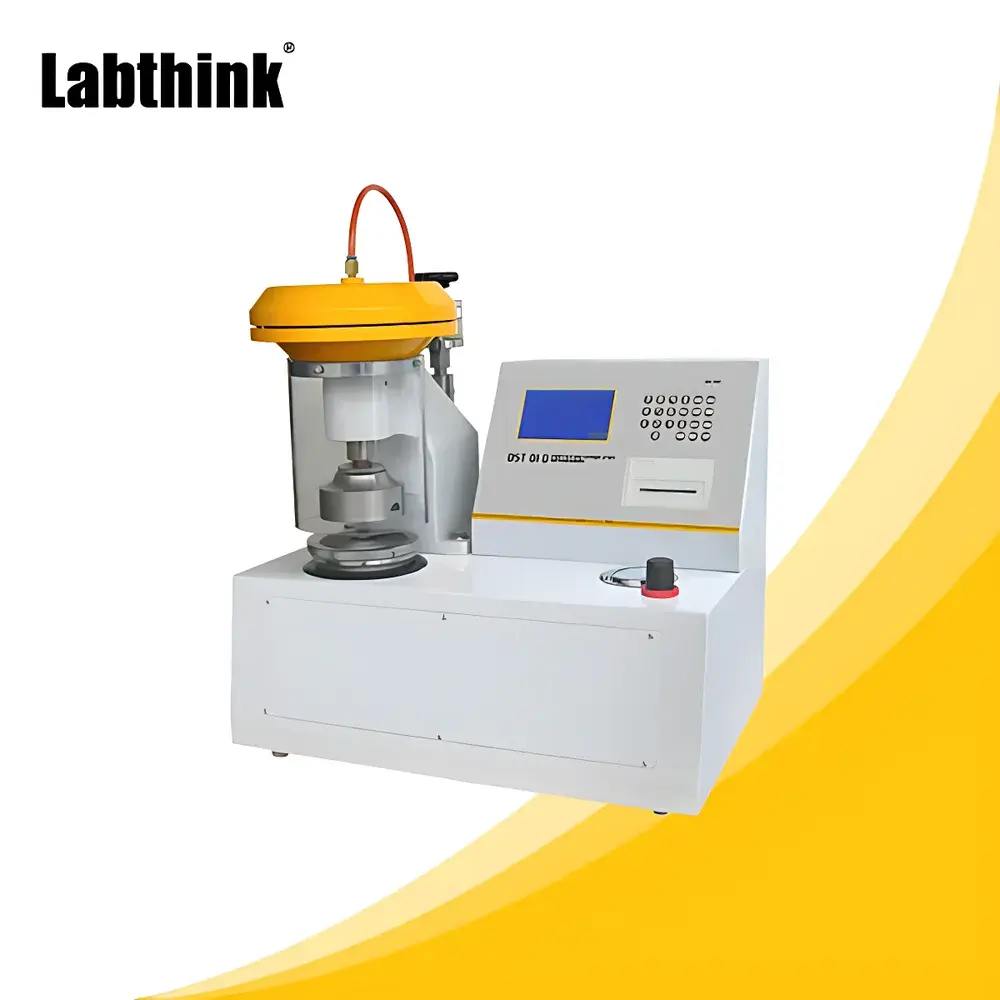
Labthink BST-01B Intelligent Bursting Strength Tester
| Brand | Labthink |
|---|---|
| Model | BST-01B |
| Measurement Range | 40–1600 kPa |
| Accuracy | ≤0.5% FS |
| Resolution | 0.1 kPa |
| Hydraulic Oil Flow Rate | 95 ± 5 mL/min (methyl silicone oil) |
| Diaphragm Resistance | 25–35 kPa (at 9 mm dome height) |
| Clamp Pressure | >430 kPa (adjustable) |
| Upper Clamp Ring ID | Φ(30.5 ± 0.05) mm |
| Lower Clamp Ring ID | Φ(33.1 ± 0.05) mm |
| System Seal Integrity | <10% Pmax pressure drop within 1 min |
| Power Supply | AC 220 V, 50 Hz |
| Dimensions | 530 × 360 × 590 mm |
| Weight | 80 kg |
| Compliance | GB/T 454, GB/T 3198, ISO 2758, YBB00152002, GB 12255-90 |
Overview
The Labthink BST-01B Intelligent Bursting Strength Tester is a precision-engineered instrument designed for quantitative evaluation of bursting resistance in flexible packaging materials—primarily aluminum foil and paper-based substrates—under controlled hydraulic loading conditions. It operates on the principle of the Mullen-type burst test: a standardized circular specimen is clamped pneumatically between upper and lower annular rings; a rubber diaphragm beneath the specimen is hydraulically pressurized at a constant volumetric flow rate until the specimen ruptures. The peak hydraulic pressure recorded at failure constitutes the bursting strength value, expressed in kPa (or convertible units: kgf/cm², lbf/in²). This method is grounded in classical membrane mechanics and conforms to internationally recognized mechanical integrity assessment protocols used in packaging quality assurance and regulatory compliance workflows.
Key Features
- Microprocessor-based closed-loop control system with integrated signal conditioning circuitry ensures high reproducibility and long-term stability across repeated test cycles.
- Pneumatic specimen clamping mechanism delivers uniform, adjustable clamping force (>430 kPa), minimizing edge slippage and ensuring consistent stress distribution during pressurization.
- Real-time graphical display of force–time and pressure–time curves on a 5-inch LCD interface supports immediate visual validation of test behavior and rupture dynamics.
- Automatic peak-hold functionality captures maximum burst pressure with 0.1 kPa resolution; data retention persists through power interruption via non-volatile memory backup.
- Multi-unit conversion engine supports seamless switching among kPa, kgf/cm², and lbf/in²—enabling direct alignment with regional reporting requirements and legacy documentation systems.
- Integrated thermal-printer outputs full test reports including timestamp, sample ID, individual values, statistical aggregates (mean, min, max), and calculated burst index—fully traceable and audit-ready.
- RS232 serial interface enables bidirectional communication with external PCs; optional Labthink proprietary software provides advanced data logging, batch analysis, and GLP-compliant electronic record generation.
Sample Compatibility & Compliance
The BST-01B accommodates standard test specimens of 100 mm diameter (per ISO 2758 and GB/T 454), with precise clamp ring geometry (upper ID: Φ30.5 ± 0.05 mm; lower ID: Φ33.1 ± 0.05 mm) ensuring repeatable active test area definition. It is validated for use with aluminum foils (e.g., pharmaceutical blister lidding, food-grade barrier layers per GB/T 3198 and YBB00152002) and diverse paper grades—including kraft, corrugated medium, test liner, and coated board—commonly assessed under GB 12255-90 and ASTM D774. All mechanical and hydraulic subsystems meet ISO/IEC 17025 foundational metrological criteria for testing laboratories, and the instrument’s firmware architecture supports audit trails required under FDA 21 CFR Part 11 when paired with compliant software.
Software & Data Management
The optional Labthink BurstTest Suite is a Windows-based application supporting automated test sequencing, customizable report templates (PDF/CSV/XLSX), and statistical process control (SPC) charting. It implements role-based user access, electronic signatures, and immutable audit logs—including operator ID, timestamp, parameter changes, and raw sensor data streams—to satisfy GLP and GMP documentation rigor. Data export functions comply with LIMS integration standards, and calibration event records—including date, technician ID, reference standard ID, and as-found/as-left values—are retained indefinitely within the database schema.
Applications
This instrument serves as a core QC tool in packaging R&D, manufacturing QA, and regulatory submission support. Typical use cases include: verification of foil integrity for sterile barrier systems; comparative evaluation of paperboard stiffness-to-burst ratio in carton design; incoming inspection of laminated substrate batches; shelf-life stability monitoring of moisture-sensitive wraps; and root-cause analysis of seal failure mechanisms in thermoformed trays. Its robust construction and calibrated hydraulic actuation make it suitable for both routine production-floor deployment and accredited laboratory environments.
FAQ
What types of materials can be tested on the BST-01B?
Aluminum foils (including pharmaceutical, food, and industrial grades), uncoated and coated papers, paperboards, and certain thin laminates meeting ISO 2758 dimensional and structural criteria.
Is compressed air supply included with the instrument?
No—the BST-01B requires an external oil-free air compressor delivering 0.02–0.3 m³/min at 0.6–0.7 MPa; this is specified as user-provided infrastructure per installation guidelines.
Does the instrument support automated calibration verification?
Yes—through integrated zero-point and span checks using certified pressure transducers; full calibration procedures follow ISO 6508-1 traceability chains and are documented in the supplied calibration certificate.
Can test data be exported to Excel or LIMS systems?
Yes—via RS232 or optional USB-to-serial adapter; the Labthink software exports native CSV and XML formats compatible with major LIMS platforms and statistical analysis tools.
What maintenance is required for long-term accuracy?
Quarterly verification of diaphragm integrity and clamp seal performance; annual recalibration of the pressure transducer and flow control valve by an ISO/IEC 17025-accredited service provider is recommended.