
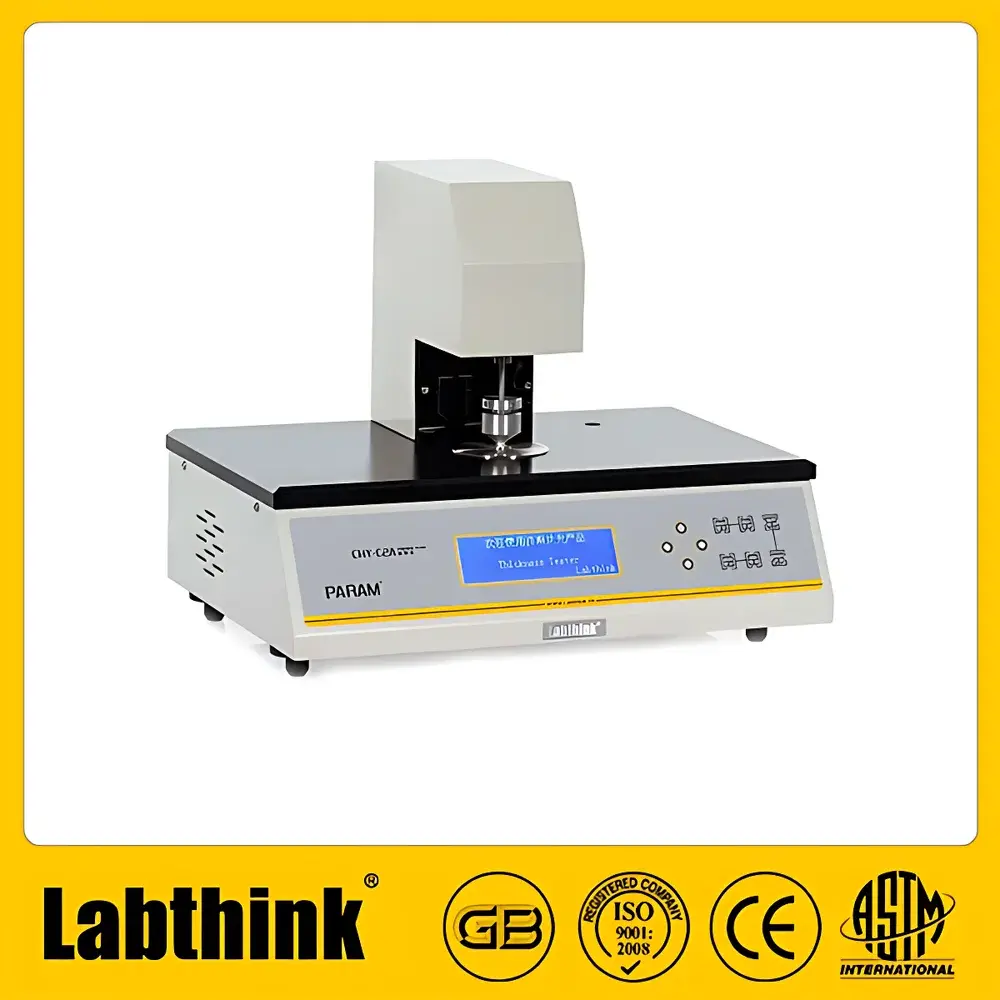
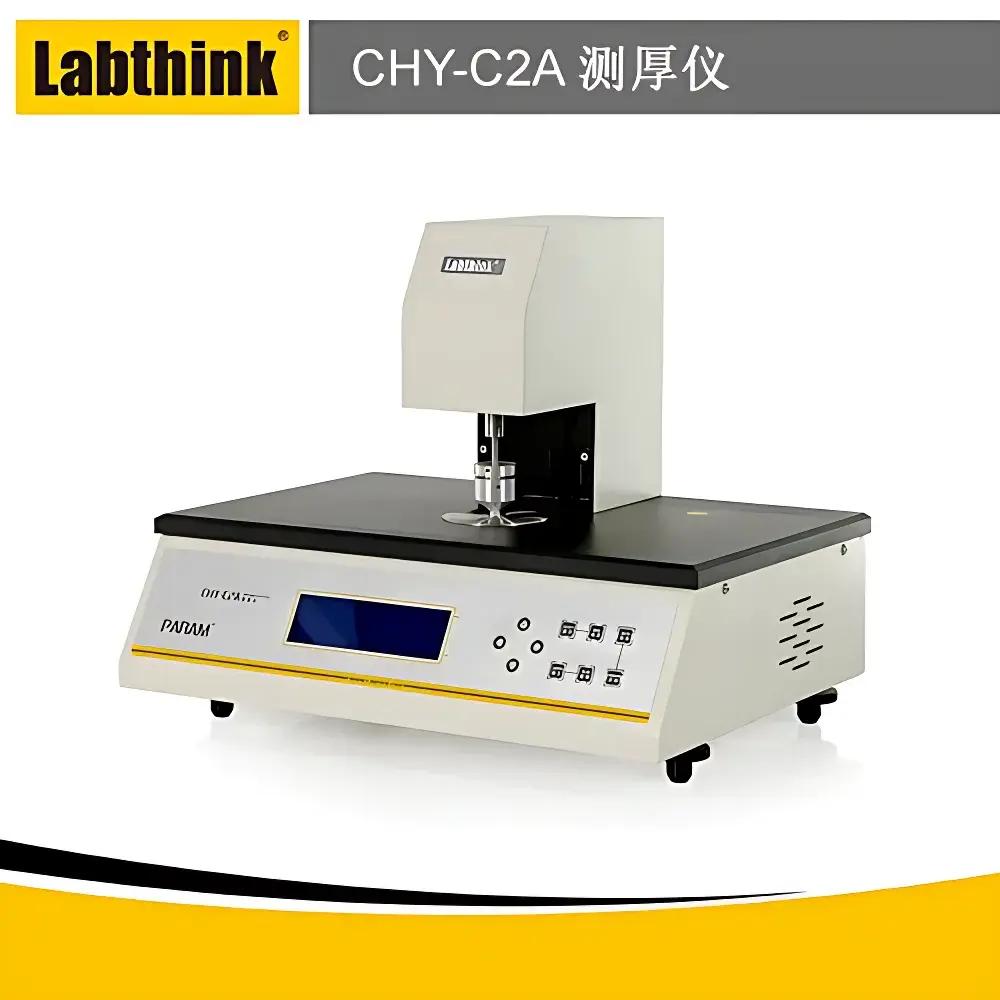
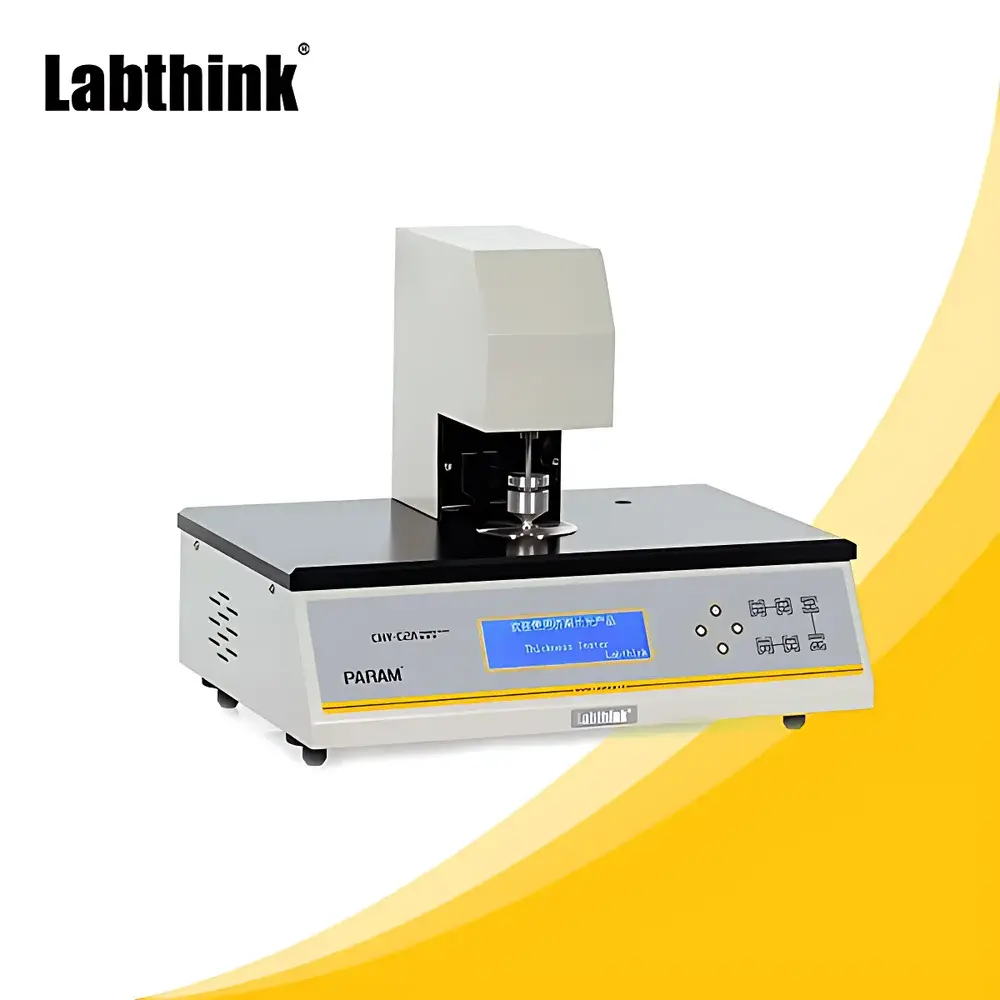
Labthink CHY-C2A Desktop Film Thickness Gauge
| Brand | Labthink |
|---|---|
| Model | CHY-C2A |
| Type | Mechanical Contact Thickness Gauge |
| Measurement Principle | Controlled-Load Mechanical Displacement Sensing |
| Compliance Standards | ISO 4593, ISO 534, ISO 3034, GB/T 6672, GB/T 451.3, ASTM D374, ASTM D1777, TAPPI T411, JIS K6250, JIS K6783, JIS Z1702, BS 3983, BS 4817 |
| Load Range | 0–2 mm (standard), optional 0–6 mm or 0–12 mm |
| Resolution | 0.1 µm |
| Measurement Speed | Adjustable up to 10 tests/min |
| Applied Pressure | 17.5 ± 1 kPa (for films), 50 ± 1 kPa (for paper) |
| Contact Area | 50 mm² (film mode), 200 mm² (paper mode) |
| Power Supply | 220 VAC 50 Hz / 120 VAC 60 Hz |
| Dimensions (L×W×H) | 461 × 334 × 357 mm |
| Net Weight | 32 kg |
| Interface | RS232 |
| Data Management | Lystem™ Laboratory Data Sharing System support |
| Calibration | Certified standard gauge blocks included |
| Software Options | Optional PC-based analysis software with audit trail, statistical reporting, and 21 CFR Part 11 compliance modules |
Overview
The Labthink CHY-C2A Desktop Film Thickness Gauge is a precision mechanical contact thickness measurement system engineered for high-reproducibility thickness determination of flexible planar materials. It operates on the principle of controlled-load displacement sensing: a calibrated load is applied via a standardized contact probe onto the specimen surface, and the resulting mechanical deflection—measured by a high-resolution linear encoder—is converted into thickness data. This method ensures traceable, operator-independent measurements compliant with international standards governing thickness metrology for thin, compressible, and semi-rigid substrates. Unlike optical or ultrasonic alternatives, the CHY-C2A eliminates refractive index dependency and substrate transparency constraints, making it suitable for opaque, multilayered, or metallized films where non-contact methods fail. Its rigid cast-alloy frame, temperature-stabilized load train, and zero-backlash actuation mechanism collectively minimize thermal drift and hysteresis—critical for GLP/GMP-regulated quality control environments.
Key Features
- Standardized mechanical loading architecture compliant with ISO 4593 (plastic film), ISO 534 (paperboard), and ASTM D374 (electrical insulating materials), ensuring cross-laboratory comparability.
- Dual-mode contact configuration: interchangeable 50 mm² probe for polymer films and 200 mm² probe for paper/board—automatically recognized and pressure-compensated via firmware calibration maps.
- Motorized probe lift mechanism eliminates manual handling errors; programmable dwell time (0.1–5 s) enables consistent compression relaxation per test sequence.
- Real-time statistical engine computes and displays mean, min, max, standard deviation, and coefficient of variation for each test batch—data retained in non-volatile memory.
- Integrated RS232 interface supports bidirectional communication with external PCs; compatible with Labthink’s Lystem™ platform for centralized test protocol management, electronic signatures, and audit-ready report generation.
- Self-diagnostic startup routine verifies encoder linearity, load cell zero stability, and probe alignment—flagging deviations beyond ±0.2 µm or ±0.5 kPa before test initiation.
Sample Compatibility & Compliance
The CHY-C2A accommodates specimens ranging from 10 µm polyimide films to 3 mm corrugated board substrates. Its adjustable load range (0–2 mm base, extendable to 0–12 mm) and dual-pressure calibration (17.5 kPa for films, 50 kPa for paper) meet material-specific deformation requirements defined in ISO 3034 (cellulose films), JIS Z1702 (laminated packaging), and TAPPI T411 (paper thickness). All mechanical components are manufactured to ISO 2768-mK general tolerances; probe surfaces are hardened stainless steel (HV 600) with Ra ≤ 0.05 µm finish to prevent specimen marking. The instrument conforms to IEC 61000-4 electromagnetic compatibility standards and carries CE marking under EU Machinery Directive 2006/42/EC. For regulated industries, optional firmware enables 21 CFR Part 11-compliant user access control, electronic signature logging, and immutable audit trails.
Software & Data Management
The optional Lystem™ Laboratory Data Sharing System provides a secure, role-based interface for configuring test methods, assigning operator permissions, and archiving raw data with metadata (operator ID, timestamp, environmental conditions, calibration status). Reports export in PDF/A-1b format with embedded digital signatures and checksum validation. Statistical process control (SPC) charts—X-bar/R, Cpk, and trend analysis—are auto-generated per ASTM E2587. Data integrity safeguards include write-once storage, automatic backup to network drives, and tamper-evident log files. Integration with enterprise LIMS systems is supported via HL7 and ASTM E1384 messaging protocols.
Applications
- Quality assurance of BOPP, PET, PE, and PVDC barrier films in packaging R&D and production lines.
- Thickness uniformity verification of lithium-ion battery separators (e.g., PP/PE microporous membranes) per UL 2591 and IEC 62660-1.
- Coating weight correlation studies using thickness-to-density conversion for gravure- and slot-die-coated electrodes.
- Regulatory submission support for FDA 510(k) dossiers requiring ISO 10993-12-compliant material characterization.
- Calibration traceability for secondary thickness standards used in accredited metrology labs (ISO/IEC 17025).
FAQ
What standards does the CHY-C2A directly support out-of-the-box?
It ships pre-configured with measurement routines aligned to ISO 4593, ISO 534, ASTM D374, and GB/T 6672—including automatic pressure and dwell time selection based on material class.
Can the instrument measure textured or embossed films without indentation artifacts?
Yes—the 50 mm² probe’s low 17.5 kPa load minimizes plastic deformation; optional micro-indentation compensation algorithms adjust for surface topography-induced baseline shifts.
Is calibration traceable to national metrology institutes?
Standard gauge blocks are certified to NIST-traceable uncertainties of ±0.15 µm (k=2); full calibration certificates with uncertainty budgets are available upon request.
How is operator error mitigated during manual mode operation?
The system enforces mandatory dwell confirmation before reading acquisition and rejects measurements outside ±5% of expected thickness range—preventing misloaded or folded specimens from corrupting datasets.
Does the Lystem™ software support multi-site data synchronization?
Yes—centralized database architecture enables real-time synchronization across geographically distributed labs, with conflict resolution protocols for concurrent edits and version-controlled method updates.



