
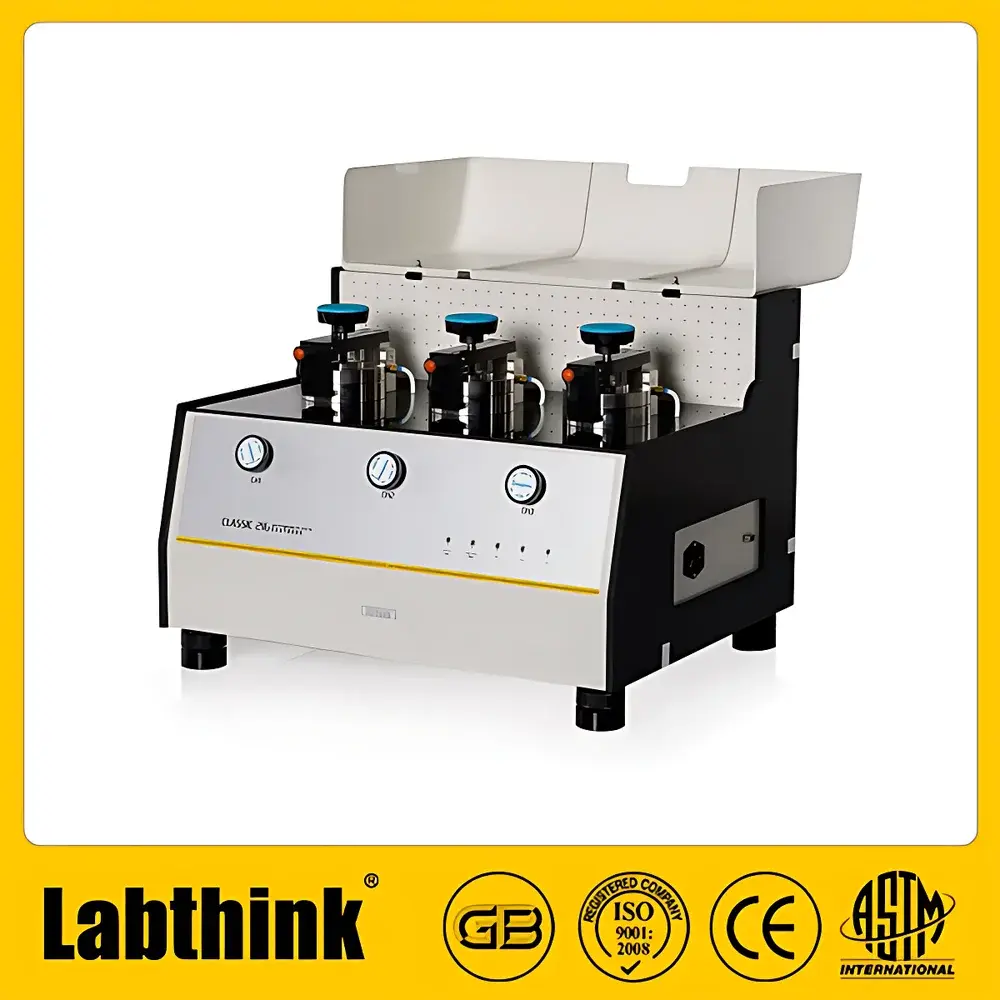
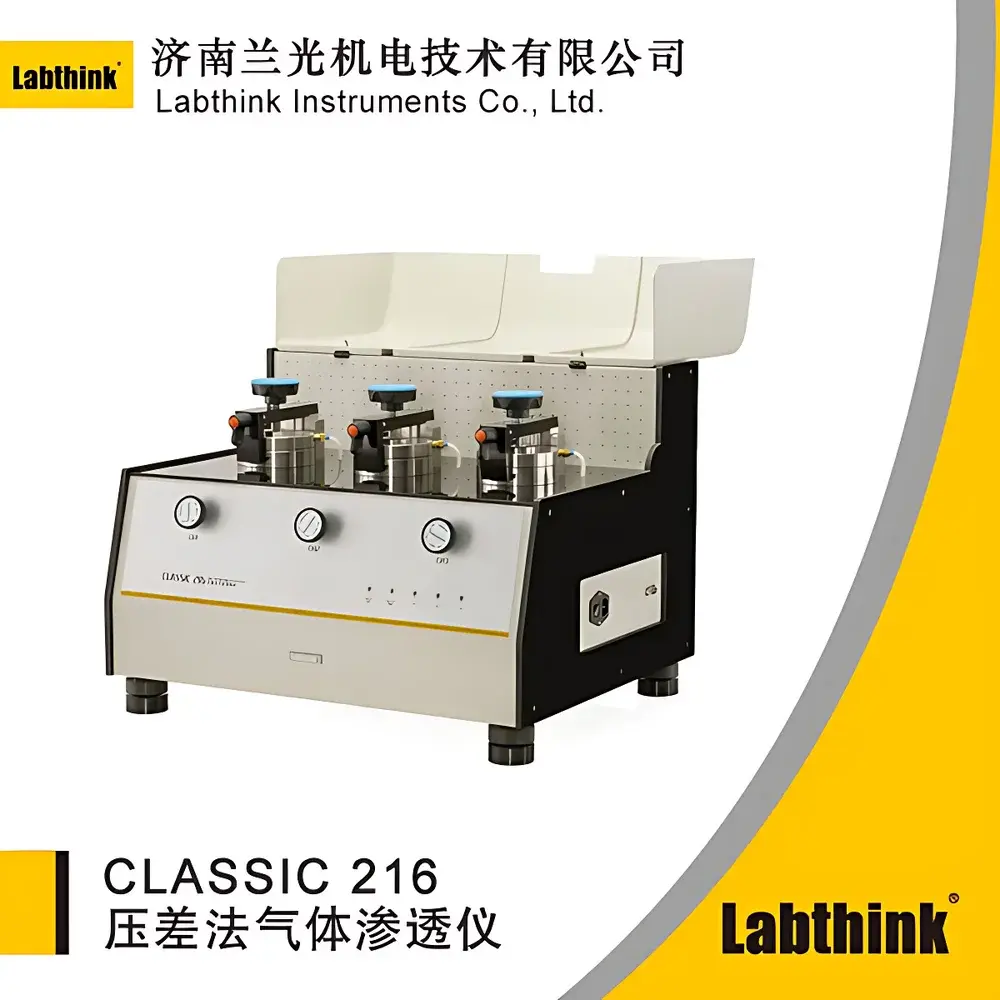
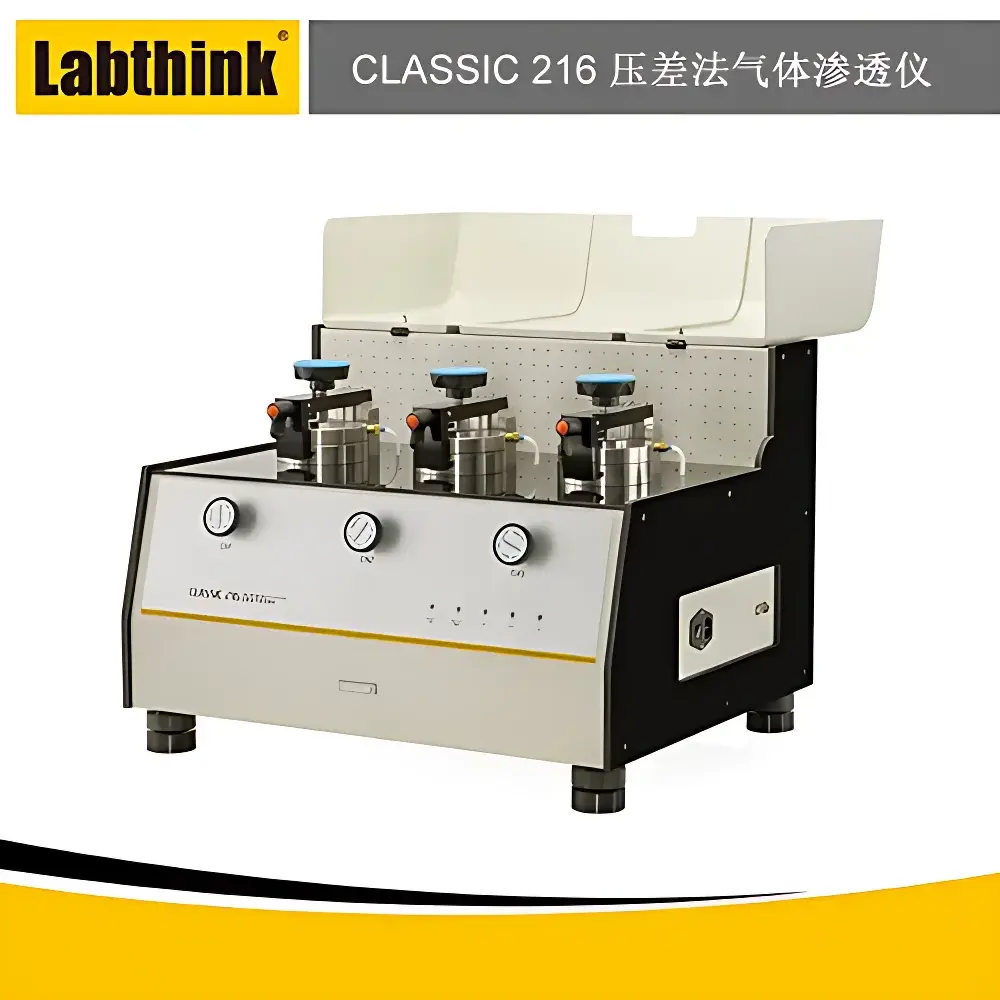
Labthink CLASSIC 216 Differential-Pressure Gas Permeability Analyzer
| Brand | Labthink |
|---|---|
| Origin | Shandong, China |
| Manufacturer Type | Direct Manufacturer |
| Country of Origin | China |
| Model | CLASSIC 216 |
| Price Range | USD 14,000 – 57,000 |
| Test Principle | Differential-Pressure (Manometric) Method |
| Standards Compliance | ISO 15105-1, ISO 2556, ASTM D1434, GB/T 1038-2000, JIS K7126-1, YBB 00082003-2015 |
| Test Gases | O₂, N₂, CO₂, He, air |
| Measurement Range | 0.1–50,000 cm³/m²·24h·0.1 MPa (standard) |
| Number of Test Cells | 3 (independent) |
| Vacuum Resolution | 0.1 Pa |
| Chamber Vacuum Level | <20 Pa |
| Temperature Control Range | 15–55 °C (external chiller/heater required) |
| Humidity Control Options | 0% RH, 100% RH, or intermediate levels per ASTM E104 (humidity generator optional) |
| Specimen Diameter | Φ97 mm |
| Effective Test Area | 38.48 cm² |
| Test Pressure Differential | −0.1 to +0.1 MPa |
| Supply Gas Pressure | 0.4–0.6 MPa |
| Tubing Interface | Φ6 mm polyurethane |
| Dimensions (L×W×H) | 670 × 540 × 430 mm |
| Weight | 75 kg |
| Power Supply | AC 220 V / 50 Hz or AC 120 V / 60 Hz |
Overview
The Labthink CLASSIC 216 Differential-Pressure Gas Permeability Analyzer is an engineered solution for precise, reproducible measurement of gas transmission rates (GTR), permeability coefficients (P), diffusion coefficients (D), and solubility coefficients (S) in flexible barrier materials. Operating on the manometric differential-pressure principle per ISO 15105-1 and ASTM D1434, the instrument quantifies gas flux across a specimen under a controlled pressure gradient—typically vacuum on the downstream side and regulated test gas pressure on the upstream side. This method delivers thermodynamically grounded results applicable to regulatory submissions, material qualification, and process validation in packaging R&D, quality control, and regulatory compliance workflows. Designed for high-reproducibility barrier assessment, it supports both routine QC testing and advanced kinetic modeling—including Arrhenius-based temperature dependence analysis and multi-gas comparative studies.
Key Features
- Triple independent test cells enable concurrent evaluation of three specimens—identical or dissimilar—without cross-contamination or shared environmental influence.
- High-resolution vacuum sensing (0.1 Pa) and stable sub-20 Pa chamber vacuum ensure low-noise baseline conditions critical for detecting ultra-low permeation rates in high-barrier films (e.g., SiOₓ-coated PET, AlOₓ-laminates, PVDC-coated substrates).
- Dual-mode test logic: proportional control for rapid stabilization and fuzzy logic algorithm for adaptive endpoint recognition—reducing operator dependency and improving inter-laboratory repeatability.
- Modular thermal and humidity control architecture: temperature range spans 15–55 °C (with external chiller/heater); humidity options include dry (0% RH), saturated (100% RH), or programmable intermediate levels per ASTM E104 (humidity generator sold separately).
- Scalable measurement range: standard configuration covers 0.1–50,000 cm³/m²·24h·0.1 MPa; extended-volume option supports up to ≥500,000 cm³/m²·24h·0.1 MPa for highly permeable materials such as LDPE, biodegradable starch blends, or nonwoven laminates.
- Integrated calibration protocol using certified reference films ensures traceable accuracy and inter-instrument comparability—essential for GLP-compliant environments and FDA 21 CFR Part 11–aligned data integrity frameworks.
Sample Compatibility & Compliance
The CLASSIC 216 accommodates flat, non-porous sheet materials with uniform thickness and surface integrity, including monolayer and multilayer polymer films (e.g., BOPP, PET, PE, EVOH), metallized foils (Al, SiOₓ), paperboard composites (e.g., foil-laminated cigarette packaging), pharmaceutical blister lidding, and emerging bio-based substrates (PLA, PHA, starch-PVA blends). It complies with international standards governing barrier performance verification: ISO 15105-1 (gas transmission rate determination), ISO 2556 (plastic film permeability), ASTM D1434 (gas transmission through plastics), JIS K7126-1 (Japanese industrial standard), and YBB 00082003-2015 (Chinese pharmaceutical packaging regulation). Its design supports audit-ready documentation for GMP and GLP environments, including full electronic audit trails, user access controls, and raw sensor data logging.
Software & Data Management
Controlled via dedicated Windows-based software, the system captures time-resolved pressure rise curves from each test cell at configurable intervals (1–60 s), computes real-time permeation kinetics, and generates standardized reports aligned with ISO/ASTM reporting conventions. Data export formats include CSV, PDF, and XML—enabling integration with LIMS and enterprise QA systems. The software implements 21 CFR Part 11–compatible features: electronic signatures, role-based permissions, immutable audit logs, and automatic backup of raw sensor outputs and processed parameters (GTR, P, D, S). Calibration history, maintenance records, and test method versions are embedded within each report for full traceability.
Applications
- Primary Packaging Qualification: Oxygen transmission rate (OTR) testing of food pouches, medical device sterile barriers, and pharmaceutical blister packs under accelerated aging conditions.
- Material Development: Comparative screening of barrier coatings, nanocomposite films, and co-extruded structures using helium (He) as a surrogate tracer gas for accelerated permeability profiling.
- Regulatory Submissions: Generation of stability-indicating barrier data for FDA IND/NDA dossiers and EU MDR technical files—particularly where shelf-life modeling depends on validated permeation coefficients.
- Sustainability Assessment: Quantifying CO₂ and O₂ permeability in compostable films (e.g., PBAT/PLA blends) to correlate degradation kinetics with functional barrier loss.
- Failure Analysis: Pinpointing delamination, microcracking, or coating defects in high-barrier laminates via anomalous diffusion profiles or non-linear pressure rise behavior.
FAQ
What gases can be tested with the CLASSIC 216?
O₂, N₂, CO₂, He, and compressed air are supported. Helium is commonly used for rapid screening due to its small molecular diameter and high diffusivity—enabling detection of subtle defects in ultra-high-barrier structures.
Is temperature and humidity control included in the base configuration?
Temperature control requires an external chiller/heater unit; humidity control beyond 0% and 100% RH necessitates an optional ASTM E104–compliant humidity generator.
Can the instrument validate compliance with pharmaceutical packaging standards?
Yes—it meets YBB 00082003-2015 and supports OTR testing per USP <671> and EP 2.6.27, with full audit trail functionality for FDA 21 CFR Part 11 compliance.
How is calibration performed?
Certified reference films with NIST-traceable permeability values are used for daily system verification; calibration certificates and uncertainty budgets are provided with each standard film lot.
What sample preparation tools are included?
Standard configuration includes a circular die cutter (Φ97 mm), vacuum grease, quantitative filter paper, and a two-stage vacuum pump—ensuring immediate operational readiness upon installation.






