
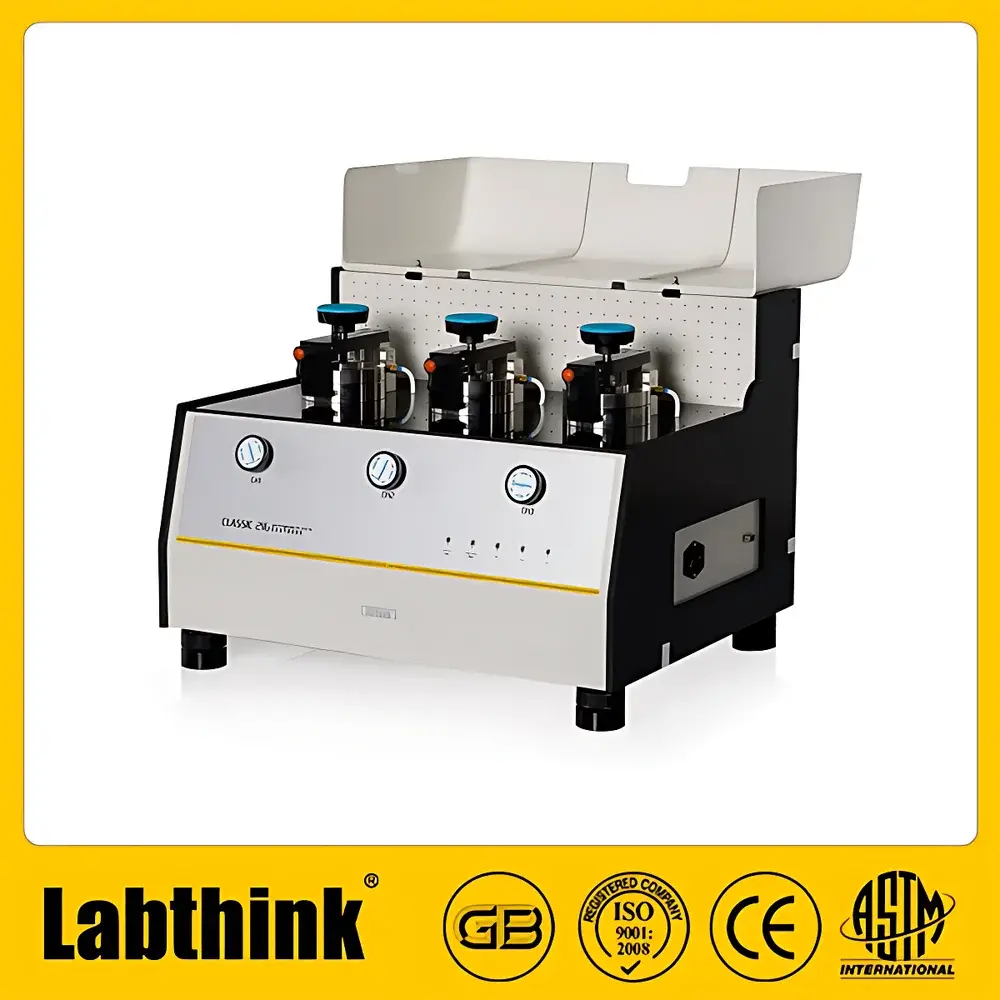
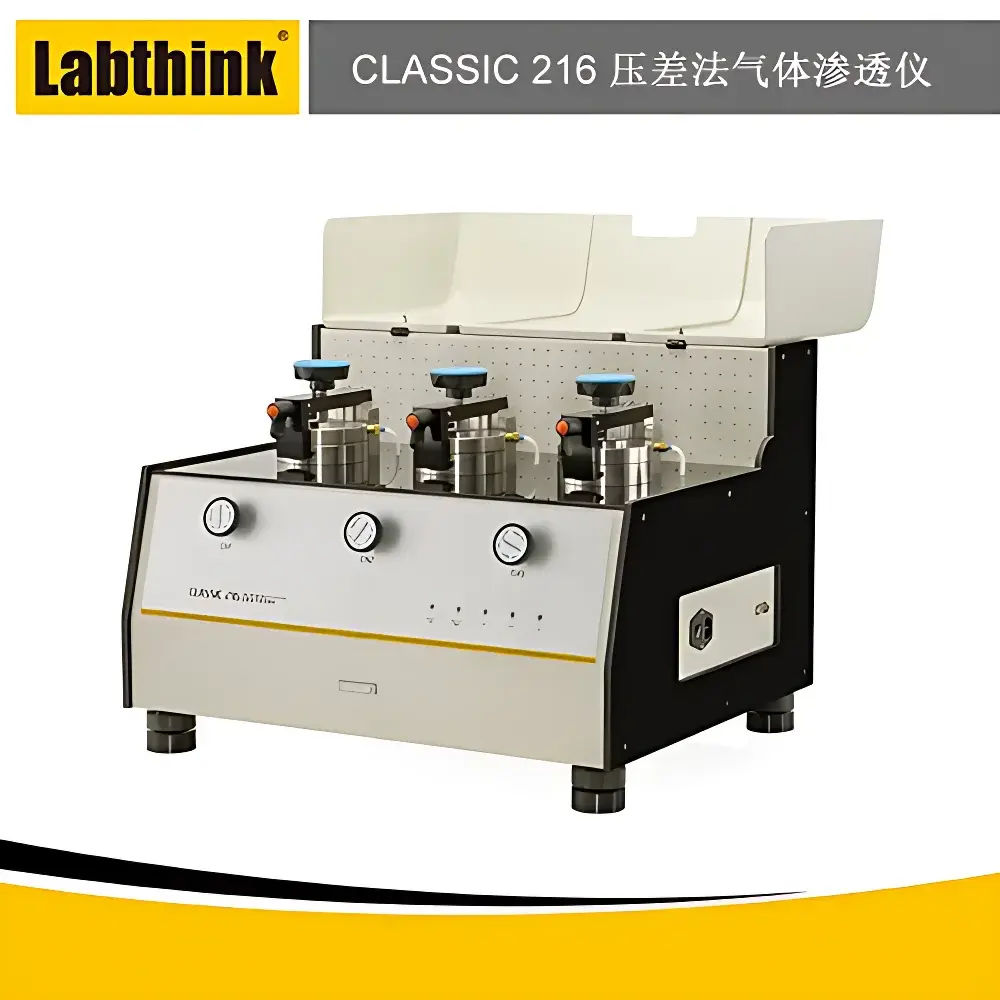
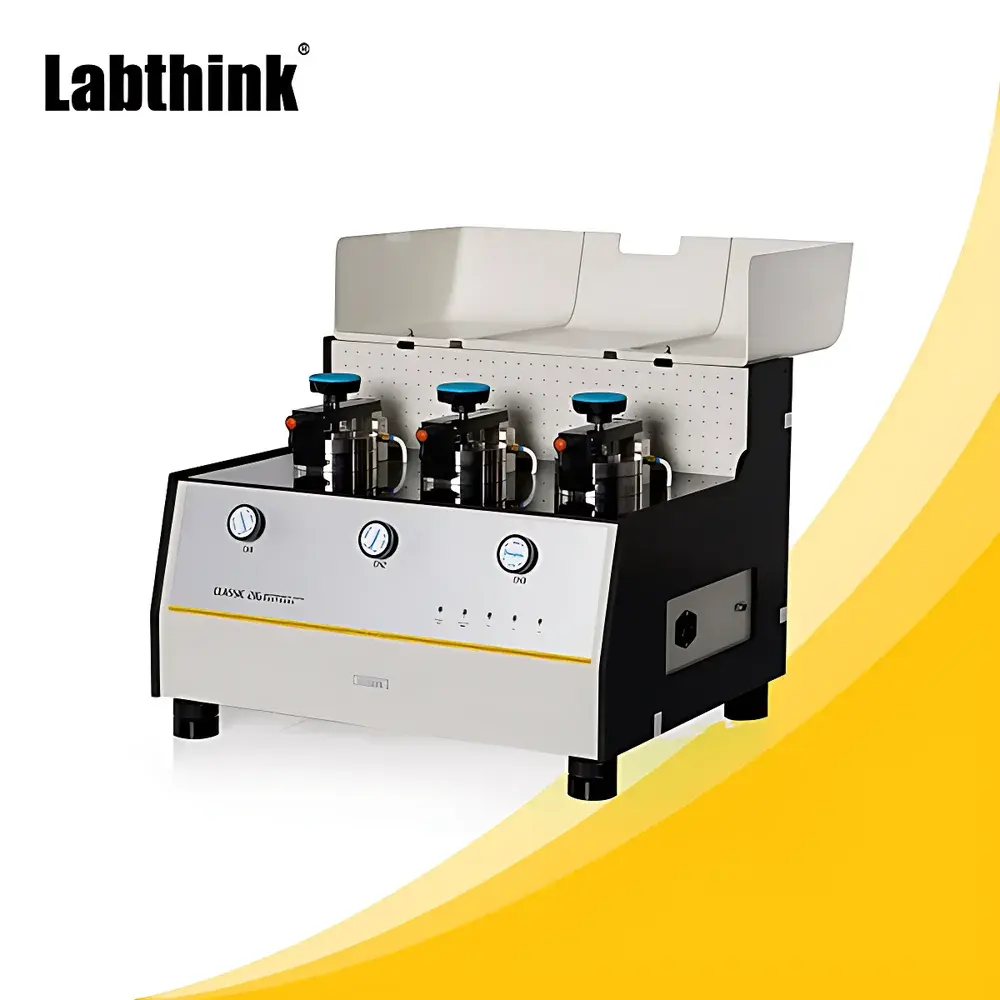
Labthink CLASSIC216 Differential-Pressure Method Gas Permeability Analyzer
| Brand | Labthink |
|---|---|
| Origin | Shandong, China |
| Manufacturer Type | Manufacturer |
| Country of Origin | China |
| Model | CLASSIC216 |
| Price Range | USD 14,000 – 85,000 |
| Test Gases | O₂, CO₂, N₂, Air, He, H₂, CH₄ |
| Test Range | 0.1–50,000 cm³/m²·24h·0.1MPa (standard) |
| Specimen Count | 3 independent chambers |
| Vacuum Resolution | 0.1 Pa |
| Chamber Vacuum Level | <20 Pa |
| Temperature Control Range | 15–55 °C (external chiller/heater required) |
| Humidity Control Options | 0% RH, 100% RH, or intermediate levels per ASTM E104 (humidity generator optional) |
| Specimen Diameter | Φ97 mm |
| Effective Test Area | 38.48 cm² |
| Test Pressure Differential | −0.1 to +0.1 MPa |
| Supply Gas Pressure | 0.4–0.6 MPa |
| Interface | Φ6 mm polyurethane tubing |
| Dimensions | 670 × 540 × 430 mm (L×W×H) |
| Weight | 75 kg |
| Power | AC 220 V / 50 Hz or AC 120 V / 60 Hz |
Overview
The Labthink CLASSIC216 Differential-Pressure Method Gas Permeability Analyzer is an engineered precision instrument designed for quantitative determination of gas transmission rates (GTR), permeability coefficients (P), diffusion coefficients (D), and solubility coefficients (S) in barrier materials. It operates on the fundamental principle of steady-state gas permeation driven by a controlled pressure differential across a planar specimen—commonly referred to as the manometric or pressure-difference method. This technique conforms to Fick’s first law of diffusion and is widely accepted for its thermodynamic rigor and reproducibility in regulatory and industrial quality control environments. The system maintains a high-vacuum reference chamber (lower cavity) while pressurizing the upper cavity with a defined test gas, thereby establishing a constant transmembrane partial pressure gradient. Real-time monitoring of pressure rise in the evacuated lower chamber enables calculation of gas flux, from which all derived barrier parameters are computed using standardized physical models.
Key Features
- Triple independent test chambers enable concurrent evaluation of three specimens—identical or dissimilar—without cross-contamination or interference, significantly improving throughput for comparative studies or batch validation.
- High-resolution vacuum sensing (0.1 Pa) and stable sub-20 Pa base vacuum level ensure accurate detection of minute gas influx, critical for ultra-high-barrier materials such as AlOx-coated PET or SiOx-laminated films.
- Dual-mode process logic—proportional control and fuzzy inference—optimizes test initiation and endpoint detection under variable permeation kinetics, minimizing operator-dependent variability.
- Modular thermal and humidity conditioning architecture supports integration with external temperature-controlled baths (15–55 °C range) and ASTM E104-compliant humidity generators, enabling full environmental parameter mapping per ISO 15105-1 Annex B.
- Scalable measurement range extends from ultra-low permeability (500,000 cm³/m²·24h·0.1MPa) via optional volumetric expansion kits—essential for R&D on biodegradable polymers or porous packaging substrates.
- Pre-installed calibration routines with certified reference membranes (e.g., NIST-traceable low-density polyethylene standards) ensure inter-laboratory data comparability and support audit readiness for GLP/GMP compliance.
Sample Compatibility & Compliance
The CLASSIC216 accommodates rigid and flexible planar specimens up to Φ97 mm diameter and 38.48 cm² effective test area. It is validated for use with plastic films (e.g., PET, OPP, PA), metallized and oxide-coated laminates, aluminum foil and foil composites, rubber sheets, engineering thermoplastics (PP, PVC, PVDC), paperboard, and bio-based matrices including starch-PLA blends and cellulose derivatives. All operational protocols align with internationally harmonized standards: ISO 15105-1 (plastics—determination of gas transmission rate—part 1: differential pressure method), ISO 2556 (gas transmission rate of plastics film and sheeting), ASTM D1434 (standard test method for determining gas permeability characteristics), JIS K7126-1 (plastic films—determination of gas permeability), GB/T 1038-2000 (Chinese national standard for plastic film gas permeability), and YBB 00082003-2015 (Chinese pharmaceutical packaging standard). Data acquisition and reporting modules comply with FDA 21 CFR Part 11 requirements when configured with electronic signature and audit trail functionality.
Software & Data Management
Control and analysis are executed via Labthink’s proprietary PermeData™ software suite, running on Windows-based host computers. The interface provides real-time graphical visualization of pressure vs. time curves, automatic baseline correction, non-linear regression fitting for transient-phase analysis, and multi-point Arrhenius modeling for temperature-dependent permeability extrapolation. All raw sensor outputs—including vacuum transducer readings, temperature logs, and valve actuation timestamps—are stored in encrypted binary archives with SHA-256 checksums. Export options include CSV, PDF test reports with embedded metadata (operator ID, calibration certificate ID, environmental log), and XML formats compatible with LIMS integration. Audit trails record every user action—including method edits, result overrides, and calibration events—with immutable timestamps and operator authentication.
Applications
- Regulatory Packaging Qualification: Oxygen transmission rate (OTR) verification for sterile medical device pouches (ISO 11607-1), pharmaceutical blister lidding foils (YBB 00082003), and child-resistant closures per USP <671>.
- Food Shelf-Life Modeling: CO₂ permeability assessment of modified atmosphere packaging (MAP) films used in meat, cheese, and baked goods applications to predict microbial stability and package integrity.
- Material Development: Diffusion coefficient profiling of nanocomposite films containing clay, graphene, or MOFs; comparative evaluation of deposition techniques (sputtering, ALD, plasma polymerization).
- Sustainability Assessment: Quantitative permeability benchmarking of compostable films (e.g., PHA, PBAT blends) against conventional PET or PP under identical climatic conditions.
- Failure Analysis: Root-cause investigation of seal integrity loss, coating delamination, or pinhole-induced permeation spikes in roll-to-roll converted flexible packaging.
FAQ
What gases can be tested with the CLASSIC216?
Oxygen (O₂), nitrogen (N₂), carbon dioxide (CO₂), air, helium (He), hydrogen (H₂), and methane (CH₄) are supported. Gas purity and supply pressure (0.4–0.6 MPa) must meet ISO 8573-1 Class 2 requirements.
Is temperature and humidity control included in the base configuration?
No. Precise thermal regulation (15–55 °C) requires an external recirculating chiller/heater unit; humidity control (0–100% RH) necessitates an optional ASTM E104-compliant humidity generator.
How is system calibration performed?
Using certified reference membranes traceable to national metrology institutes. The software guides users through automated zero-point and span calibration routines with built-in uncertainty propagation reporting.
Can the instrument validate compliance with FDA 21 CFR Part 11?
Yes—when deployed with PermeData™ v4.2+ and configured with role-based access control, electronic signatures, and full audit trail logging, it meets predicate rule requirements for electronic records and signatures.
What maintenance is required for long-term accuracy?
Annual verification of vacuum transducer linearity, quarterly replacement of vacuum pump oil and filter elements, and semi-annual re-greasing of sealing surfaces with fluorinated vacuum grease (included in standard kit).





