
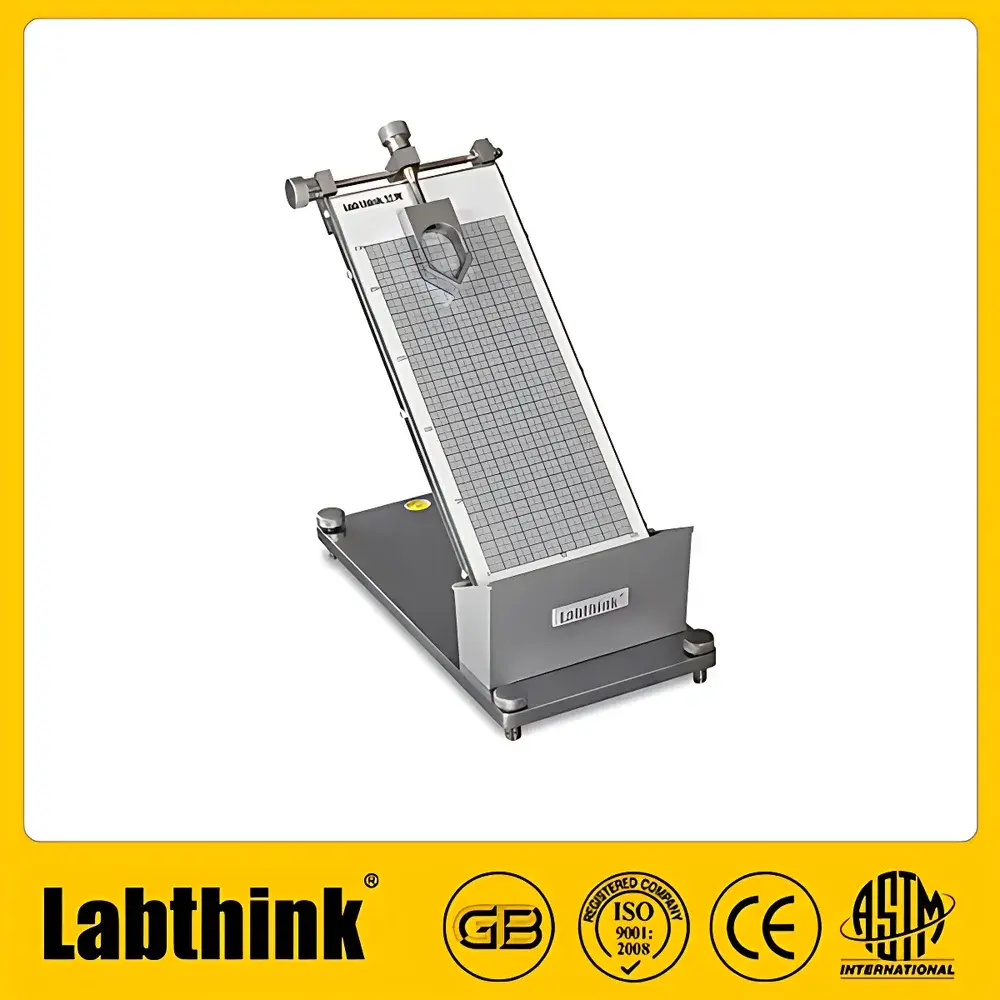
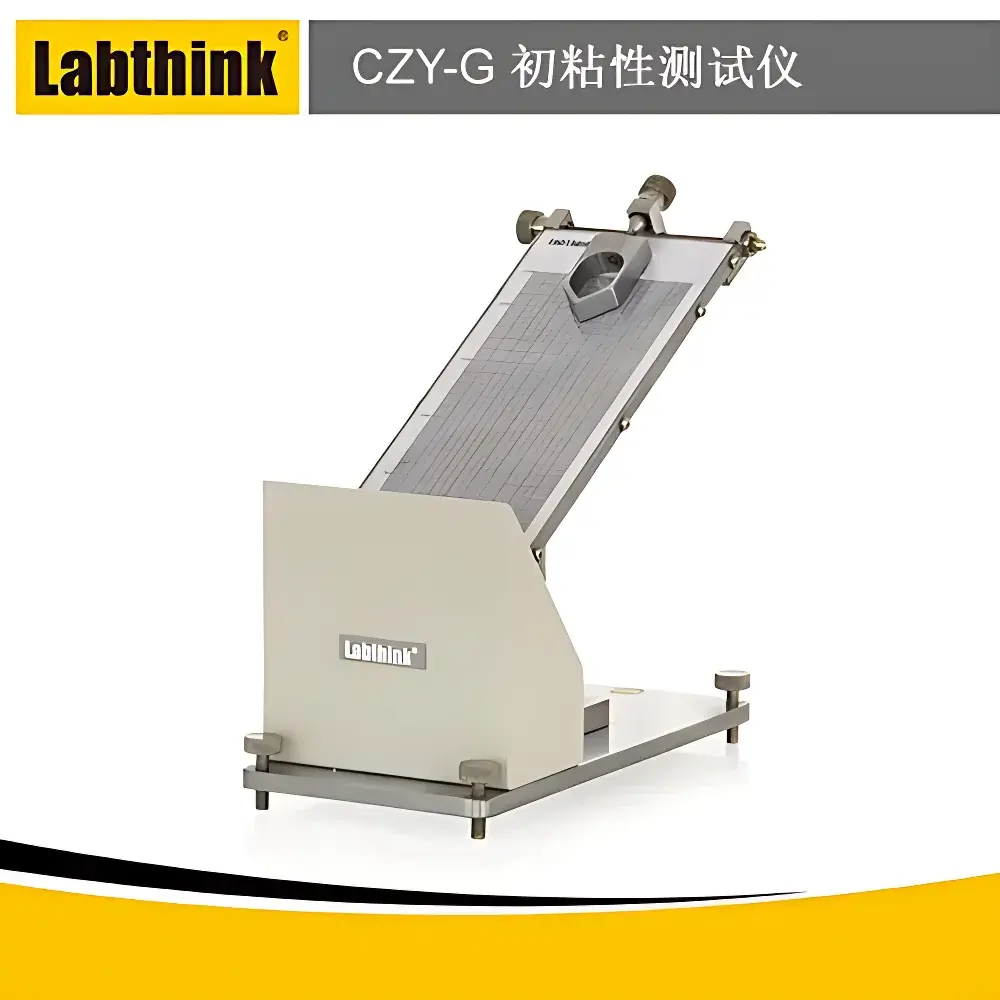
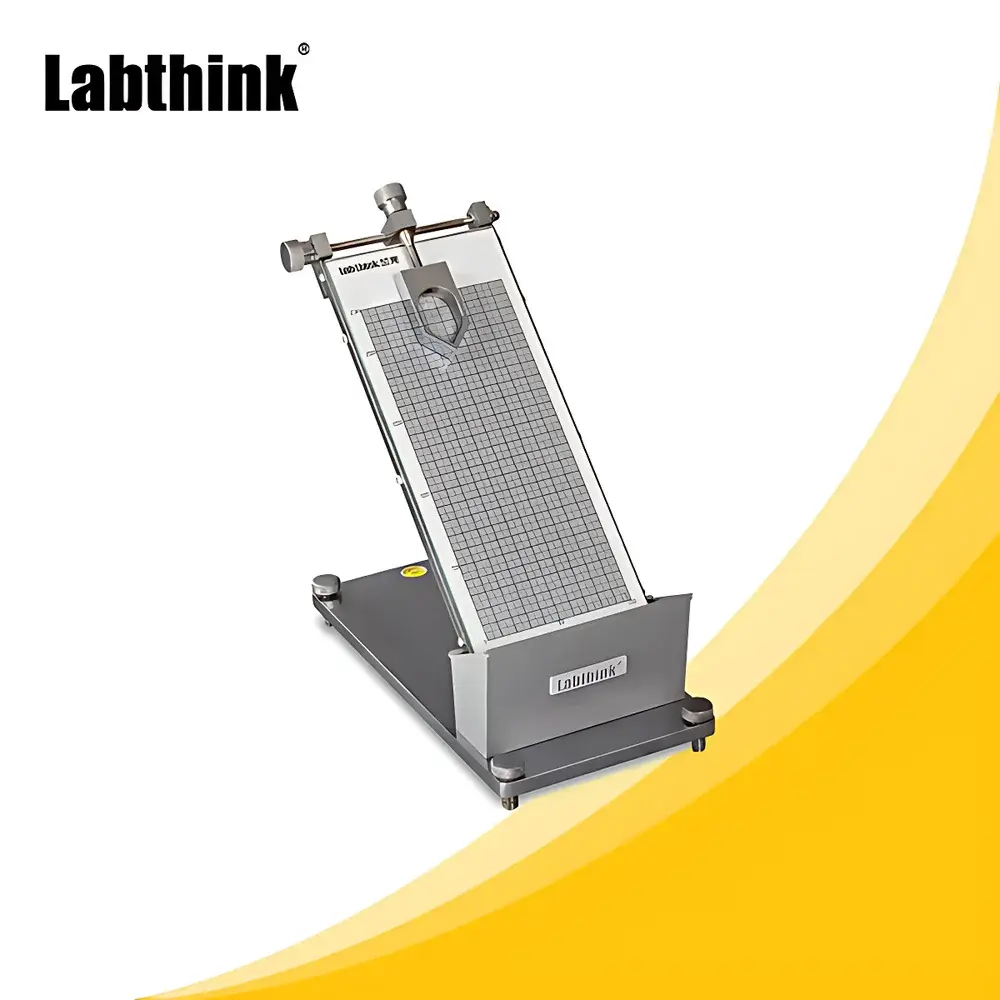
Labthink CYZ-G Initial Adhesion Tester (Steel Ball Rolling Method)
| Brand | Labthink |
|---|---|
| Origin | Shandong, China |
| Manufacturer Type | Direct Manufacturer |
| Product Category | Domestic |
| Model | CYZ-G |
| Instrument Type | Initial Adhesion Tester |
| Adjustable Inclination Angle | 0–60° |
| Tabletop Width | 120 mm |
| Test Zone Width | 80 mm |
| Standard Steel Balls | 1/32″ to 1″ (0.794 mm to 25.4 mm) |
| Dimensions (L×W×H) | 320 × 140 × 180 mm |
| Net Weight | 6 kg |
| Compliance Standards | GB/T 4852, JIS Z 0237 |
Overview
The Labthink CYZ-G Initial Adhesion Tester is an engineered precision instrument designed for quantitative evaluation of the instantaneous tack—the initial adhesive bond formed upon brief, light contact—of pressure-sensitive adhesives (PSAs). It operates on the standardized inclined-plane steel ball rolling method, a widely accepted physical test principle in global adhesive quality control. In this method, a polished steel ball of defined diameter is released from rest at the top of an inclined plane onto the adhesive surface of a test specimen. The largest ball that does not roll off the adhesive zone within a specified observation time (typically 5 seconds) defines the “ball number,” which serves as a comparative index of initial tack. This principle relies on the balance between gravitational force component along the incline and the adhesive energy dissipated during transient contact—making the test highly sensitive to surface energy, viscoelastic relaxation, and interfacial wetting behavior of PSAs.
Key Features
- Adjustable inclination angle (0° to 60°) enables method flexibility across material classes—from low-tack protective films to high-energy medical adhesives—while maintaining compliance with standardized test conditions.
- Optimized test zone geometry (80 mm width) ensures consistent ball trajectory and minimizes edge effects, supporting repeatable placement and alignment per ASTM D3121 and ISO 29651 guidance.
- Full set of traceable, hardened steel calibration balls (1/32″ to 1″; i.e., 0.794 mm to 25.4 mm diameter) conforms to dimensional tolerances specified in GB/T 4852 and JIS Z 0237, ensuring metrological integrity across laboratories.
- Robust aluminum alloy frame with anti-slip base provides mechanical stability during ball release and rolling phases, reducing vibration-induced measurement variance.
- Compact footprint (320 × 140 × 180 mm) and lightweight design (6 kg net weight) facilitate integration into QC labs, R&D workbenches, or mobile testing stations without requiring dedicated anchoring or environmental conditioning.
Sample Compatibility & Compliance
The CYZ-G accommodates flat, flexible substrates including acrylic- and rubber-based pressure-sensitive tapes, silicone-coated release liners, polyolefin-based protective films, hydrocolloid wound dressings, transdermal patches, and energy-efficient appliance labeling films. Specimens are mounted on a rigid backing plate using standardized clamping to eliminate substrate deformation during ball impact. The instrument fulfills essential requirements of GB/T 4852–2002 “Test Method for Initial Tack of Pressure-Sensitive Adhesive Tapes” and JIS Z 0237:2019 “Methods of Test for Pressure-Sensitive Adhesive Tapes.” While not a regulatory device per se, its mechanical configuration and operational protocol align with the physical test parameters referenced in ISO 29651 (adhesive tack measurement), FDA guidance for medical adhesive characterization, and internal SOPs for GLP-compliant adhesive development workflows.
Software & Data Management
The CYZ-G is a manually operated mechanical tester with no embedded electronics or digital interface. All measurements are recorded visually and documented in laboratory notebooks or LIMS-compatible spreadsheets. This analog architecture eliminates software validation requirements under FDA 21 CFR Part 11 while ensuring long-term operational reliability, minimal maintenance, and full transparency in result derivation. Users are advised to implement controlled documentation practices—including operator ID, ambient temperature/humidity (recommended: 23 ± 2°C, 50 ± 5% RH), substrate lot number, and ball serial traceability—to support audit readiness for ISO 9001, IATF 16949, or pharmaceutical GMP environments.
Applications
- Quality assurance of PSA-coated labels used on refrigerators, air conditioners, and other energy-rated white goods—ensuring label retention during transport and installation without residue.
- Formulation screening of acrylic copolymer dispersions during R&D, where incremental changes in monomer ratio or crosslink density directly influence ball-number outcomes.
- Batch-to-batch consistency verification for medical-grade silicone adhesives used in wearable sensors and ECG electrodes, where tack must balance skin adherence with pain-free removal.
- Supplier qualification of release liner systems, where low initial tack on the silicone side correlates with clean delamination performance in automated assembly lines.
- Educational use in polymer science laboratories to demonstrate the empirical relationship between viscoelastic time–temperature superposition and macroscopic tack behavior.
FAQ
What standards does the CYZ-G comply with?
It is fully aligned with GB/T 4852–2002 and JIS Z 0237:2019 for initial tack measurement using the inclined steel ball method.
Is calibration certification provided with the steel ball set?
Each ball set includes a dimensional verification report traceable to national metrology institutes; users should retain this documentation for internal calibration records.
Can the instrument be used for non-standard ball sizes?
Only certified balls within the 1/32″–1″ range are recommended; deviation compromises comparability with published data and standard-conforming results.
What environmental conditions are required for valid testing?
Testing shall be conducted in a conditioned room at 23 ± 2°C and 50 ± 5% RH per GB/T 2918, with specimens acclimated for ≥2 hours prior to test.
Does Labthink offer training or application support?
Yes—Labthink provides technical documentation, video-based operating procedures, and remote application consultation for method transfer and troubleshooting.



