
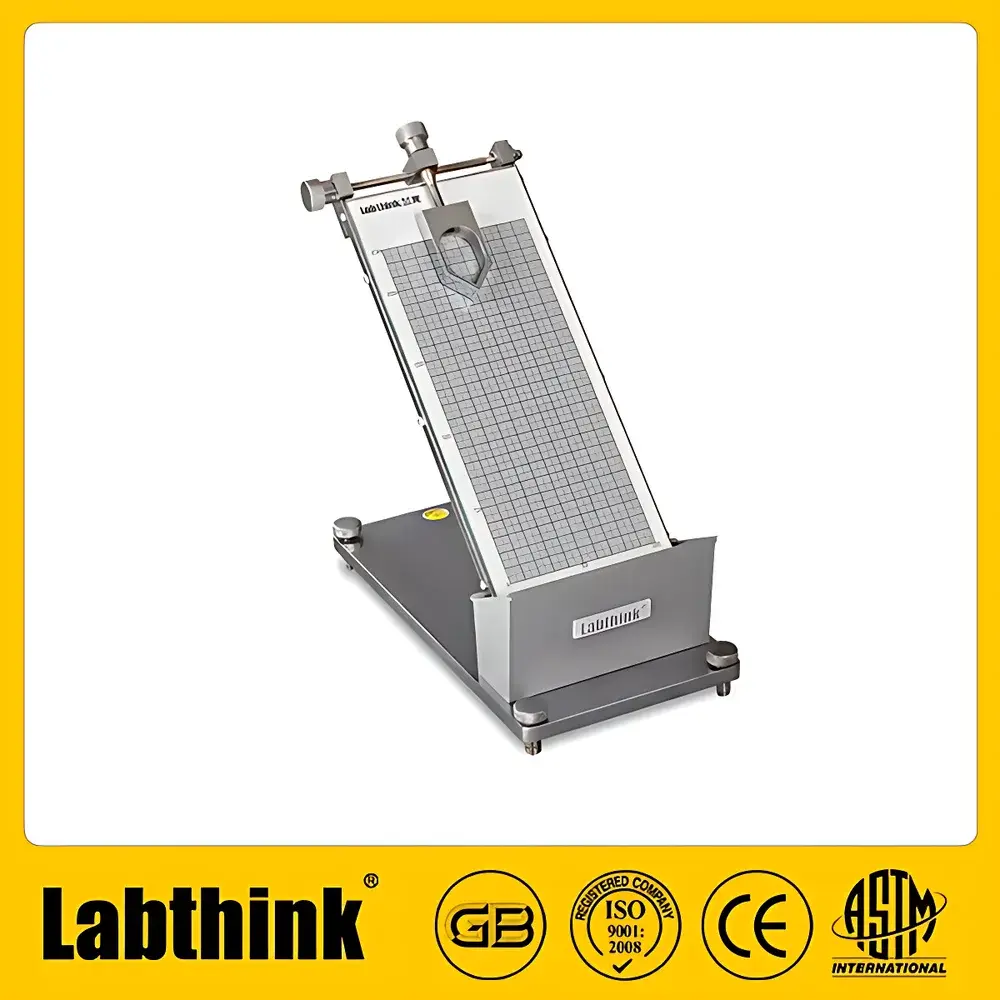
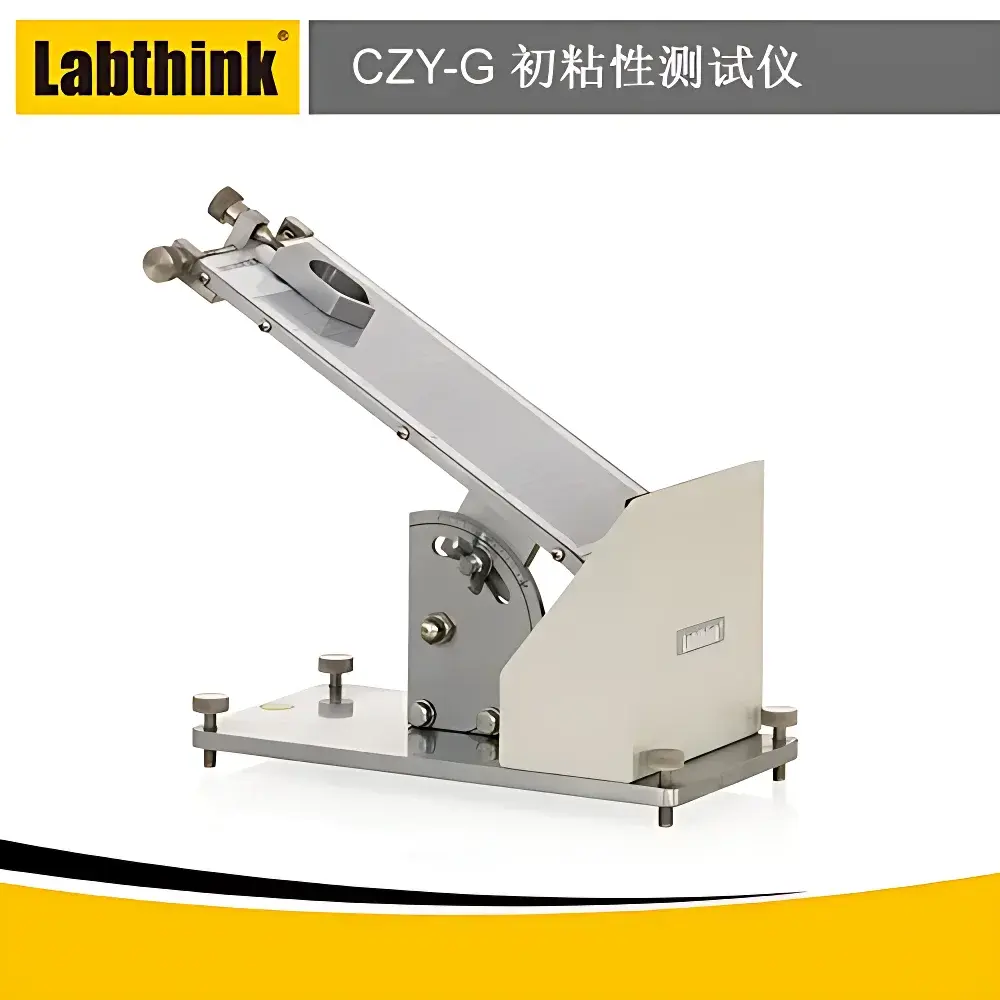
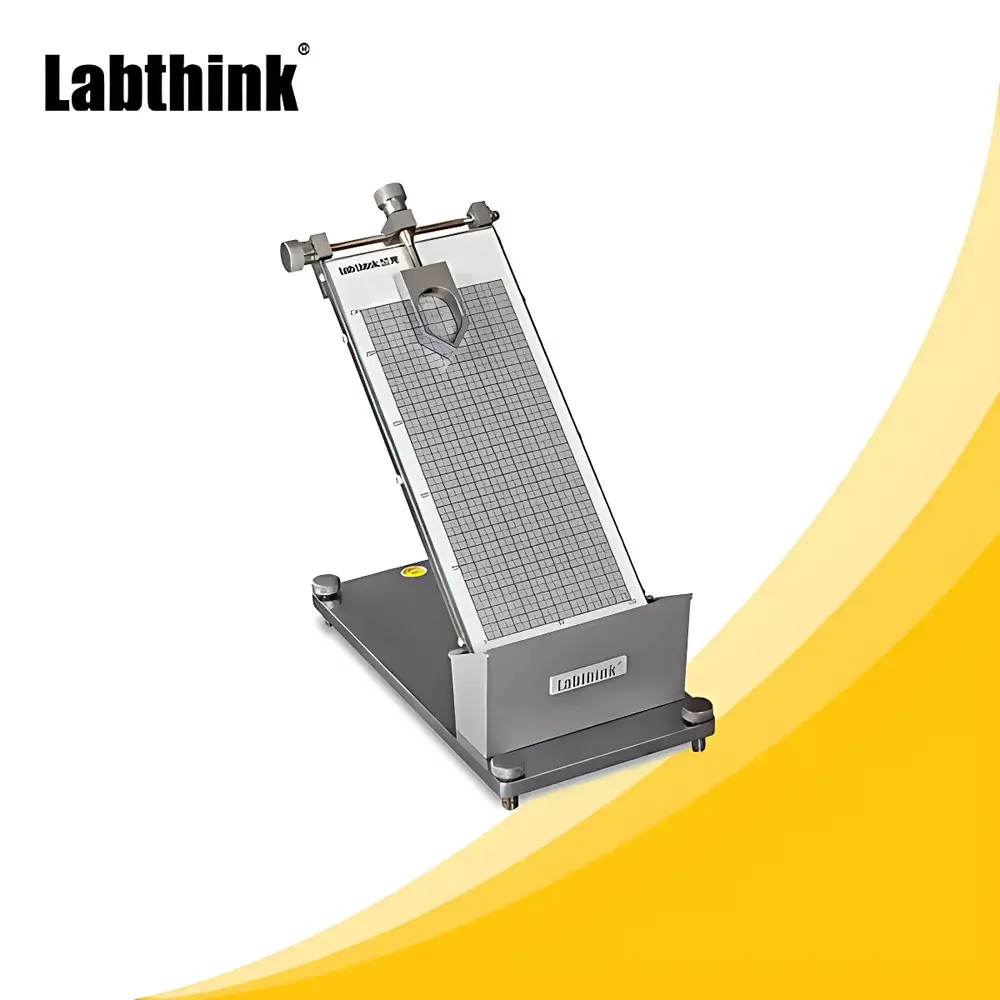
Labthink CZY-G Initial Adhesion Tester (Rolling Ball Method, Compliant with GB/T 4852)
| Brand | Labthink |
|---|---|
| Model | CZY-G |
| Origin | Shandong, China |
| Manufacturer Type | Direct Manufacturer |
| Instrument Category | Initial Adhesion Tester |
| Adjustable Inclination Angle | 0–60° |
| Test Surface Width | 120 mm |
| Effective Test Zone Width | 80 mm |
| Standard Steel Balls | 1/32″ to 1″ (0.794 mm to 25.4 mm) |
| Dimensions (L×W×H) | 320 × 140 × 180 mm |
| Net Weight | 6 kg |
Overview
The Labthink CZY-G Initial Adhesion Tester is an engineered precision instrument designed for quantitative evaluation of the initial tack—the instantaneous adhesive force developed upon brief, light contact—of pressure-sensitive adhesives (PSAs). It operates strictly in accordance with the rolling ball method specified in GB/T 4852–2002, the Chinese national standard equivalent to ASTM D3121 and closely aligned with ISO 8510-1 for preliminary tack assessment. The principle relies on controlled gravitational acceleration of standardized steel spheres down an inclined plane onto the adhesive surface; the largest ball that fails to roll off within a defined distance (typically 100 mm) is recorded as the “tack index,” providing a comparative, reproducible metric for batch-to-batch consistency and formulation screening. This method is widely accepted in R&D labs, QC departments, and regulatory submission dossiers for medical adhesives, labeling films, protective masking tapes, and transdermal patch substrates.
Key Features
- Continuously adjustable inclination angle from 0° to 60°, enabling fine-tuned sensitivity across low- to high-tack formulations.
- Rigid aluminum alloy frame with precision-machined stainless-steel test ramp, ensuring long-term dimensional stability and resistance to environmental drift.
- Calibrated steel ball set compliant with GB/T 4852 specifications (diameters ranging from 1/32″ to 1″), traceable to NIM (National Institute of Metrology, China) standards.
- Defined test zone width of 80 mm ensures uniform application of contact pressure and eliminates edge effects during ball release.
- Compact benchtop footprint (320 × 140 × 180 mm) optimized for integration into regulated laboratory workflows without requiring dedicated floor space.
- No electronic sensors or software dependency—mechanical design ensures intrinsic reliability, minimal maintenance, and full auditability under GLP/GMP environments.
Sample Compatibility & Compliance
The CZY-G accommodates flat, flexible PSA-coated substrates up to 120 mm wide, including but not limited to acrylic- and rubber-based pressure-sensitive tapes, silicone-release liners, medical-grade hydrocolloid films, PET/PE protective films, and paper-based self-adhesive labels. Samples are mounted on the horizontal base plate using double-sided tape or vacuum fixation (optional accessory), ensuring consistent positioning and eliminating slippage during testing. The instrument meets the physical configuration and procedural requirements of GB/T 4852–2002, and its operational methodology is recognized by regulatory reviewers evaluating adhesive performance data for Class I/II medical devices (per YY/T 0148) and packaging validation per GB/T 19633. While not an electronic data logger, its manual protocol supports full traceability when documented within a validated SOP framework compliant with ISO/IEC 17025 and FDA 21 CFR Part 11 Annex 11 expectations for paper-based records.
Software & Data Management
The CZY-G is a purely mechanical tester with no embedded firmware, touchscreen interface, or digital output. All measurements are recorded manually in laboratory notebooks or LIMS-integrated spreadsheets. This architecture eliminates cybersecurity risks, software validation burdens, and calibration drift associated with sensor-based systems. Users maintain full control over data entry, unit conversion (e.g., ball diameter to nominal tack grade), and statistical analysis (e.g., mean tack index ± SD across n=3 replicates per lot). For laboratories implementing electronic records, Labthink provides a companion Test Procedure Template (SOP-CZY-G-01) and Raw Data Sheet (Form ADH-02), both structured to support ALCOA+ principles (Attributable, Legible, Contemporaneous, Original, Accurate, Complete, Consistent, Enduring, Available) during internal audits or regulatory inspections.
Applications
- Quality control of incoming raw materials (e.g., PSA-coated jumbo rolls prior to slitting).
- Formulation development of new adhesive chemistries—tracking tack evolution during monomer selection or crosslinker optimization.
- Stability studies assessing tack loss after accelerated aging (40°C/75% RH, 6 months) per ISO 11607-1.
- Comparative benchmarking against competitor products using identical test conditions and ball sets.
- Supporting technical documentation for CE marking submissions under MDR Annex I General Safety and Performance Requirements (GSPR 10.2.1 – adhesion performance).
- Validation of cleaning efficacy on adhesive residues—measuring residual tack post-solvent wipe.
FAQ
Is the CZY-G compliant with international standards beyond GB/T 4852?
Yes—the rolling ball method implemented aligns technically with ASTM D3121 (Standard Test Method for Rubber Property—Tack by Rolling Ball) and ISO 8510-1 (Adhesives—Determination of Tack—Part 1: Rolling Ball Method), facilitating global data acceptance.
Can the instrument be used for non-standard ball sizes or custom inclinations?
While the calibrated ball set covers 1/32″ to 1″, users may introduce traceable, certified balls outside this range for internal R&D; however, results would be considered non-standard and require method validation per ICH Q2(R2).
Does Labthink offer IQ/OQ documentation for the CZY-G?
Yes—upon request, Labthink supplies a vendor-provided Installation Qualification (IQ) checklist and Operational Qualification (OQ) protocol template, fully editable for site-specific execution under GMP/GLP frameworks.
What maintenance is required?
Routine cleaning of the ramp surface with isopropyl alcohol and visual inspection of ball sphericity and surface finish every 500 tests; no scheduled recalibration is mandated per GB/T 4852, though annual metrological verification of ball diameters is recommended.



