


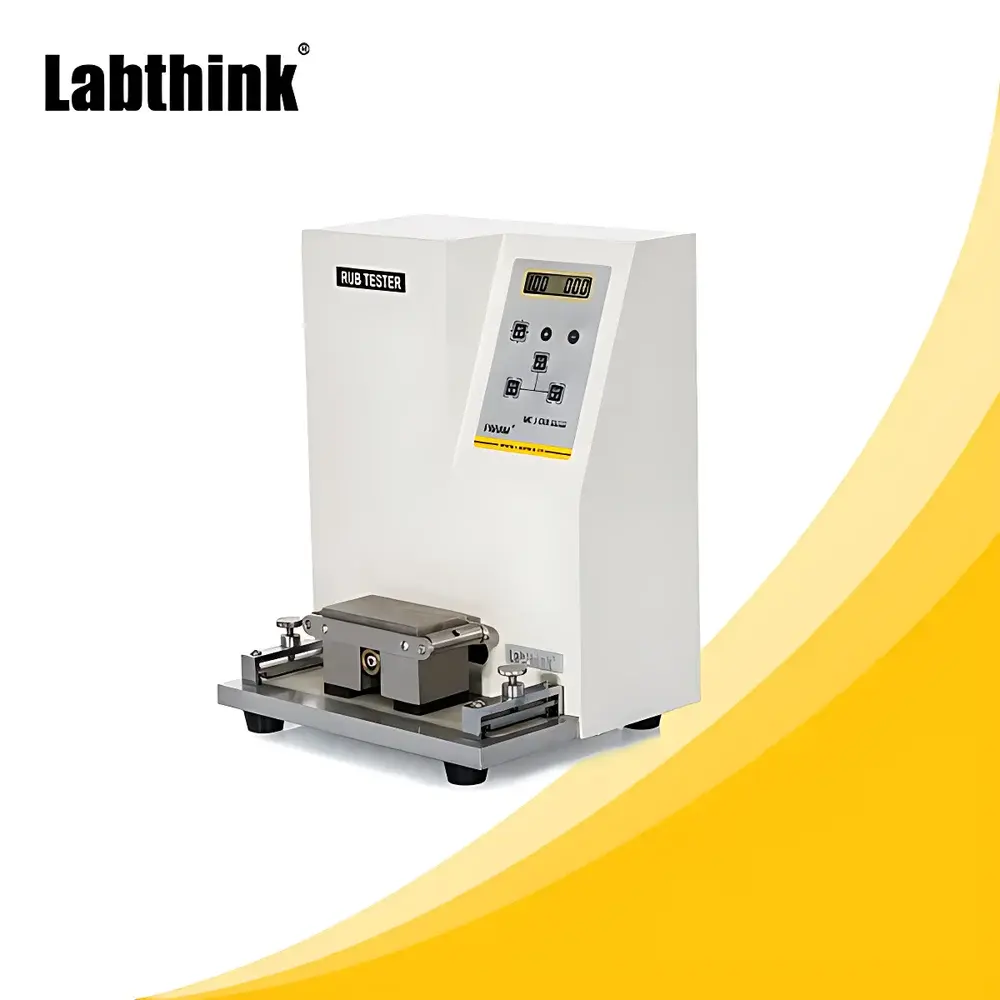
Labthink MCJ-01A GB/T 7706 Ink Abrasion Tester for Flexographic & Letterpress Printing
| Key | Brand: Labthink |
|---|---|
| Model | MCJ-01A |
| Origin | Shandong, China |
| Manufacturer Type | Direct Manufacturer |
| Compliance Standard | GB/T 7706 |
| Applied Load | 20 ± 0.2 N |
| Stroke Frequency | 43 cycles per minute (cpm) |
| Abrasion Area | 155 mm (L) × 50 mm (W) |
| Cycle Count Range | 0–999 |
| Specimen Size | 230 mm (L) × 50 mm (W) |
| Power Supply | 220 VAC, 50 Hz / 120 VAC, 60 Hz |
| Dimensions (L×W×H) | 260 × 230 × 360 mm |
| Net Weight | 22 kg |
Overview
The Labthink MCJ-01A GB/T 7706 Ink Abrasion Tester is a precision-engineered instrument designed specifically for evaluating the mechanical durability of ink layers in flexographic and letterpress printing applications. It operates on the principle of controlled linear reciprocation under standardized normal load, simulating real-world handling, stacking, and transportation stresses that printed materials undergo during distribution and end-use. The device conforms strictly to the Chinese national standard GB/T 7706—“Test Method for Abrasion Resistance of Ink Layer on Flexographic and Letterpress Printed Materials”—which defines the test geometry, loading conditions, motion profile, and evaluation criteria for quantifying ink rub resistance. Unlike generic abrasion testers, the MCJ-01A integrates a cam-driven reciprocating mechanism powered by a high-precision electronic speed-controlled motor, ensuring consistent stroke frequency (43 cpm), uniform contact pressure (20 ± 0.2 N), and repeatable travel path across the full 155 mm × 50 mm abrasion zone. Its fully enclosed friction platform eliminates acoustic interference and ensures operator safety during extended testing sessions.
Key Features
- Microprocessor-based control system with integrated LCD display and tactile PVC membrane keypad for intuitive parameter input and real-time cycle monitoring
- Embedded standardized abrasion stage with precisely aligned guide rails and low-friction linear bearings to maintain constant stroke amplitude and minimize mechanical hysteresis
- Zero-noise operation enabled by optimized cam kinematics and vibration-damped housing construction
- Power-loss memory function: automatically retains set cycle count and operational state upon unexpected power interruption, preventing data loss and retest redundancy
- Dual-voltage compatibility (220 VAC/50 Hz and 120 VAC/60 Hz) for seamless deployment in global laboratory environments without external transformers
- Compact benchtop footprint (260 × 230 × 360 mm) with rigid steel frame and anti-slip rubber feet for stable positioning on ISO-compliant lab benches
Sample Compatibility & Compliance
The MCJ-01A accommodates flat, rigid, or semi-rigid substrates up to 230 mm in length and 50 mm in width—including coated paper, corrugated board, plastic films, metalized foils, and photopolymer printing plates (e.g., PS plates). It supports both qualitative assessment (e.g., visual grading of ink transfer onto white cotton cloth per GB/T 7706 Annex A) and semi-quantitative analysis when paired with spectrophotometric or densitometric post-test evaluation. The instrument meets essential metrological requirements outlined in JJF 1070–2005 (General Rules for Verification of Measuring Instruments) and is compatible with GLP-compliant documentation workflows. While GB/T 7706 is its primary reference standard, test protocols may be adapted—under validated conditions—to align with related international methods such as ISO 11664-6 (colorimetry), ASTM D523 (gloss), or TAPPI T479 (rub resistance of printed surfaces), provided deviations are documented and justified per ISO/IEC 17025 clause 7.2.2.
Software & Data Management
The MCJ-01A operates as a standalone hardware platform with no proprietary software dependency. All test parameters and cycle counts are stored locally in non-volatile memory and displayed directly on the front-panel LCD. For laboratories requiring digital traceability, Labthink provides optional RS-232 serial interface (standard) and USB-to-serial adapter support, enabling integration with third-party LIMS or custom Python/Excel-based logging tools. Audit trails—including date/time stamps, operator ID fields (via manual entry), and cycle completion flags—can be exported in CSV format. The device supports 21 CFR Part 11–compliant configurations when deployed with validated electronic record systems; however, signature capture and user authentication must be implemented at the host application level, not within the instrument firmware.
Applications
- Quality assurance of flexographic and letterpress ink formulations for food packaging, pharmaceutical cartons, and label stock
- Evaluation of photopolymer plate durability (PS plates) during press run simulations
- Comparative screening of varnish, lacquer, and UV-curable overprint coatings for scuff resistance
- Root-cause analysis of print marring, ink rub-off, and substrate delamination in production troubleshooting
- Supplier qualification testing for ink vendors and coating material suppliers under contractual performance clauses
- Supporting R&D efforts in developing abrasion-resistant pigment dispersions and binder systems
FAQ
What standards does the MCJ-01A comply with?
It is engineered and verified to meet the technical requirements of GB/T 7706, the sole national standard governing ink abrasion testing for flexographic and letterpress printed materials in China.
Can the test load be adjusted?
No. The unit applies a fixed nominal load of 20 ± 0.2 N, as mandated by GB/T 7706. Load adjustment would invalidate conformance to the standard and compromise inter-laboratory reproducibility.
Is calibration certification included?
Each unit ships with a factory calibration report traceable to CNAS-accredited standards. Annual recalibration using certified dead-weight sets and calibrated tachometers is recommended per ISO/IEC 17025 Clause 6.4.
What maintenance is required?
Monthly inspection of cam follower lubrication, periodic cleaning of the abrasion track with isopropyl alcohol, and annual verification of stroke length and frequency using optical encoder validation tools.
Does it support automatic pass/fail judgment?
No. Pass/fail determination is based on visual or instrumental assessment of the abraded specimen post-test, per GB/T 7706 Section 6. The instrument itself performs only mechanical execution of the defined test protocol.






