
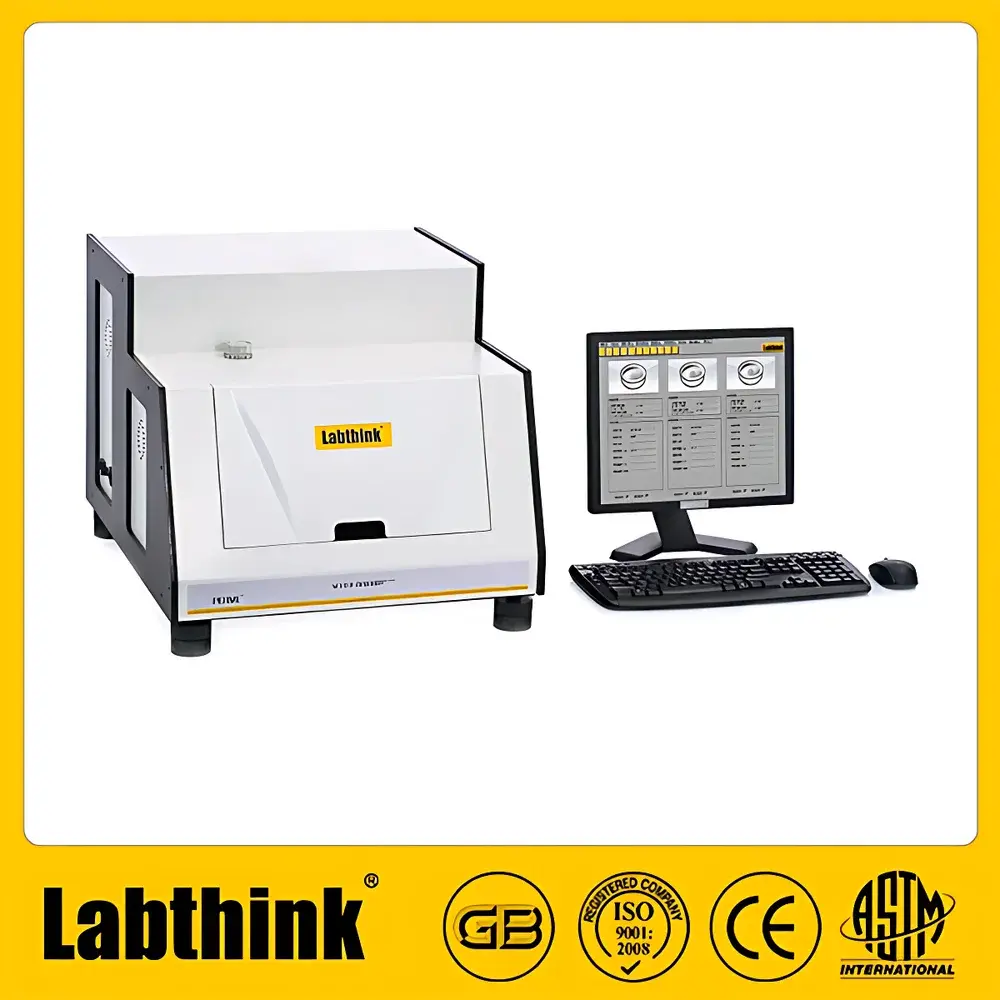
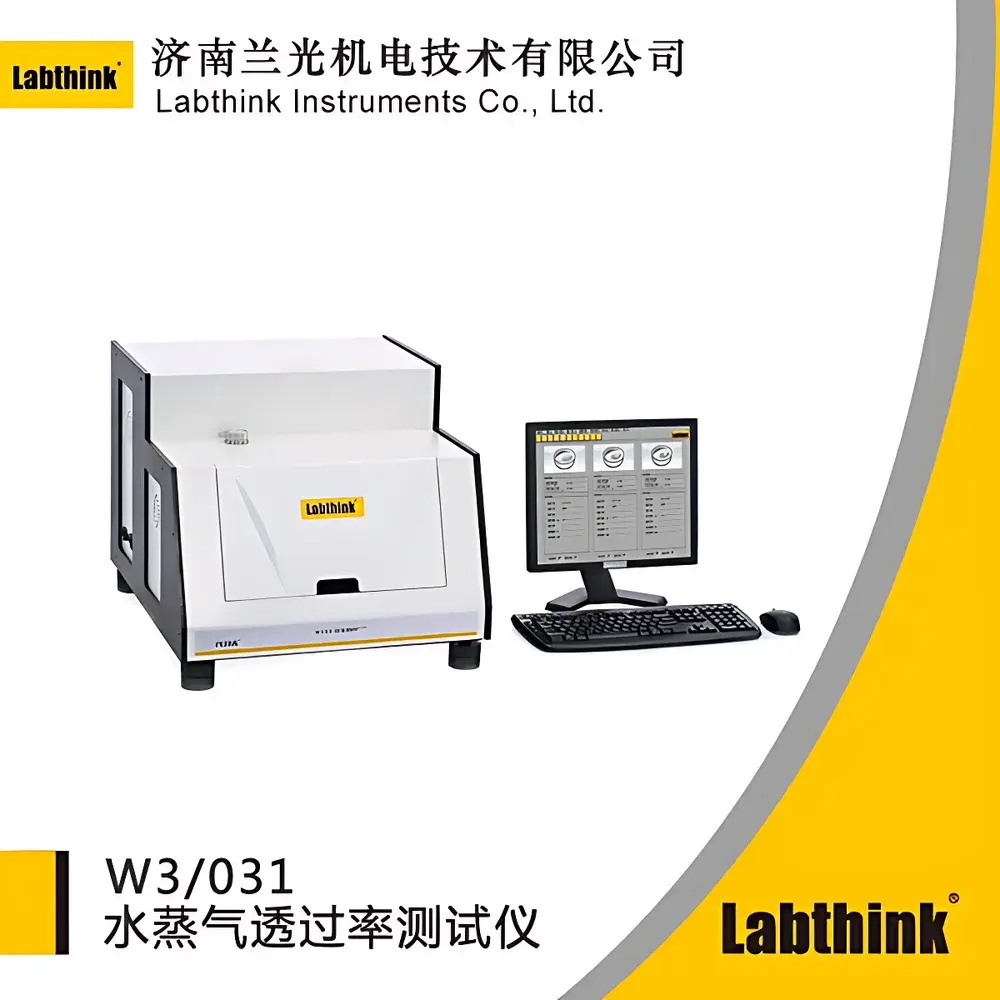
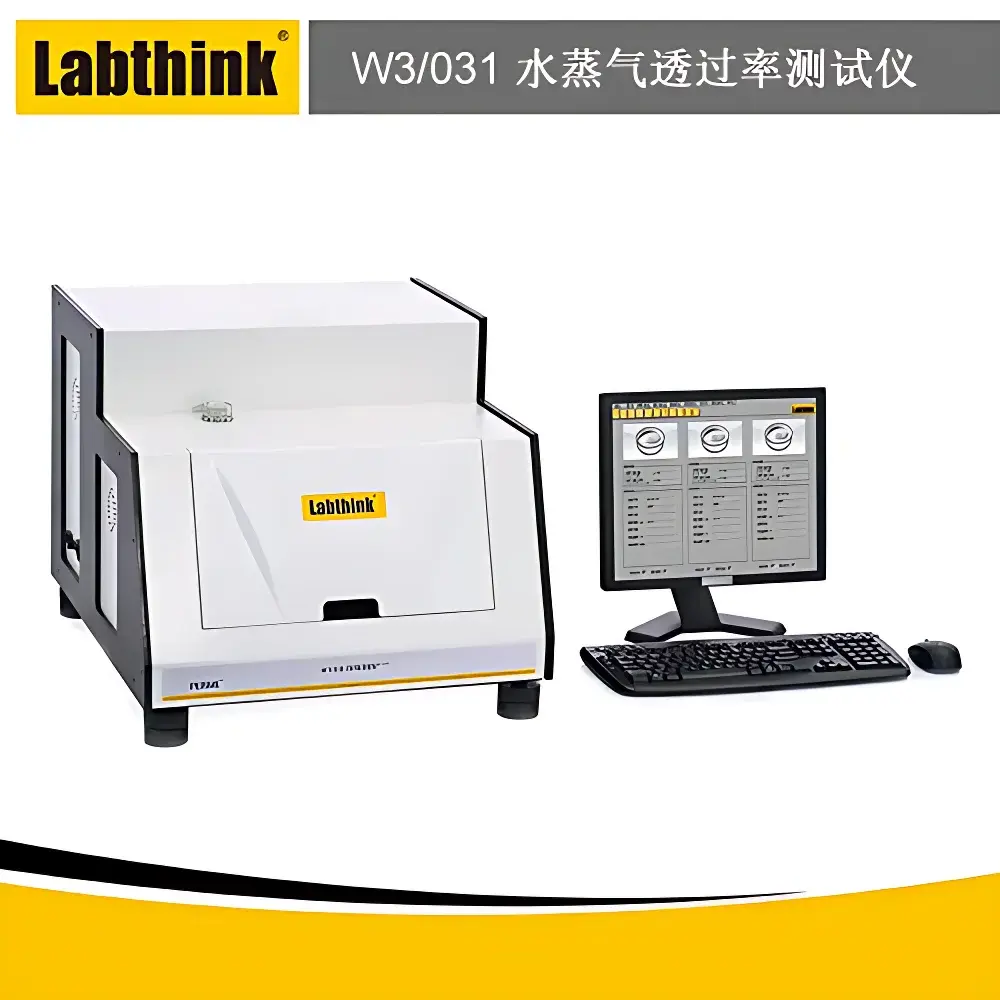
Labthink PERME W3/031 ASTM E96 Gravimetric Water Vapor Transmission Rate (WVTR) Tester
| Brand | Labthink |
|---|---|
| Model | PERME W3/031 |
| Principle | Gravimetric Cup Method |
| Standards | ASTM E96, ASTM D1653, ISO 2528, GB/T 1037, GB/T 16928, TAPPI T464, DIN 53122-1, JIS Z0208, YBB00092003 |
| Test Range | 0.1–10,000 g/m²·24h |
| Resolution | 0.0001 g |
| Accuracy | ±0.01 g/m²·24h |
| Temperature Control | 15–55 °C (±0.1 °C) |
| Humidity Control | 10–98% RH (±1% RH) |
| Sample Area | 33 cm² |
| Sample Thickness | ≤3 mm |
| Sample Diameter | Φ74 mm |
| Cup Quantity | 3 independent cups |
| Air Flow Velocity | 0.5–2.5 m/s |
| Chamber Volume | 27 L |
| Power Supply | 220 VAC 50 Hz / 120 VAC 60 Hz |
| Net Weight | 83 kg |
| Dimensions | 580 × 680 × 470 mm (L×W×H) |
Overview
The Labthink PERME W3/031 is a gravimetric water vapor transmission rate (WVTR) tester engineered for precision measurement of moisture barrier performance in flexible packaging materials, pharmaceutical blister foils, medical device pouches, and high-barrier films. It operates on the standardized cup method (ASTM E96 Procedure A & B), where a conditioned test specimen seals a desiccant- or water-filled permeation cup, establishing a defined vapor pressure gradient across the sample. Mass change of the cup is monitored continuously via high-resolution analytical balance integrated into a thermally and humidity-stabilized chamber. The system calculates WVTR (g/m²·24h) based on Fick’s first law of diffusion, with results traceable to NIST-calibrated reference masses and validated against certified standard membranes. Designed for compliance-critical environments, the W3/031 meets the physical and procedural requirements of ISO/IEC 17025-accredited laboratories and supports audit-ready documentation under FDA 21 CFR Part 11 when paired with Lystem™ software.
Key Features
- Triple independent test stations: Three sealed permeation cups operate simultaneously under identical environmental conditions, enabling parallel testing of up to three samples—each with fully autonomous data acquisition and result calculation.
- High-stability climate control: Dual-zone temperature and humidity regulation (15–55 °C; 10–98% RH) with ±0.1 °C thermal uniformity and ±1% RH humidity stability, verified per ASTM E2654 calibration protocols.
- Microgram-level mass resolution: Integrated 0.0001 g resolution balance with active drift compensation and anti-vibration isolation ensures reproducible gravimetric tracking over extended test durations (up to 168 h).
- Embedded industrial computing platform: Real-time Linux-based controller replaces legacy microcontroller architectures, delivering deterministic I/O response, synchronized sensor sampling, and secure local data buffering—even during network interruption.
- Modular gas handling system: Onboard air drying unit with dual-stage filtration (desiccant + particulate), adjustable laminar flow (0.5–2.5 m/s), and pressure-regulated supply (0.6 MPa) ensure consistent boundary layer conditions per ISO 2528 Annex A.
Sample Compatibility & Compliance
The W3/031 accommodates circular specimens up to Φ74 mm and thicknesses ≤3 mm—including oriented polypropylene (OPP), aluminum-laminated PET, SiOx-coated PET, cold-form foil, and hydrophilic hydrogels used in transdermal patches. All mechanical interfaces (cup sealing, sample clamping, weight suspension) conform to dimensional tolerances specified in ASTM E96 Section 7. Instrument validation follows IQ/OQ protocols aligned with ISO/IEC 17025:2017 Clause 6.5. Measurement uncertainty is quantified per GUM (JCGM 100:2008) and documented in the Certificate of Conformance supplied with each unit. Regulatory alignment includes full support for pharmaceutical packaging qualification per USP , FDA Guidance for Industry on Container Closure Systems, and EU Annex 1 requirements for sterile barrier validation.
Software & Data Management
Lystem™ v3.0 software provides role-based access control, electronic signatures, and ALCOA+ compliant data governance. All raw mass-vs.-time datasets are stored with immutable metadata (operator ID, environmental logs, calibration timestamps). Audit trails record every parameter modification, report generation, or user login—exportable as PDF/A-2 or CSV with digital signature embedding. When deployed on a secure LAN, Lystem™ enables centralized management across multiple W3/031 units via web-accessible dashboards, facilitating trend analysis, SPC charting, and automated report distribution to QMS platforms (e.g., TrackWise, MasterControl). Software validation packages (IQ/OQ/PQ) and 21 CFR Part 11 configuration files are available upon request.
Applications
- Quality control of food packaging laminates for shelf-life prediction under accelerated aging conditions.
- Barrier validation of sterile medical packaging per ISO 11607-1, including peel strength–WVTR correlation studies.
- Development screening of nanocomposite films and atomic layer deposited (ALD) coatings for flexible electronics encapsulation.
- Regulatory submission support for FDA 510(k) and CE Mark dossiers requiring quantitative moisture ingress data.
- Comparative evaluation of edge-seal integrity in pouch formats using controlled defect insertion protocols.
FAQ
Does the W3/031 support both desiccant-dry and water-wet cup configurations per ASTM E96?
Yes—the instrument is configured for both Procedure A (dry cup, 0% RH interior) and Procedure B (water-filled cup, 100% RH interior), with automatic humidity setpoint adjustment and cup-specific environmental logging.
Can test data be exported directly to LIMS or ERP systems?
Yes—Lystem™ supports ODBC-compliant database connections and HL7/FHIR-compatible API endpoints for bidirectional integration with laboratory information management systems.
Is hardware calibration traceable to national metrology institutes?
All mass sensors are factory-calibrated using NIST-traceable weights (Class E2), and temperature/humidity sensors are verified against PTB-certified reference probes; calibration certificates include measurement uncertainty budgets.
What maintenance intervals are recommended for long-term accuracy?
Balance recalibration every 6 months; desiccant replacement every 3 months under continuous 90% RH operation; annual full-system verification including airflow profile mapping and thermal uniformity mapping per ASTM E2654.
How is operator error minimized during sample loading?
The cup loading station features guided alignment pins, torque-limited clamping, and real-time seal-integrity feedback via vacuum decay monitoring—preventing false negatives from incomplete sealing.
Related Products







