


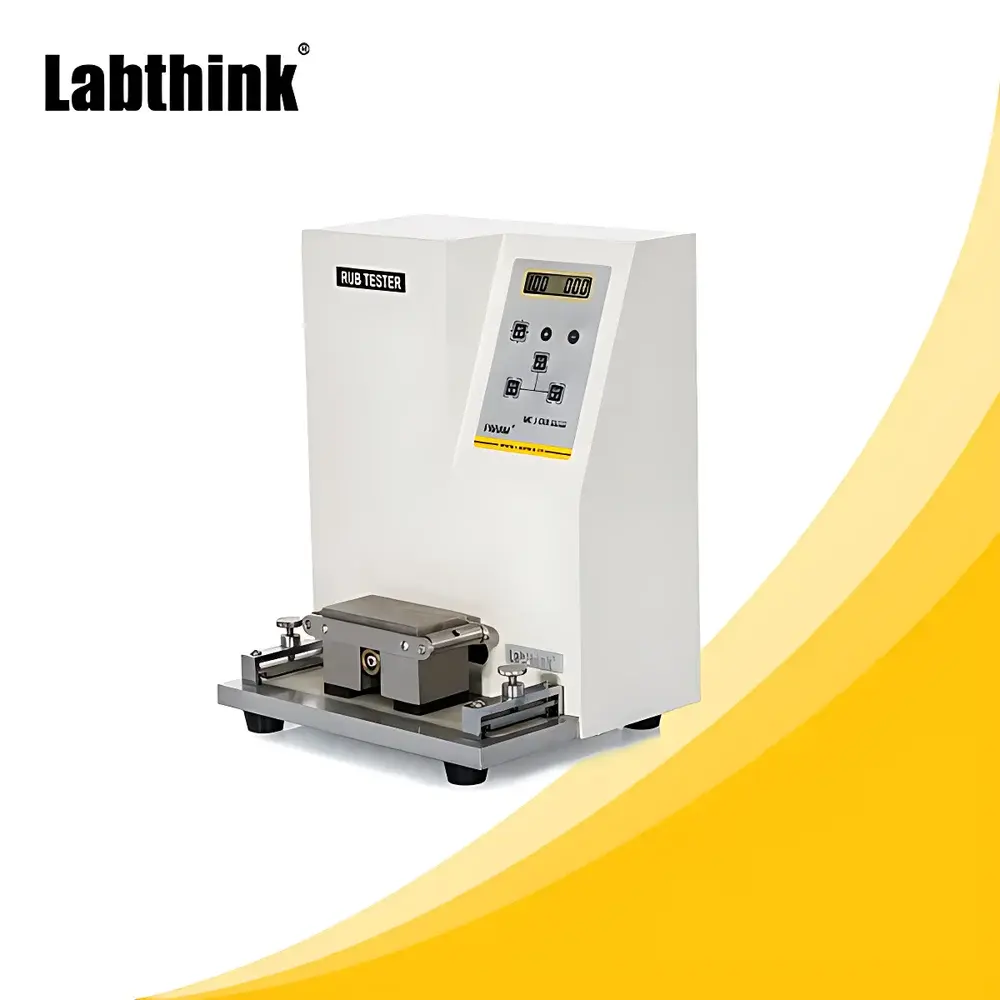
Labthink PRAM-MCJ-01A Reciprocating Tribological Tester for Printed Coating and Ink Abrasion Resistance Testing
| Brand | Labthink |
|---|---|
| Origin | Shandong, China |
| Manufacturer Type | Direct Manufacturer |
| Region of Origin | Domestic (China) |
| Model | PRAM-MCJ-01A |
| Price Range | USD 1,400 – 7,000 |
| Instrument Type | Reciprocating Tribological Tester |
| Friction Load | 20 ± 0.2 N |
| Oscillation Frequency | 43 cycles per minute (cpm) |
| Contact Area | 155 mm (L) × 50 mm (W) |
| Test Cycles | 0–999 (programmable) |
| Specimen Size | 230 mm (L) × 50 mm (W) |
| Power Supply | 220 VAC, 50 Hz / 120 VAC, 60 Hz |
| Dimensions (L×W×H) | 260 × 230 × 360 mm |
| Net Weight | 22 kg |
Overview
The Labthink PRAM-MCJ-01A Reciprocating Tribological Tester is an engineered solution for quantitative evaluation of abrasion resistance in printed coatings, ink layers, photosensitive emulsions on PS plates, and other thin-film surface treatments. It operates on the principle of controlled reciprocating motion under defined normal load and fixed stroke geometry—simulating real-world mechanical wear conditions such as handling, stacking, transport, and post-print processing. The instrument complies with GB/T 7706–2008, the Chinese national standard specifying test methods for abrasion resistance of flexographic and gravure printing inks, and serves as a functional equivalent to ASTM D5178 (Standard Practice for Determining Abrasion Resistance of Ink Films by Taber Abraser) when adapted with appropriate fixtures and calibration protocols. Its design emphasizes metrological stability: a precision-machined internal friction stage ensures uniform contact pressure distribution across the full 155 mm × 50 mm sliding path, while vibration-damped mechanical architecture eliminates operational noise—critical for integration into QC laboratories adjacent to sensitive instrumentation.
Key Features
- Microprocessor-controlled operation with embedded firmware enabling precise cycle counting (0–999), repeatable load application (20 ± 0.2 N), and consistent oscillation frequency (43 cpm)
- Integrated friction platform with hardened stainless-steel guide rails and PTFE-coated slider interface to minimize parasitic friction and ensure long-term repeatability
- PVC membrane keypad and backlit LCD display provide intuitive local control—no external PC required for basic operation or result readout
- Power-loss memory function retains set parameters and accumulated cycle count during unexpected shutdown, preventing data loss and ensuring audit-ready continuity
- Modular specimen holder accommodates standardized 230 mm × 50 mm substrates—including offset paper, coated cardboard, aluminum PS plates, and polymer films—without tooling changes
- Compact footprint (260 × 230 × 360 mm) and low mass (22 kg) enable deployment on shared lab benches without structural reinforcement
Sample Compatibility & Compliance
The PRAM-MCJ-01A accepts flat, rigid, or semi-rigid specimens up to 0.8 mm thickness, including but not limited to: lithographic printing plates (PS and CTP plates), UV-curable inkjet coatings, gravure and flexo ink films on paper/board, laminated packaging surfaces, and functional barrier coatings on flexible electronics substrates. It supports comparative testing across material lots, curing conditions, and formulation variants—directly informing print process optimization and shelf-life validation. While primarily aligned with GB/T 7706, its mechanical configuration permits adaptation for ISO 1518–1 (paints and varnishes — determination of resistance to abrasion) and TAPPI T 476 (abrasion resistance of printing inks) via documented SOPs. All firmware and calibration records are traceable to internal quality system documentation, supporting GLP-compliant environments where instrument qualification (IQ/OQ) is required.
Software & Data Management
The device operates autonomously via onboard firmware; no proprietary software installation is mandatory. However, Labthink provides optional CSV export capability via RS-232 serial interface for integration into LIMS or Excel-based QA reporting workflows. Cycle completion triggers audible feedback and automatic display hold, allowing unattended batch testing. Parameter settings are password-protected to prevent inadvertent modification in multi-user labs. Audit trails—including operator ID (manually entered), test date/time stamp, cycle count, and pass/fail status based on pre-defined visual inspection criteria—are retained in non-volatile memory for minimum 12 months. The system does not implement FDA 21 CFR Part 11 electronic signature functionality, but raw data files exported externally may be managed under institutional Part 11 compliance frameworks.
Applications
- Evaluation of ink adhesion durability on corrugated board and folding cartons subjected to palletization stress
- Quantitative comparison of UV-cured vs. solvent-based ink systems on high-speed label stock
- PS plate manufacturer qualification of photosensitive layer resilience to blanket-to-plate contact wear
- Coating supplier verification of scratch resistance for metallized PET used in pharmaceutical blister packaging
- R&D screening of nano-additive reinforced acrylic topcoats for digital print finishing applications
- Root-cause analysis of premature ink rub-off in cold-chain logistics environments involving condensation and abrasion
FAQ
What standards does the PRAM-MCJ-01A directly support?
It is designed and validated per GB/T 7706–2008. Equivalent performance can be demonstrated for ASTM D5178 and ISO 1518–1 with method transfer documentation.
Is calibration certification included with shipment?
Yes—a factory-issued calibration report traceable to CNAS-accredited reference standards is provided, covering load cell verification and cycle timing accuracy.
Can the friction speed be adjusted beyond 43 cpm?
No. The drive mechanism is fixed-frequency to maintain strict compliance with GB/T 7706’s specified oscillation rate; variable-speed operation would invalidate conformance claims.
What maintenance is required for long-term reliability?
Biannual inspection of slider alignment and cleaning of rail surfaces with isopropyl alcohol; no lubrication is permitted on contact surfaces.
Does the instrument support automated pass/fail judgment?
No. Final assessment relies on standardized visual or instrumental (e.g., densitometer/delta E) evaluation of post-test specimens per user-defined acceptance criteria.



