
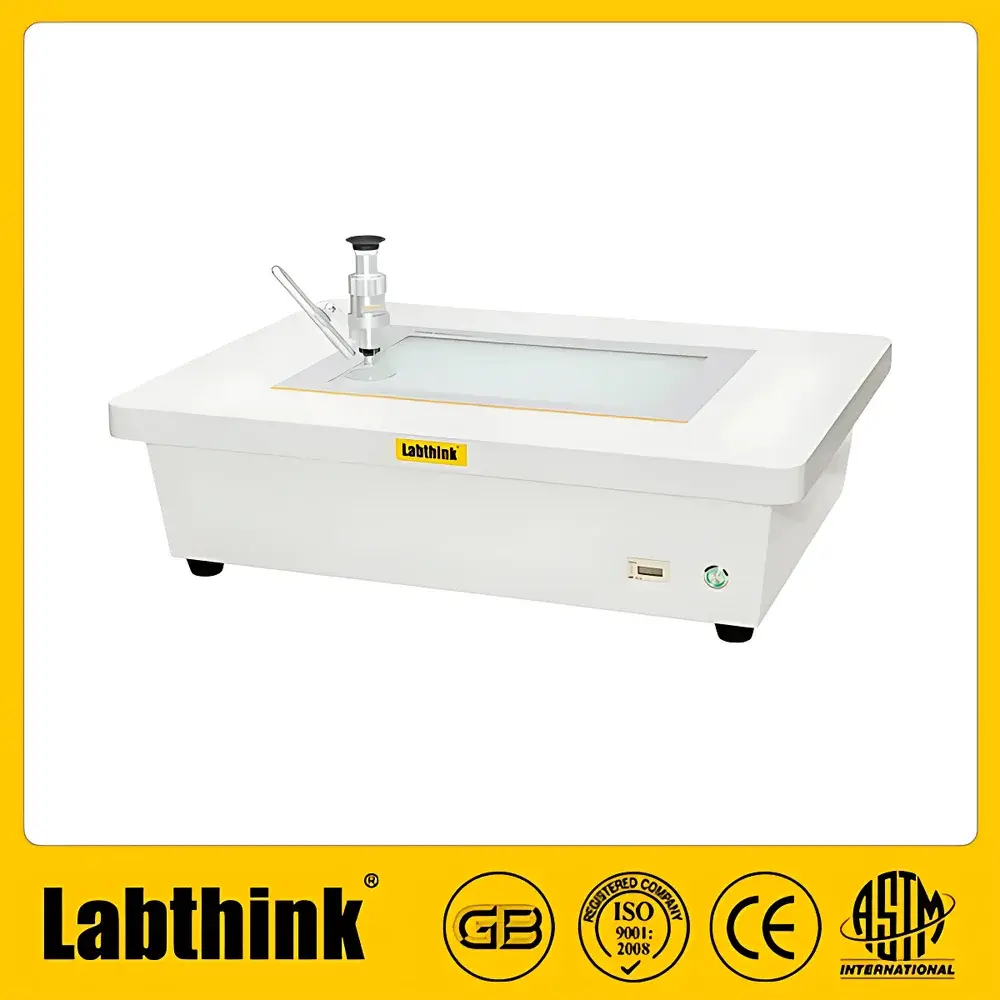
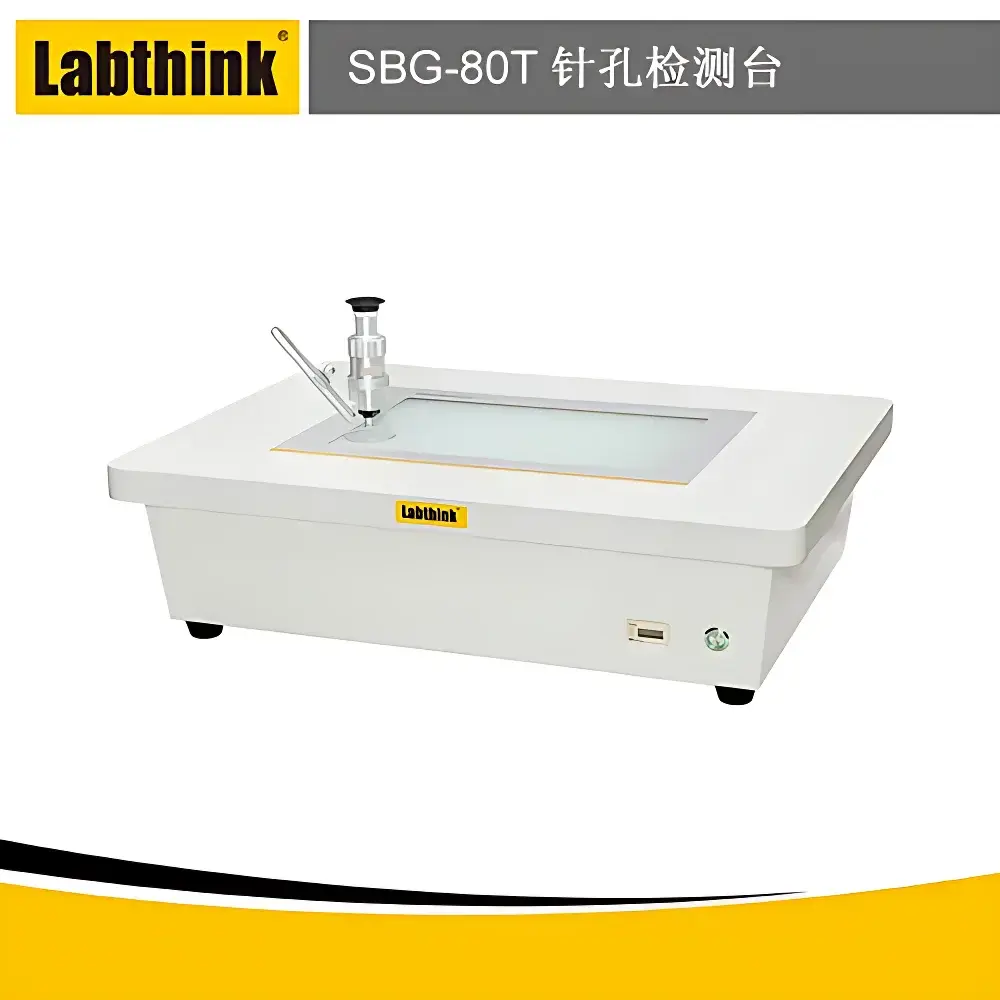
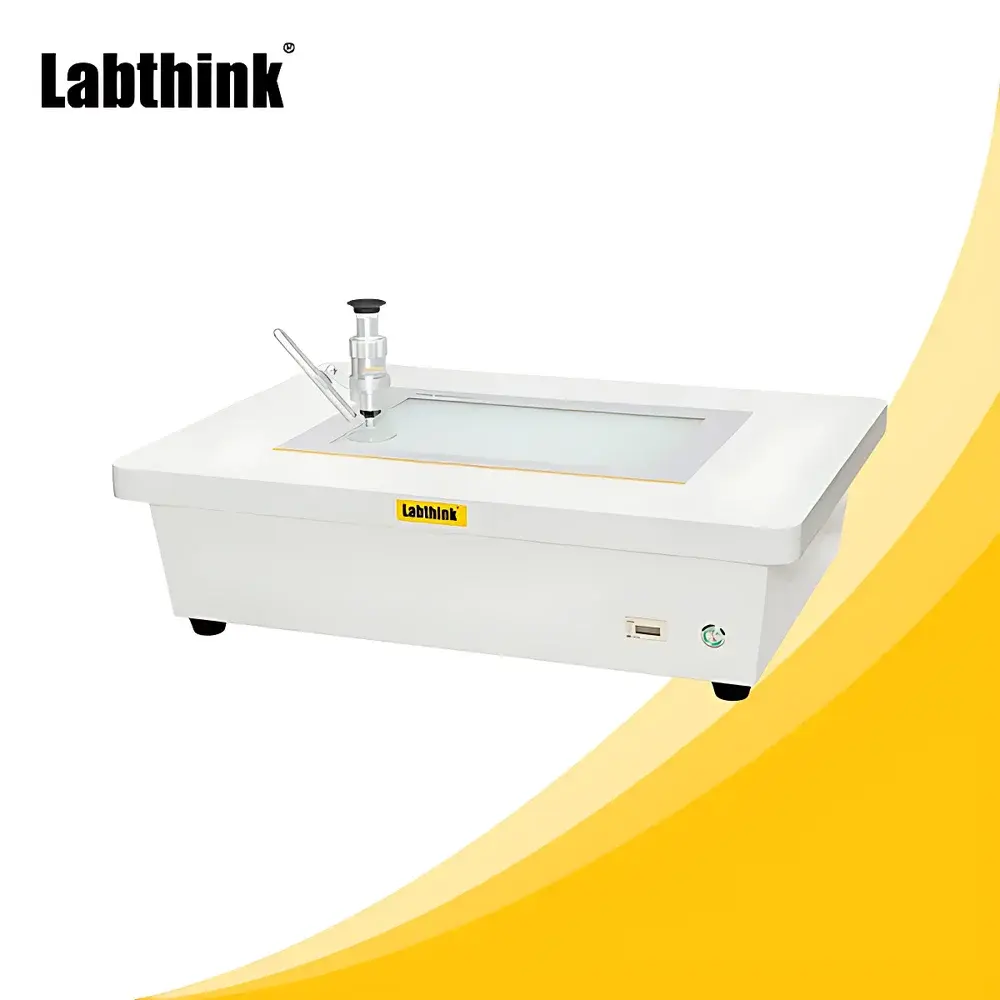
Labthink SBG-80T Pharmaceutical Aluminum Foil Pinhole Inspection Station
| Brand | Labthink |
|---|---|
| Model | SBG-80T |
| Light Source | CIE D65-compliant 6500 K fluorescent tube |
| Observation Area | 400 × 250 mm |
| Illuminance on Glass Surface | ~1000 lux |
| Ambient Illuminance Requirement | 20–50 lux |
| Magnification | 100× |
| Minimum Scale Division | 0.01 mm |
| Color Rendering Index (CRI) | ≥95 |
| Light Uniformity | ±5% across observation area |
| Power Supply | 220 VAC 50 Hz / 120 VAC 60 Hz |
| Dimensions (L×W×H) | 800 × 600 × 230 mm |
| Net Weight | 10 kg |
| Compliance Standards | GB/T 3198, GB/T 22638.2, YBB 00152002–2015, CY3–91, CIE S 002:2022 |
Overview
The Labthink SBG-80T Pharmaceutical Aluminum Foil Pinhole Inspection Station is a precision optical inspection system engineered for quantitative assessment of pinhole defects in pharmaceutical-grade aluminum foil. It operates on the principle of transmitted-light visualization: under standardized D65 illuminance and controlled ambient lighting conditions, microscopic pinholes—typically ranging from 5 µm to 100 µm in diameter—become optically resolvable due to differential light transmission through defect sites in the foil substrate. The instrument integrates a high-CRI (≥95) D65-spectrum fluorescent lamp with a thermally stabilized, optically homogenized projection path, ensuring photometric consistency compliant with CIE S 002:2022 and ISO/CIE joint recommendations for colorimetric evaluation environments. Designed specifically for regulatory-constrained packaging quality control, the SBG-80T supports objective, repeatable enumeration and dimensional characterization of pinholes—critical parameters directly linked to barrier integrity, sterility maintenance, and shelf-life validation in pharmaceutical primary packaging.
Key Features
- D65-standard illumination system with integrated lifetime tracking: CIE-compliant 6500 K spectral output, calibrated to ±200 K tolerance and maintained via real-time lamp-hour logging.
- Optimized optical path: Precision-ground diffuser plate and collimated beam geometry ensure ≤±5% illuminance uniformity across the full 400 × 250 mm observation field—eliminating edge falloff artifacts during systematic scanning.
- High-magnification visual metrology: 100× fixed-magnification microscope with 0.01 mm vernier scale enables direct measurement of pinhole diameter and spatial distribution without digital interpolation.
- Controlled ambient compatibility: Built-in ambient light sensor interface (optional) and specified operating range (20–50 lux) facilitate integration into ISO 14644-1 Class 7 or 8 cleanroom QA laboratories.
- Regulatory-ready mechanical architecture: All optical components mounted on vibration-damped aluminum alloy chassis; no moving parts subject to calibration drift; CE-marked electrical subsystems.
Sample Compatibility & Compliance
The SBG-80T accommodates standard roll-fed or sheet-cut pharmaceutical aluminum foils (thicknesses 0.02–0.05 mm), including laminated structures such as Alu–Alu, Alu–PVC, and cold-forming foils per EP 2.9.17 and USP . It satisfies mandatory test requirements defined in YBB 00152002–2015 (Chinese Pharmacopoeia packaging standards), GB/T 22638.2 (aluminum foil physical testing methods), and GB/T 3198 (general-purpose aluminum foil specifications). Instrument validation documentation—including IQ/OQ protocols, illuminance mapping reports, and inter-laboratory reproducibility data—is provided to support GLP/GMP audit readiness. While not an electronic data capture device, its analog optical design inherently avoids 21 CFR Part 11 compliance complexities—making it suitable for facilities requiring deterministic, non-software-dependent inspection workflows.
Software & Data Management
The SBG-80T is a hardware-only inspection station with no embedded firmware or digital interface. All measurements are performed manually using the calibrated ocular micrometer and recorded in paper-based or LIMS-integrated logbooks per facility SOPs. Optional accessories include traceable NIST-calibrated luminance reference tiles (model LRT-6500-D65) and ISO 12233 resolution test charts for periodic optical verification. For labs implementing digital documentation, Labthink provides a companion Excel-based Pinhole Audit Template (v2.1), pre-formatted to accept manual entry of pinhole count, location coordinates (X/Y grid), and measured diameters—enabling automated summary statistics (e.g., pinholes/m², max observed diameter, spatial clustering index) aligned with ISO 2859-1 sampling plans.
Applications
- Pharmaceutical packaging QC: Routine release testing of blister foil batches against YBB 00152002–2015 limits (e.g., ≤5 pinholes per 1 m² for sterile products).
- Supplier qualification: Comparative pinhole density analysis across foil lots from multiple vendors under identical illumination and observer protocols.
- Process troubleshooting: Correlation of pinhole patterns (e.g., linear streaks vs. random dispersion) with upstream slitting, annealing, or coating process deviations.
- Stability study support: Monitoring pinhole formation kinetics during accelerated aging (40 °C/75% RH) per ICH Q1A(R2), where barrier degradation manifests first as micro-defect proliferation.
- Reference method validation: Serving as the benchmark optical platform for verifying sensitivity thresholds of automated vision systems (e.g., line-scan CCD inspectors) prior to deployment.
FAQ
What lighting standard does the SBG-80T conform to, and why is D65 critical for pharmaceutical foil inspection?
The SBG-80T implements a CIE D65 spectral power distribution (6500 K, CRI ≥95) as specified in CY3–91 and ISO/CIE 11664-2:2018. D65 ensures consistent chromatic adaptation for human observers and eliminates metamerism-related misjudgments—essential when distinguishing true pinholes from oxide specks or surface scratches.
Can the SBG-80T be used for non-pharmaceutical aluminum foils?
Yes. Its optical specifications meet GB/T 3198 and GB/T 22638.2 requirements for industrial foil grades; however, acceptance criteria (e.g., maximum allowable pinholes/m²) must be defined per application-specific standards or internal specifications.
Is microscope calibration traceable to national standards?
The 0.01 mm vernier scale is factory-verified against ISO 6506-1 certified gauge blocks. Full calibration certificates (including uncertainty budgets per GUM) are available upon request for metrological traceability.
Does the instrument require annual recalibration?
No scheduled recalibration is mandated; however, users must perform daily illuminance verification (using a calibrated lux meter at center and four corners) and quarterly uniformity mapping per ASTM E308-22 Annex A3 guidelines.
How is operator variability minimized during pinhole counting?
Labthink recommends dual-observer protocol per ISO 5725-2:1994, with predefined pass/fail criteria (e.g., ≥2/3 consensus on borderline features) and documented training records—practices validated in cross-site collaborative studies involving 12 QA laboratories.
Related Products





