
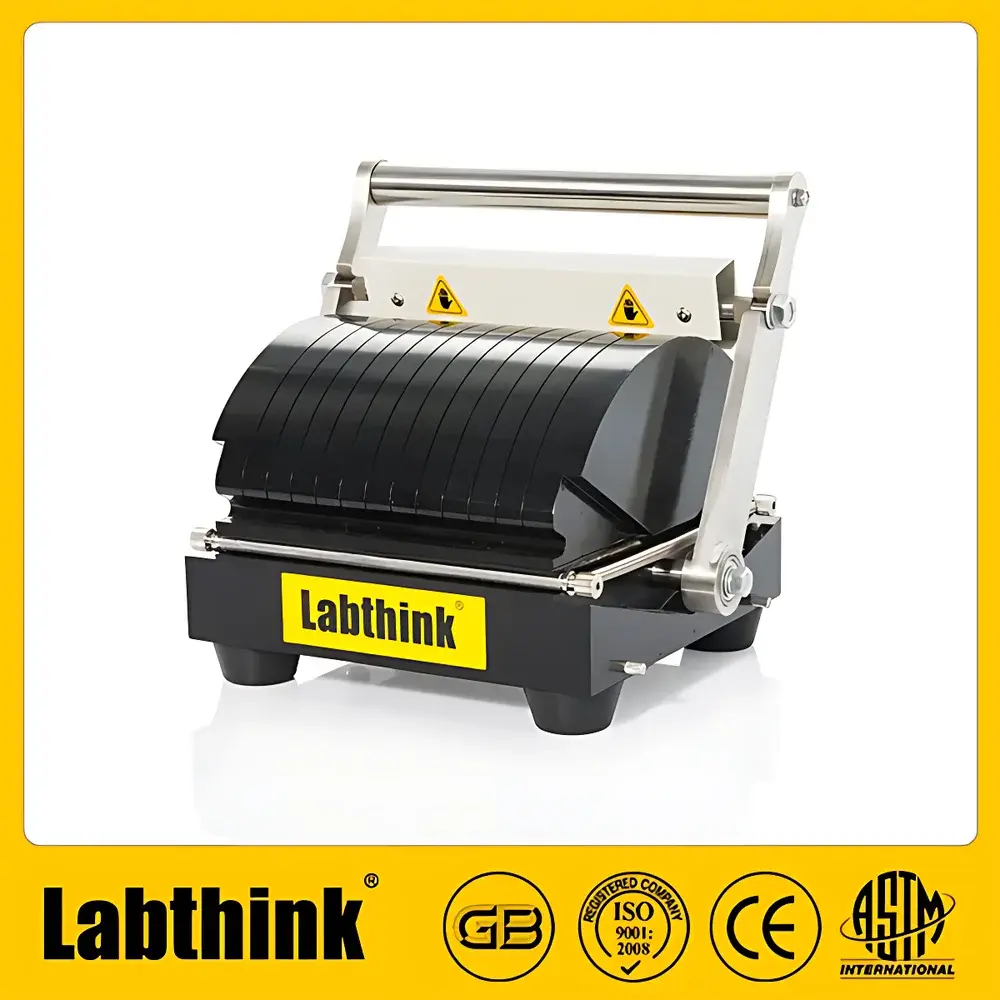
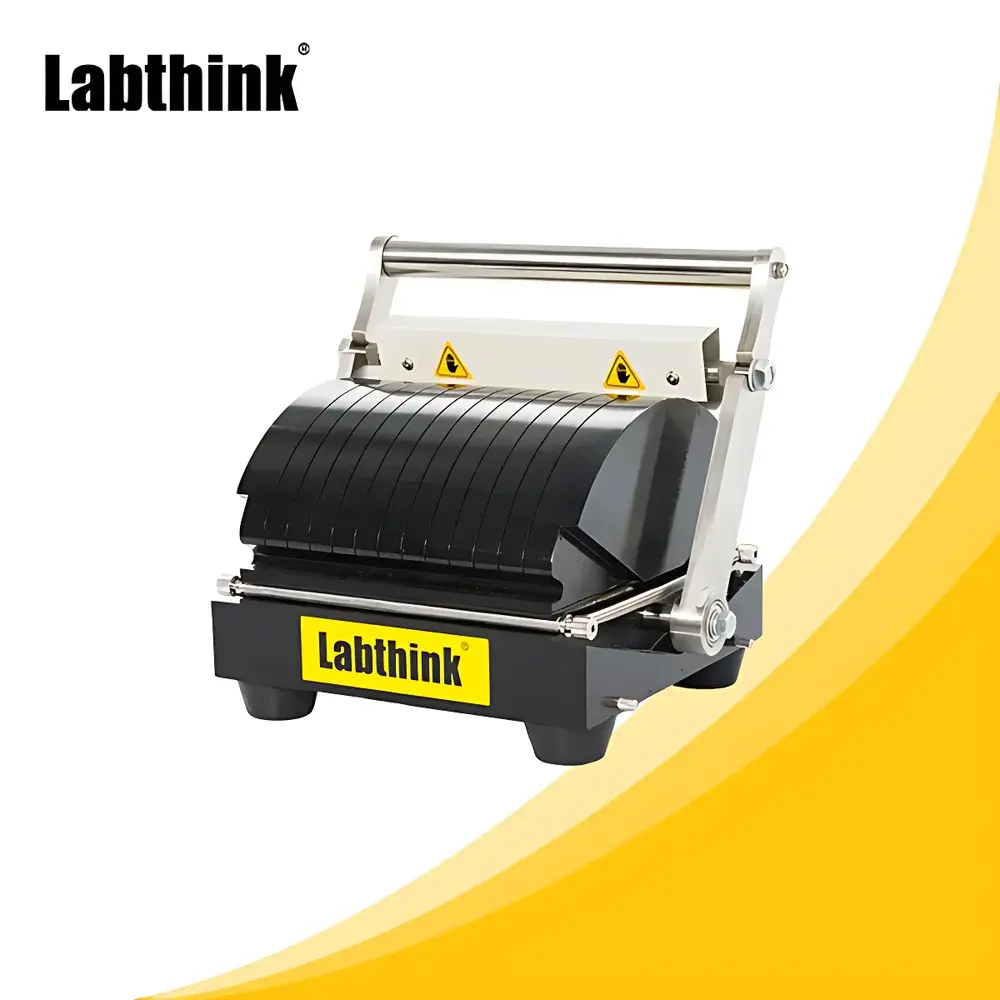
Labthink Strip Sampler-01 Manual Multi-Strip Film Sampling Device
| Brand | Labthink |
|---|---|
| Model | Strip Sampler-01 |
| Origin | Shandong, China |
| Manufacturer Type | Direct Manufacturer |
| Country of Origin | China |
| Sample Width | 15 mm (customizable) |
| Sample Length | < 600 mm |
| Number of Strips per Cut | 11 (customizable) |
| Max. Sample Thickness | < 2 mm |
| Compatible Materials | Paper, Flexible Plastic Films |
| Dimensions (L×W×H) | 350 × 300 × 290 mm |
| Net Weight | 15 kg |
| Power Requirement | None (Manual Operation Only) |
| Blade Type | Imported High-Hardness Steel Blade |
| Compliance | GB/T 1040.3–2006, ISO 527–3:1995 |
Overview
The Labthink Strip Sampler-01 is a precision-engineered, manually operated multi-strip sampling device designed specifically for standardized specimen preparation in packaging material testing laboratories. It operates on a mechanical shear principle—utilizing a fixed anvil and a synchronized linear-motion cutting blade guided by a robust linkage mechanism—to produce uniform, dimensionally accurate strips from flexible sheet materials. Unlike motorized or pneumatic cutters, the Strip Sampler-01 requires no external power source or compressed air supply, making it ideal for environments where electrical safety, portability, or operational simplicity is prioritized. Its primary function is to support tensile property evaluation (e.g., tensile strength, elongation at break) per international standards including ISO 527–3:1995 and GB/T 1040.3–2006, where strict dimensional conformity of test specimens directly impacts measurement reproducibility and regulatory acceptability.
Key Features
- Manual operation with zero energy dependency—no electricity, no air compressor, no maintenance-intensive components.
- Simultaneous multi-strip cutting: produces up to 11 identical strips in a single stroke, ensuring batch consistency and minimizing inter-operator variability.
- Precision-guided linkage system ensures straight-line blade travel, delivering consistent 15 mm strip width (±0.1 mm tolerance typical under controlled ambient conditions) and eliminating skew or taper.
- Imported high-hardness steel cutting blade provides extended service life and maintains edge integrity across thousands of cuts—even on abrasive or laminated films.
- Ergonomic arc-surface clamping mechanism fully flattens samples without localized compression, preventing micro-creases or surface deformation that could compromise tensile test validity.
- Full-blade shielding design ensures operator safety: the cutting edge remains fully enclosed during loading, positioning, and actuation—eliminating risk of accidental contact.
- Lightweight aluminum alloy frame (net weight: 15 kg) enables easy relocation between lab benches, QC stations, or production-floor sampling points.
Sample Compatibility & Compliance
The Strip Sampler-01 accommodates a broad range of thin, flexible substrates used in primary and secondary packaging, including biaxially oriented polypropylene (BOPP), polyester (PET), polyethylene (PE), aluminum foil laminates, coated paperboard, and metallized films—provided thickness remains below 2 mm. Its geometry and clamping force are optimized for low-modulus, high-ductility materials, avoiding slippage or puckering during cutting. All dimensional outputs comply with the specimen geometry requirements defined in ISO 527–3 (Type 1A and 1B strips) and GB/T 1040.3 (Type I and II dumbbell-free strip specimens). As a pre-test preparation tool—not a measuring instrument—the device itself falls outside metrological calibration scope; however, its mechanical repeatability supports GLP-compliant documentation when integrated into validated laboratory workflows.
Software & Data Management
The Strip Sampler-01 is a standalone mechanical instrument with no embedded electronics, firmware, or connectivity interfaces. Consequently, it does not generate digital data, require software installation, or interface with LIMS or ELN platforms. This architecture eliminates cybersecurity concerns, firmware update dependencies, and 21 CFR Part 11 compliance overhead associated with automated systems. Laboratories maintain traceability through standard operating procedures (SOPs) documenting cutter calibration checks (e.g., periodic verification of strip width using certified calipers), blade replacement logs, and sample identification protocols aligned with ISO/IEC 17025 requirements for testing competence.
Applications
- Preparation of tensile test specimens for plastic films, laminates, and coated papers in QC/QA labs.
- Standardized strip generation prior to peel strength (ASTM F904), seal strength (ASTM F88), or puncture resistance (ASTM F1306) testing.
- Routine sampling in packaging R&D for comparative mechanical property screening across material grades or process variations.
- On-site sampling in production environments where electrical infrastructure is limited or explosion-proof conditions apply.
- Education and training labs requiring durable, intuitive tools for teaching standardized specimen preparation principles.
FAQ
Is the Strip Sampler-01 compatible with ASTM D882?
Yes—its 15 mm strip width and capacity for lengths up to 600 mm satisfy the dimensional specifications for Type IV specimens in ASTM D882–22.
Can blade replacement be performed by end users?
Yes—standard blade replacement requires only a hex key; full instructions and torque specifications are provided in the operation manual.
Does Labthink provide calibration certificates for this device?
No—calibration is not applicable, as the Strip Sampler-01 is a passive mechanical tool. Users perform periodic verification using traceable micrometers or optical comparators per internal SOP.
Are custom strip widths supported beyond 15 mm?
Yes—Labthink offers factory-configured variants with widths of 5 mm, 10 mm, 20 mm, and 25 mm; minimum order quantities apply.
What is the expected service life of the standard blade?
Under typical use (≤500 cuts/day on 50 µm PET film), the imported blade maintains dimensional accuracy for ≥10,000 cuts before scheduled replacement.






