
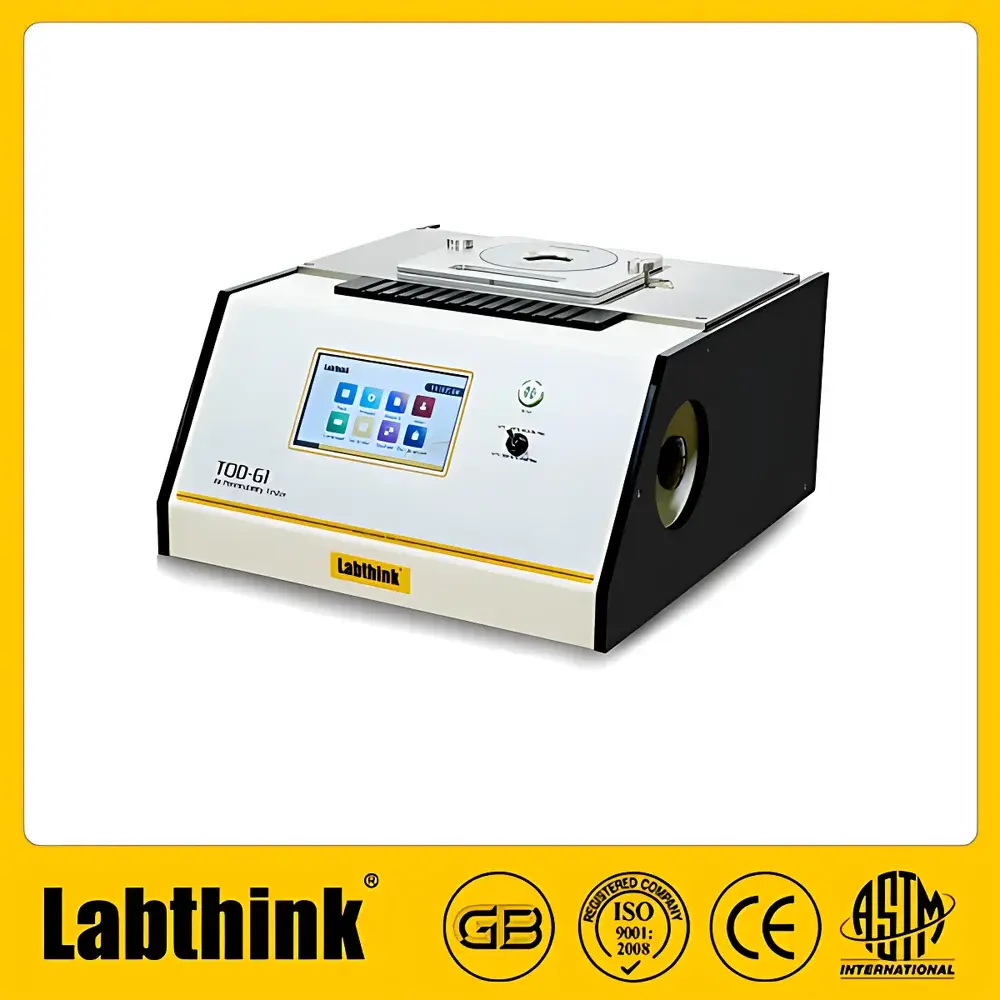
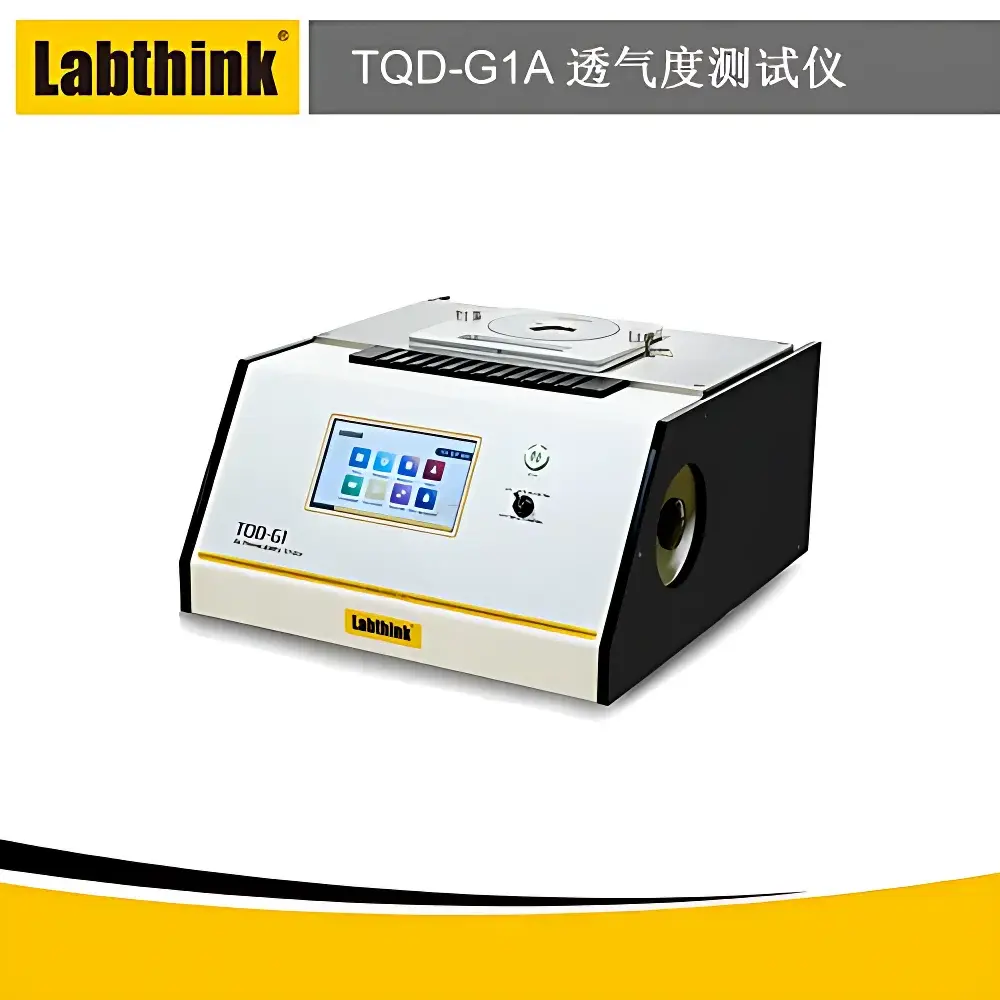
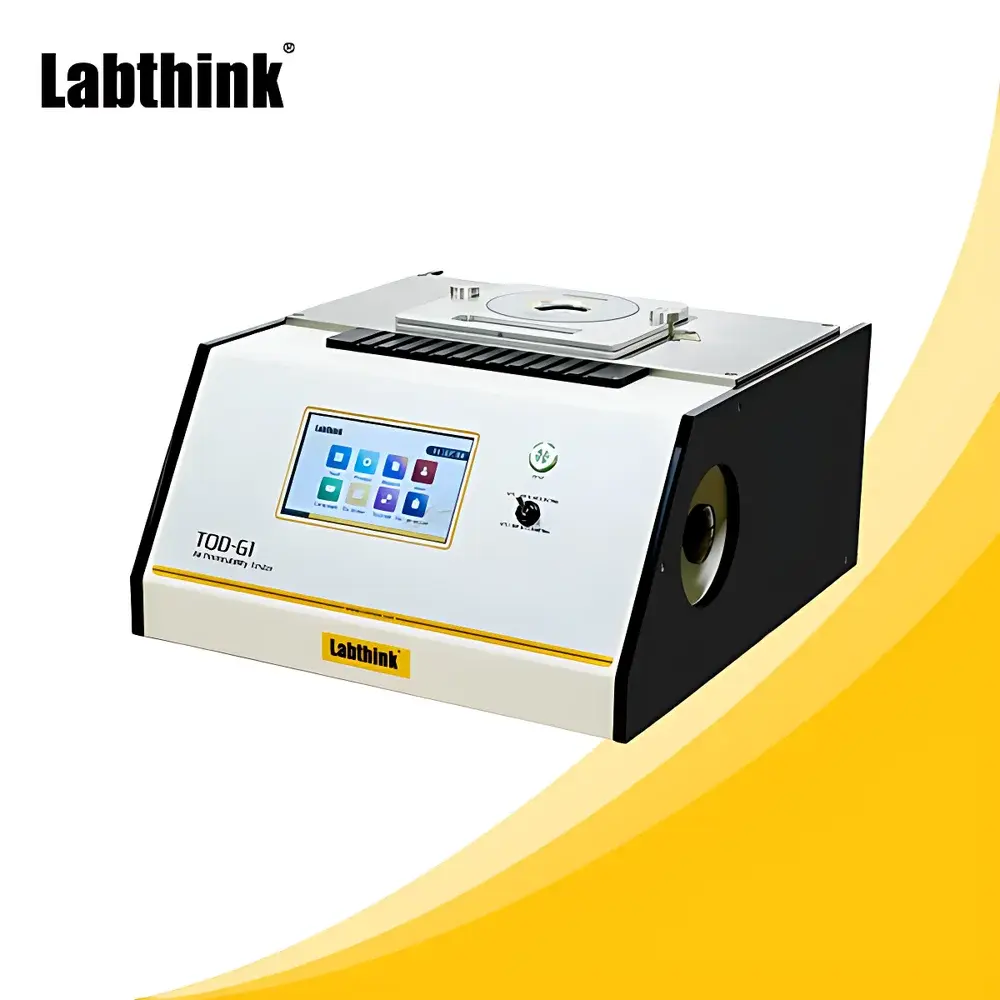
Labthink TQD-G1A Automotive Interior Leather & Textile Air Permeability Tester
| Brand | Labthink |
|---|---|
| Origin | Shandong, China |
| Manufacturer Type | Direct Manufacturer |
| Country of Origin | China |
| Model | Labthink-TQD-G1A |
| Price Range | USD 14,000 – 70,000 |
| Pressure Drop Range | 0–1000 Pa |
| Pressure Resolution | 0.1 Pa |
| Pressure Accuracy | ±0.25% FS |
| Flow Rate Range | 0–30 L/min |
| Flow Resolution | 0.1 L/min |
| Flow Accuracy | ±2% FS |
| Test Area | 20 cm² (standard, customizable) |
| Sample Size | 5 cm × 5 cm |
| Max Sample Thickness | 1 mm |
| Gas Supply | Clean compressed air (user-supplied, ≥550 kPa, >120 L/min) |
| Interface | RS232 |
| Power | 120 VAC ±10% 60 Hz / 220 VAC ±10% 50 Hz |
| Dimensions | 300 × 460 × 520 mm |
| Net Weight | 25 kg |
Overview
The Labthink TQD-G1A Air Permeability Tester is a precision-engineered instrument designed for quantitative evaluation of gas transmission behavior in porous and fibrous sheet materials under controlled differential pressure or constant flow conditions. It operates on two standardized physical principles—Method A (constant flow, variable pressure drop) and Method B (constant pressure drop, variable flow)—both grounded in Darcy’s law and widely adopted in material science laboratories for characterizing resistance to laminar airflow through planar specimens. The system is specifically calibrated for automotive interior applications—including polyurethane foam, PVC trim, genuine and synthetic leather, woven/nonwoven textiles, and carpet substrates—but its modular architecture supports broader use across packaging, medical device, filtration, and paper industries where breathability, barrier integrity, and ventilation performance are critical quality attributes.
Key Features
- Dual-mode operation: Selectable Method A (constant flow rate, pressure drop measurement) or Method B (constant pressure differential, volumetric flow quantification), compliant with ISO 9237, ASTM D737, and GB/T 5453 test protocols.
- High-fidelity sensing: Integrated high-stability electronic differential pressure transducers (0–1000 Pa range, 0.1 Pa resolution, ±0.25% full-scale accuracy) and thermal mass flow sensors (0–30 L/min, 0.1 L/min resolution, ±2% accuracy) ensure traceable, repeatable data acquisition.
- Automated pneumatic clamping: Uniform sample compression force eliminates edge leakage and operator-induced variability; accommodates specimens up to 1 mm thickness with consistent 20 cm² test area (customizable apertures available).
- Self-contained vacuum-assisted air management: Built-in maintenance-free vacuum pump ensures stable baseline pressure control and rapid equilibration between test cycles.
- Industrial-grade HMI: 7-inch color touchscreen interface with embedded real-time clock, multi-language support (English, Chinese, Spanish, German), role-based user permissions (admin/operator/auditor), and audit trail logging capability.
- Expandable connectivity: Standard RS232 serial port enables integration with LIMS or laboratory PCs; optional software package provides automated report generation, statistical process control (SPC) charts, and FDA 21 CFR Part 11–compliant electronic signatures.
Sample Compatibility & Compliance
The TQD-G1A is validated for testing flat, low-compressibility, and moderately elastic sheet materials including but not limited to: automotive upholstery leather (aniline, semi-aniline, coated), thermoplastic polyurethane (TPU) foams, PVC laminates, needle-punched nonwovens, spunbond/meltblown composites, filter papers, tissue-grade cellulose sheets, and surgical mask media. All measurements adhere to internationally recognized standards: ISO 9237 (textiles), ISO 4638 (paper and board), ISO 5636-5 (porous materials), ASTM D737 (fabric air permeability), TAPPI T460 (paper), JIS P8117 (Japanese industrial standard), and multiple Chinese national standards (GB/T 5453, GB/T 10655, GB/T 13764). The instrument’s mechanical design and sensor calibration are aligned with GLP and GMP laboratory requirements, supporting IQ/OQ/PQ validation documentation packages.
Software & Data Management
The optional Labthink PermeaSoft™ suite provides comprehensive data governance functionality. It enables scheduled test execution, batch-level metadata tagging (operator ID, lot number, environmental conditions), automatic pass/fail flagging against user-defined specification limits, and export to CSV, PDF, or XML formats. Audit trails record all parameter modifications, test start/stop timestamps, and calibration events with immutable timestamps. When deployed in regulated environments, the software supports 21 CFR Part 11 compliance via electronic signature workflows, biometric or token-based authentication, and encrypted local database storage. Raw sensor outputs—including time-resolved pressure and flow curves—are retained for retrospective analysis and root-cause investigation.
Applications
- Automotive interior qualification: Quantifying air resistance of door panel trims, seat covers, headliner substrates, and acoustic insulation layers to meet OEM specifications for cabin comfort and HVAC efficiency.
- Filtration media screening: Evaluating pressure drop vs. flow characteristics of meltblown PP, activated carbon composites, and electrospun nanofiber membranes used in cabin air filters and respirators.
- Paper & packaging development: Assessing breathability of grease-resistant food wrappers, tea bag papers, and breathable medical packaging films per ISO 5636-5.
- Medical textile validation: Measuring differential pressure across surgical gowns, drapes, and isolation masks per ASTM F2100 and EN 14683 Annex A.
- Quality control in nonwovens manufacturing: Monitoring consistency of spunlace, thermal bond, and hydroentangled web structures during roll-to-roll production.
FAQ
What compressed air specifications are required for reliable operation?
Clean, oil-free, dry compressed air at ≥550 kPa (79.7 PSI) supply pressure and ≥120 L/min free-air delivery is mandatory. A refrigerated dryer and coalescing filter are recommended upstream of the Φ8 mm PU tubing inlet.
Can the test area be modified for non-standard specimen geometries?
Yes—custom test heads with 5 cm², 10 cm², or 50 cm² orifices are available upon request; dimensional drawings and calibration certificates are provided with each configuration.
Is third-party calibration certification included with shipment?
Factory calibration is performed using NIST-traceable reference standards; ISO/IEC 17025-accredited calibration certificates are available as an add-on service.
Does the system support automated pass/fail decision logic based on internal tolerances?
Yes—PermeaSoft™ allows users to define upper/lower specification limits per test method; results are auto-flagged with visual indicators and logged in the audit trail.
How is data integrity ensured during power interruption or unexpected shutdown?
All active test sessions write to non-volatile memory every 2 seconds; unsaved data is recovered automatically upon reboot without loss of timestamped sensor records.





