
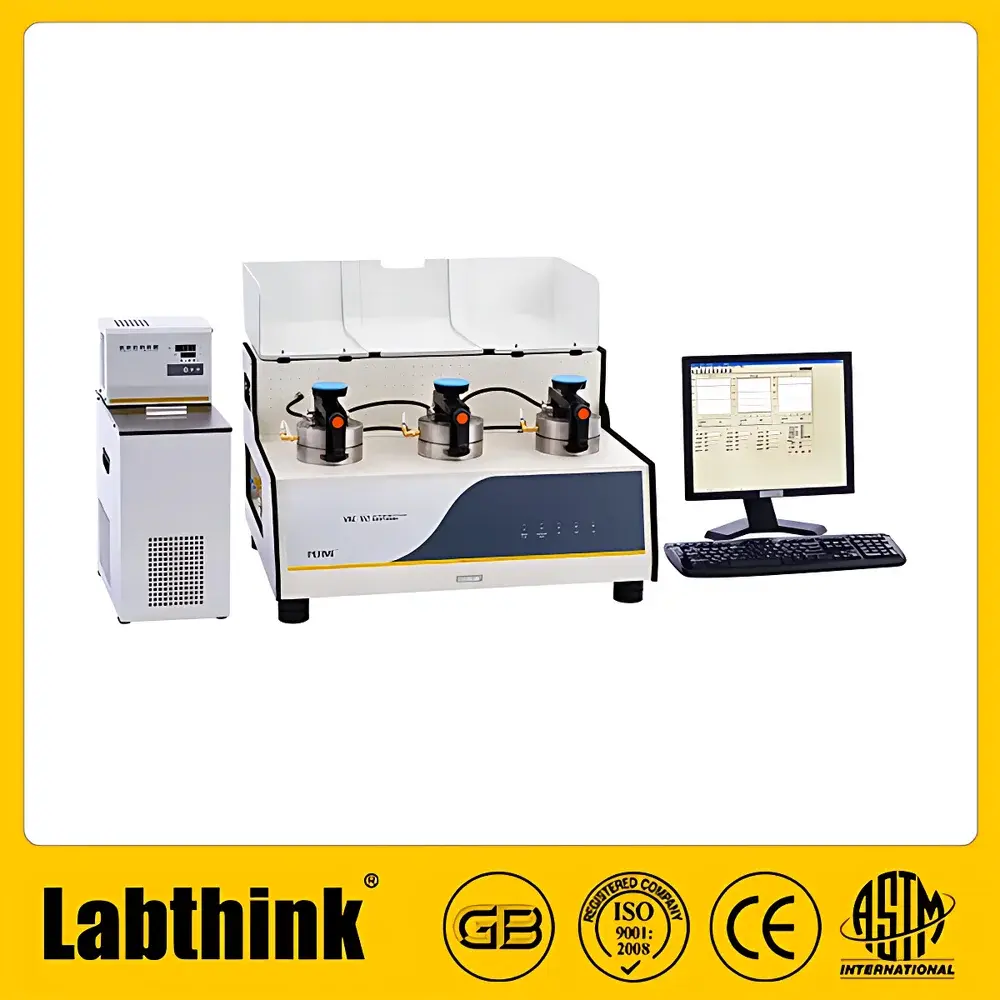
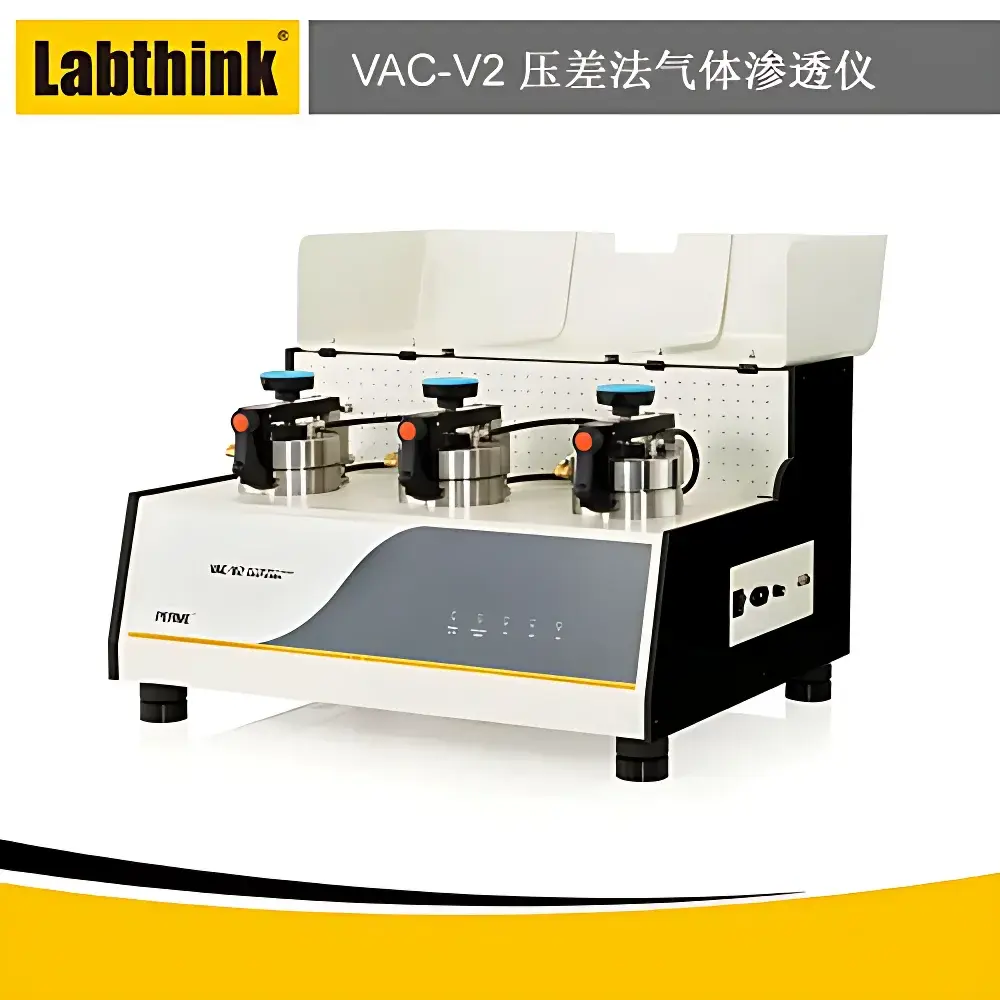
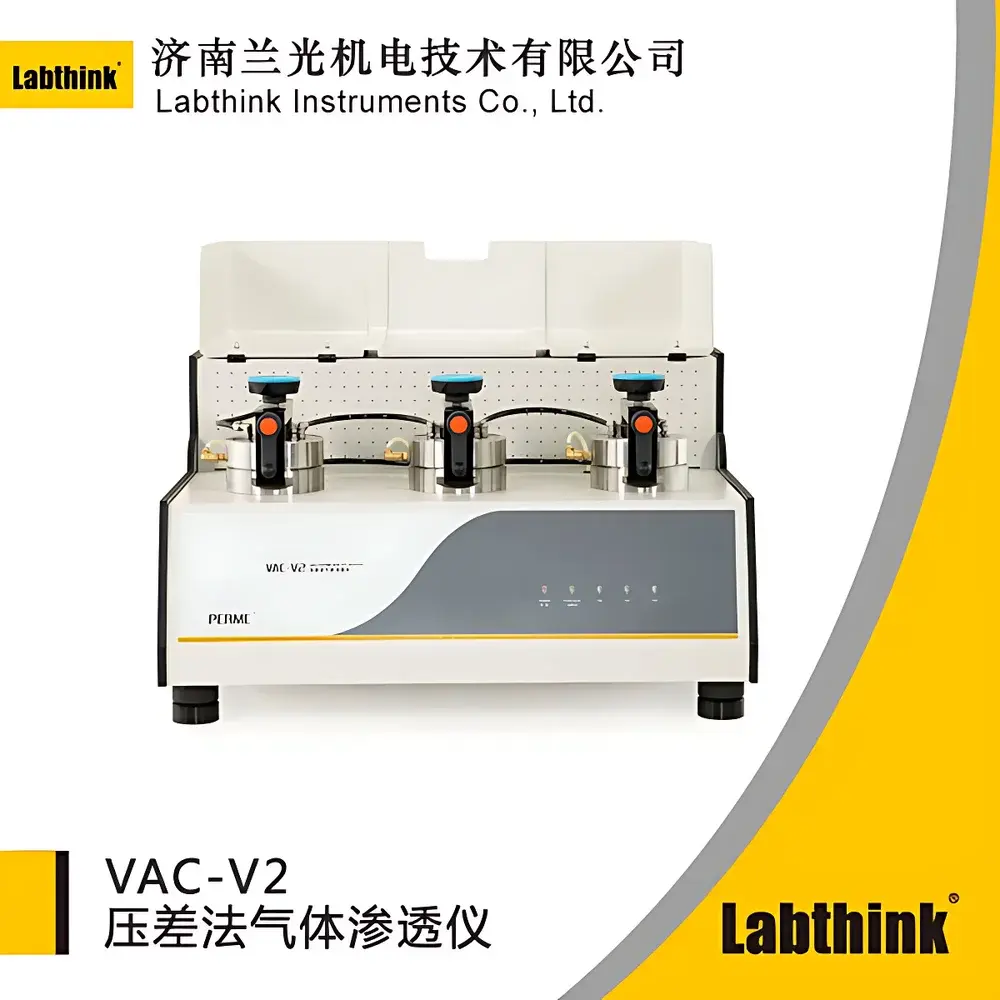
Labthink VAC-V2 Differential Pressure Gas Permeability Analyzer
| Brand | Labthink |
|---|---|
| Origin | Shandong, China |
| Manufacturer Type | Direct Manufacturer |
| Country of Origin | China |
| Model | VAC-V2 |
| Price Range | USD 14,000 – 70,000 |
| Test Principle | Differential Pressure (Manometric) Method |
| Standards Compliance | ISO 15105-1, ISO 2556, ASTM D1434, GB/T 1038-2000, JIS K7126-1, YBB 00082003 |
| Temperature Control Range | 5–95 °C |
| Temperature Accuracy | ±0.1 °C |
| Humidity Control Range | 0%RH, 5–90%RH (optional active humidification at 15–40 °C) |
| Humidity Accuracy | ±1%RH |
| Vacuum Resolution | 0.1 Pa |
| Test Chamber Vacuum Level | <20 Pa |
| Sample Size | Ø97 mm |
| Effective Test Area | 38.48 cm² |
| Gas Permeability Range | 0.05–50,000 cm³/m²·24h·0.1MPa (standard) |
| Number of Independent Test Cells | 3 |
| Test Gases | O₂, N₂, CO₂, air, He (custom modification required for flammable/explosive gases) |
| Test Pressure Range | 10–200 kPa |
| Supply Gas Pressure | 0.4–0.6 MPa |
| Interface | RS232 serial port |
| Data Management | Lystem™ Laboratory Data Sharing System |
| Power Supply | 220 VAC/50 Hz or 120 VAC/60 Hz |
| Dimensions (L×W×H) | 760×575×450 mm |
| Net Weight | 88 kg |
Overview
The Labthink VAC-V2 Differential Pressure Gas Permeability Analyzer is an engineered solution for precise, reproducible measurement of gas transmission rates (GTR) through polymeric and composite sheet materials under controlled temperature and humidity conditions. It operates on the differential pressure (manometric) principle—establishing a defined pressure gradient across a sealed test specimen while continuously monitoring pressure rise in the downstream (low-pressure) chamber via high-resolution absolute pressure transducers. This method enables direct quantification of gas permeability (P), diffusion coefficient (D), and solubility coefficient (S), where P = D × S. Designed for compliance with international standard test methods—including ISO 15105-1 (plastic films and sheets), ASTM D1434 (gas transmission rate of plastic film and sheeting), and GB/T 1038-2000—the VAC-V2 delivers traceable, auditable data essential for R&D validation, quality control, and regulatory submissions in packaging, medical device, aerospace, and advanced material development.
Key Features
- Triple independent test chambers enable concurrent evaluation of three specimens—identical or dissimilar—reducing total testing time by up to 67% versus single-cell systems.
- High-stability thermal management system maintains ±0.1 °C temperature uniformity across the full 5–95 °C operating range, critical for Arrhenius-based activation energy analysis and accelerated aging studies.
- Dual-mode process logic—proportional control and fuzzy logic algorithms—ensures robust convergence during transient permeation phases, particularly for low-permeability barrier materials (e.g., PVDC-coated films, SiOₓ- or AlOₓ-coated substrates).
- Modular design supports field-upgradable extended-range measurement capability (≥500,000 cm³/m²·24h·0.1MPa), accommodating high-permeability applications such as breathable nonwovens or biodegradable polymers.
- Integrated vacuum architecture achieves sub-20 Pa base pressure with 0.1 Pa resolution, minimizing background drift and enabling accurate detection of ultra-low permeation fluxes.
- Configurable humidity control (0%RH and 5–90%RH) with optional active humidification module allows standardized conditioning per ISO 2556 Annex A, supporting moisture-dependent barrier characterization for hygroscopic materials like EVOH or starch-based films.
Sample Compatibility & Compliance
The VAC-V2 accommodates rigid and flexible planar specimens up to Ø97 mm, including monolayer and multilayer films, laminates, foils, engineering thermoplastic sheets (e.g., PP, PVC, PVDC), rubber compounds, coated papers, fiberglass-reinforced composites, and functional coatings (e.g., fluoropolymer- or silicone-based barrier layers). Its mechanical clamping system ensures consistent gasket sealing without deformation-induced edge leakage—a common source of error in high-barrier testing. All operational parameters—including temperature setpoint, pressure ramp profile, and data acquisition interval—are programmable and stored with timestamped metadata, satisfying GLP/GMP documentation requirements. The instrument complies with FDA 21 CFR Part 11-ready data integrity protocols when used with validated Lystem™ software, providing electronic signatures, audit trails, and role-based access control.
Software & Data Management
Controlled via Labthink’s proprietary Lystem™ software suite, the VAC-V2 supports fully automated test execution, real-time permeation curve visualization, and multi-parameter regression modeling (e.g., Fickian vs. non-Fickian diffusion behavior). Raw pressure-time datasets are exported in CSV and XML formats compatible with third-party statistical tools (e.g., JMP, MATLAB). Lystem™ implements centralized database architecture for cross-instrument result aggregation, enabling comparative analysis across material batches, production lines, or supplier qualifications. Calibration verification is performed using certified reference membranes traceable to NIST standards; calibration history, operator ID, environmental logs, and instrument diagnostics are embedded in every test report.
Applications
- Packaging barrier validation: oxygen transmission rate (OTR) of pharmaceutical blister lidding, nitrogen permeability of snack food pouches, CO₂ loss in carbonated beverage containers.
- Medical device packaging: helium leak rate assessment of Tyvek®-based sterile barriers per ISO 11607-1.
- Aerospace composites: helium permeation through inflatable habitat membranes or fuel bladder liners.
- Sustainable materials: permeability kinetics of PLA, PHA, and starch-blend films under variable RH conditions per ASTM D6145.
- Automotive components: air permeation through EPDM seals and tire innerliners per SAE J1716.
- Coating performance: oxygen barrier efficacy of UV-cured acrylate or siloxane topcoats on PET substrates.
FAQ
What gases can be tested on the VAC-V2?
Standard configurations support O₂, N₂, CO₂, air, and He. Testing of flammable or toxic gases (e.g., H₂, CH₄, Cl₂) requires hardware modifications—including explosion-proof solenoid valves, inert purge pathways, and dedicated gas handling manifolds—and must be conducted under institutional safety review.
Is the instrument compliant with FDA 21 CFR Part 11?
Yes—when operated with validated Lystem™ software v3.2 or later, the system provides full Part 11 functionality: electronic signatures, immutable audit trails, and secure user authentication.
Can I perform diffusion and solubility coefficient calculations directly?
Yes. The software applies the time-lag method per ISO 15105-1 to derive D and S from primary permeation curves, with automatic correction for membrane thickness and upstream pressure.
What is the minimum detectable OTR for high-barrier films?
At 23 °C/0%RH, the detection limit is ≤0.05 cm³/m²·24h·0.1MPa for standard configuration—sufficient for evaluating AlOₓ-coated PET or metallized CPP with OTR < 0.1 cc/m²/day.
Does the system require external water supply for humidity control?
Yes. Distilled water is required for the optional active humidification module; deionized water is recommended to prevent mineral deposition in ultrasonic mist generators.
Related Products






