
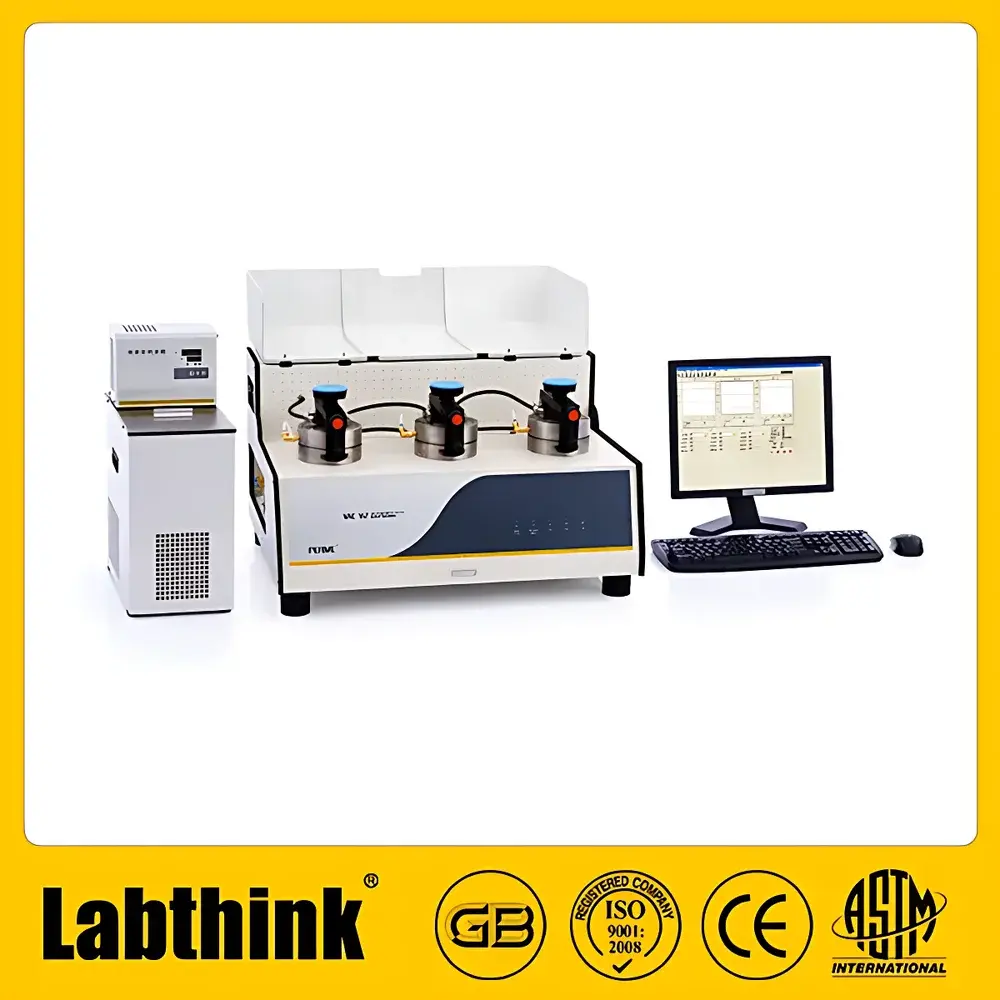
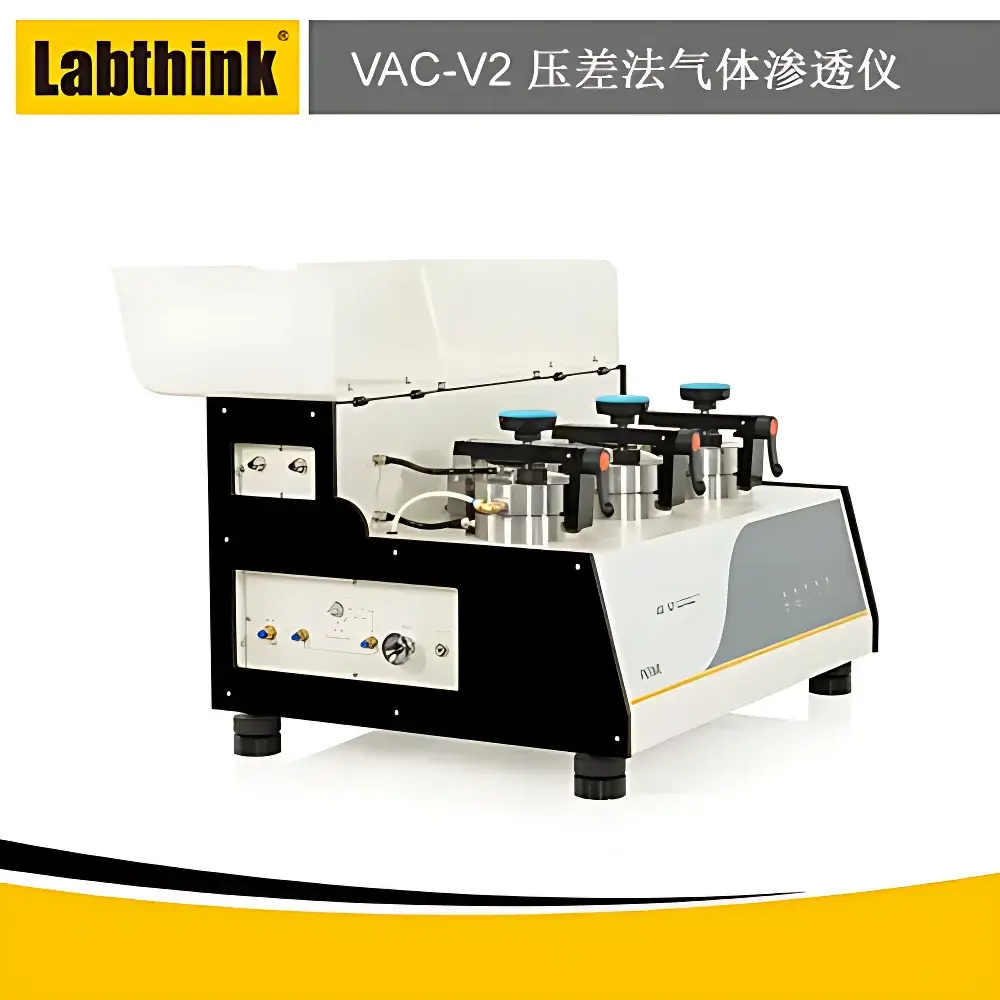
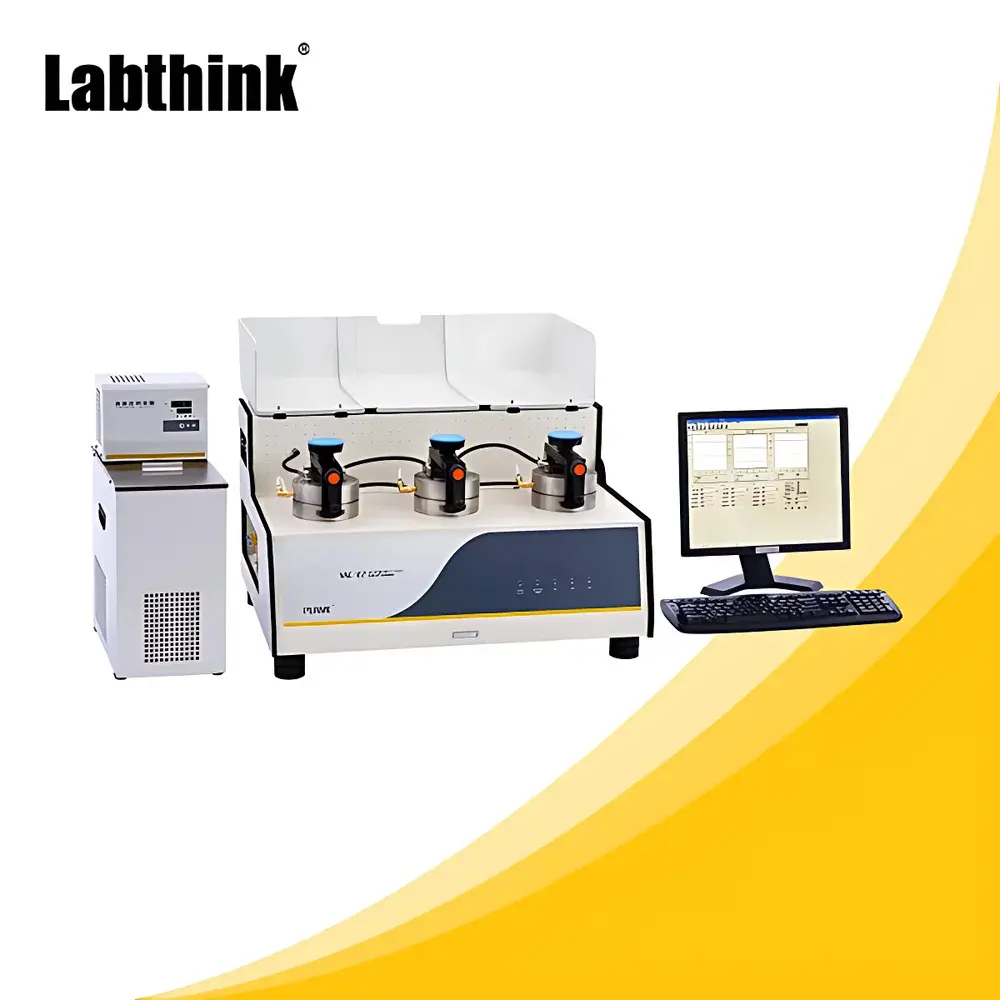
Labthink VAC-V2 Differential Pressure Gas Permeability Analyzer for Aluminum Foil Laminates and Packaging Films
| Brand | Labthink |
|---|---|
| Model | VAC-V2 |
| Measurement Principle | Differential Pressure (Manometric) Method |
| Test Gases | O₂, N₂, CO₂ |
| Test Range | 0.05–50,000 cm³/m²·24h·0.1MPa (standard) |
| Specimen Count | 3 independent test chambers |
| Vacuum Resolution | 0.1 Pa |
| Chamber Vacuum Level | <20 Pa |
| Temperature Control | 5–95 °C (±0.1 °C) |
| Humidity Control | 0%RH, 2–98.5%RH, 100%RH (optional humidity generator) |
| Humidity Accuracy | ±1%RH |
| Specimen Diameter | Φ97 mm |
| Effective Test Area | 38.48 cm² |
| Test Pressure Differential | −0.1 to +0.1 MPa |
| Gas Supply Pressure | 0.4–0.6 MPa |
| Interface | RS232 |
| Compliance | ISO 15105-1, ISO 2556, ASTM D1434, GB/T 1038-2000, JIS K7126-1, YBB00082003 |
Overview
The Labthink VAC-V2 Differential Pressure Gas Permeability Analyzer is an engineered solution for precise, traceable measurement of gas transmission rates (GTR) through flexible packaging materials—specifically optimized for aluminum foil laminates, metallized films, high-barrier composites, and pharmaceutical blister substrates used in tobacco packaging and regulated consumer goods. It operates on the manometric differential pressure principle per ISO 15105-1 and ASTM D1434: a conditioned specimen separates two sealed chambers; the lower chamber is evacuated to high vacuum (<20 Pa), while the upper chamber is pressurized with test gas (O₂, N₂, or CO₂). The resulting transient pressure rise in the low-pressure side is monitored via high-resolution capacitance manometers (0.1 Pa resolution), enabling calculation of gas permeability (P), diffusion coefficient (D), and solubility coefficient (S) via Fickian modeling. Unlike sensor-based methods, this absolute manometric approach eliminates calibration drift and provides primary-standard traceability—critical for QC labs operating under GLP, GMP, or FDA 21 CFR Part 11 requirements.
Key Features
- Triple independent test stations: Simultaneously measures three specimens—identical or dissimilar—with fully isolated pneumatic and thermal pathways, eliminating cross-talk and enabling statistical validation per ISO 5725.
- High-fidelity environmental control: Integrated Peltier-based temperature regulation (5–95 °C, ±0.1 °C) and optional humidity generation (2–98.5%RH, ±1%RH) allow accelerated aging studies and real-world condition simulation per ASTM F1249 for moisture-sensitive barrier layers.
- Dual algorithmic analysis: Combines proportional rate detection with adaptive fuzzy logic to auto-identify steady-state permeation onset—reducing operator dependency and improving inter-lab reproducibility.
- Extended-range capability: Modular volume expansion kit supports ultra-high-permeability materials (up to 500,000 cm³/m²·24h·0.1MPa), extending applicability to non-barrier polymers and porous substrates without recalibration.
- Hazardous gas compatibility: Optional system modification enables safe testing of toxic or flammable gases (e.g., H₂S, CH₄) under Class I Div 2 electrical certification—compliant with IEC 60079-0.
- Automated compliance workflow: Full computer control includes audit-trail logging, electronic signatures, and data encryption aligned with FDA 21 CFR Part 11 Annex 11 requirements.
Sample Compatibility & Compliance
The VAC-V2 accommodates rigid and flexible planar specimens up to Φ97 mm (38.48 cm² effective area), including aluminum foil/paper laminates, PET/Al/PE structures, SiOₓ-coated films, cold-forming foils, and pharmaceutical-grade PVC/PVDC blisters. Its mechanical clamping design ensures uniform sealing force across heterogeneous substrates, minimizing edge leakage artifacts. All test protocols adhere to internationally harmonized standards: ISO 15105-1 (gas permeability), ISO 2556 (O₂ transmission), ASTM D1434 (gas transmission rate), GB/T 1038-2000 (Chinese national standard), JIS K7126-1 (Japanese industrial standard), and YBB00082003 (Chinese pharmaceutical packaging specification). Validation documentation—including IQ/OQ/PQ templates, uncertainty budgets per GUM, and metrological traceability to NIM (National Institute of Metrology, China)—is supplied with each instrument.
Software & Data Management
Lystem™ Laboratory Data Management System (LDMS) is integrated as standard firmware. It provides role-based user access, version-controlled method templates, automated report generation (PDF/CSV/XLSX), and centralized storage of raw pressure-time curves, calculated coefficients, and environmental logs. Data integrity safeguards include immutable audit trails, time-stamped electronic signatures, and configurable retention policies compliant with ALCOA+ principles. The RS232 interface supports direct integration into enterprise LIMS environments (e.g., Thermo Fisher SampleManager, LabWare LIMS) and allows bidirectional synchronization with ERP systems for material release workflows. Calibration history, maintenance records, and instrument qualification status are tracked within the same database—enabling full regulatory inspection readiness.
Applications
- Tobacco packaging R&D: Quantifying O₂ ingress into aluminum foil-lined cigarette cartons to predict shelf-life degradation of flavor compounds and prevent oxidative rancidity.
- Pharmaceutical primary packaging: Validating barrier performance of cold-forming foils and push-through blisters against moisture and oxygen per USP and ICH Q5C stability guidelines.
- Food packaging QA/QC: Verifying batch-to-batch consistency of high-barrier pouches for retorted meals, coffee, and snack foods under accelerated temperature-humidity stress.
- Material supplier qualification: Supporting ASTM F1307-compliant certification of metallized PET and AlOx-coated films for medical device sterile barrier systems.
- Academic research: Enabling Arrhenius modeling of temperature-dependent permeation kinetics and sorption-diffusion parameter deconvolution for novel biopolymer blends.
FAQ
What gases can be tested on the VAC-V2?
O₂, N₂, and CO₂ are standard. Other gases—including He, H₂, and CH₄—require hardware modification and safety certification.
Is humidity control built-in or optional?
Humidity generation is optional; the base system supports dry (0%RH) and saturated (100%RH) conditions. The humidity module adds programmable 2–98.5%RH control with ±1%RH accuracy.
Does the system comply with FDA 21 CFR Part 11?
Yes—Lystem™ LDMS includes electronic signatures, audit trails, data encryption, and configurable permission levels meeting Part 11 Subpart B requirements.
Can I test specimens thicker than 1 mm?
The clamping mechanism accommodates specimens up to 3 mm thickness, provided surface flatness deviation remains below 50 µm across the test area.
How often does the system require calibration verification?
Annual calibration with certified reference membranes (e.g., NIST-traceable O₂ permeable film) is recommended; internal vacuum and temperature sensors self-validate before each test sequence.
Related Products







