Labthink VAC-V2(EX) Differential Pressure Gas Permeability Analyzer for Solubility & Diffusion Coefficient Measurement
| Brand | Labthink |
|---|---|
| Model | VAC-V2(EX) |
| Principle | Differential Pressure (Manometric) Method |
| Test Gases | O₂, N₂, CO₂, H₂, Air, He, etc. |
| Temperature Range | 5–95 °C (±0.1 °C stability) |
| Vacuum Resolution | 0.1 Pa |
| Min. Vacuum in Test Chamber | ≤10 Pa |
| Permeation Range | 0.05–50,000 cm³/m²·24h·0.1MPa (extendable to ≥500,000 cm³/m²·24h·0.1MPa) |
| Sample Size | Ø97 mm |
| Effective Area | 38.48 cm² |
| Independent Test Cells | 3 |
| Power Supply | AC 220 V, 50 Hz |
| Net Weight | 88 kg |
| Dimensions | 760 × 575 × 450 mm (L×W×H) |
| Compliance | ISO 15105-1, ISO 2556, ASTM D1434, GB/T 1038-2000, JIS K7126-1, YBB 00082003 |
Overview
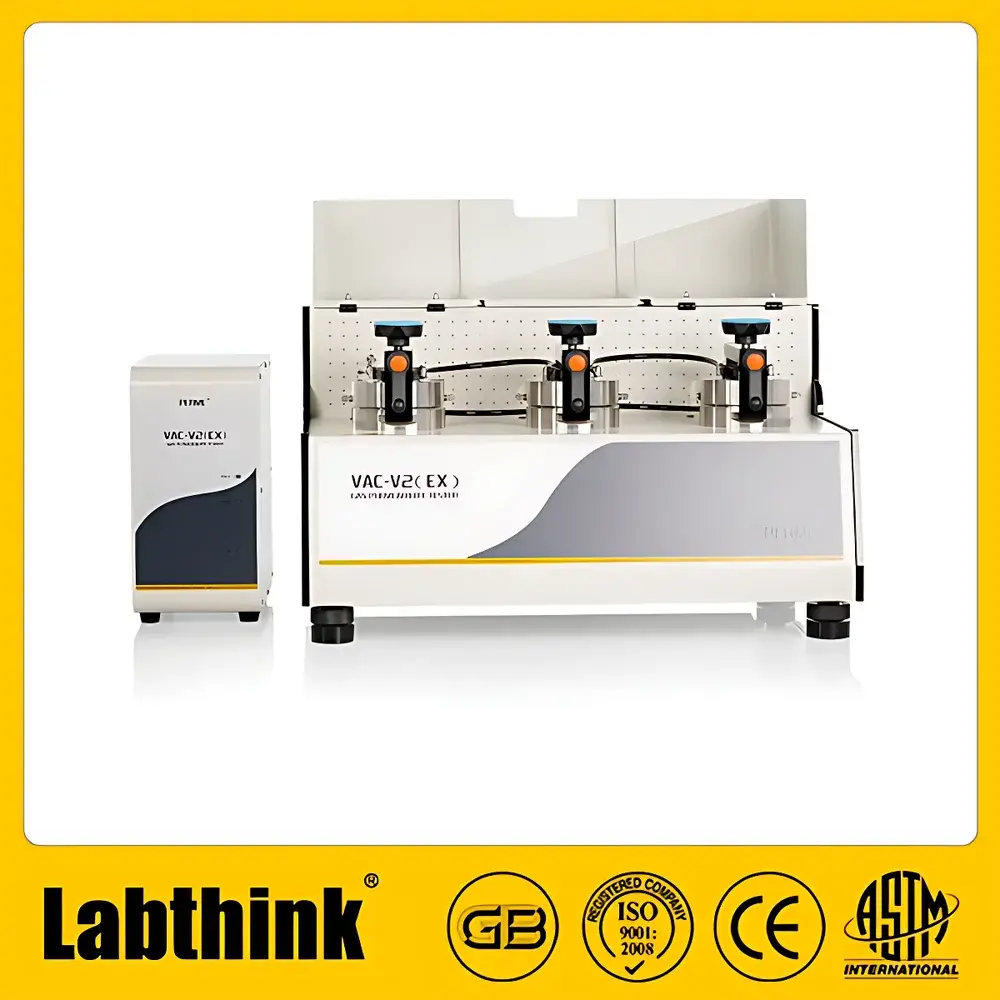
The Labthink VAC-V2(EX) Differential Pressure Gas Permeability Analyzer is an engineered solution for precise, traceable, and safe measurement of gas transport properties through polymeric, metallic, and composite barrier materials. It operates on the manometric differential pressure principle—widely recognized as the reference method for permeability quantification under controlled thermodynamic gradients. In this configuration, a conditioned specimen is sealed between two isolated chambers: a high-pressure upstream cavity (gas supply side) and a low-pressure downstream cavity (vacuum side). A stable transmembrane pressure differential—adjustable from 10 to 200 kPa—is established across the sample. As gas molecules permeate via dissolution-diffusion mechanisms, their accumulation in the evacuated lower chamber is monitored continuously using high-resolution pressure transducers. Real-time pressure rise data are converted into permeation flux, enabling simultaneous derivation of oxygen transmission rate (OTR), nitrogen transmission rate (NTR), carbon dioxide transmission rate (CO₂TR), diffusion coefficient (D), solubility coefficient (S), and permeability coefficient (P = D × S) in accordance with Fick’s second law and Henry’s law assumptions.
Key Features
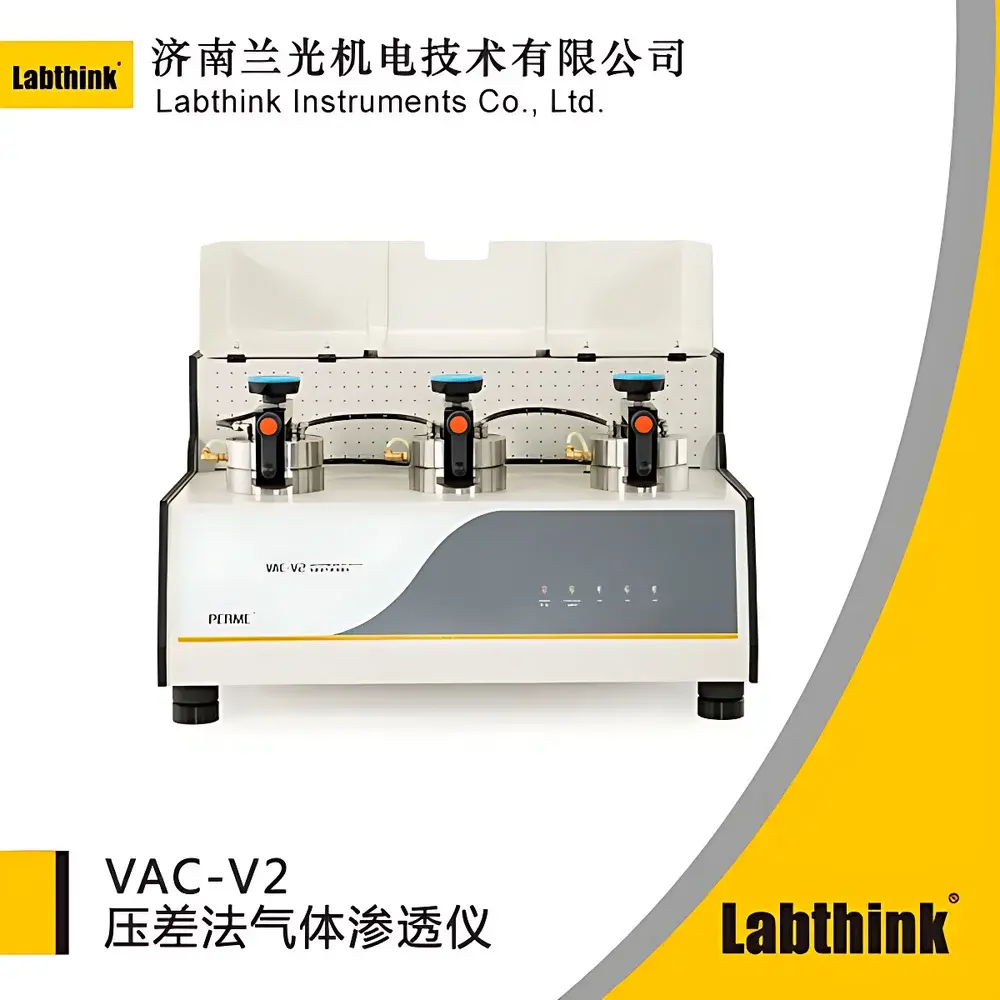
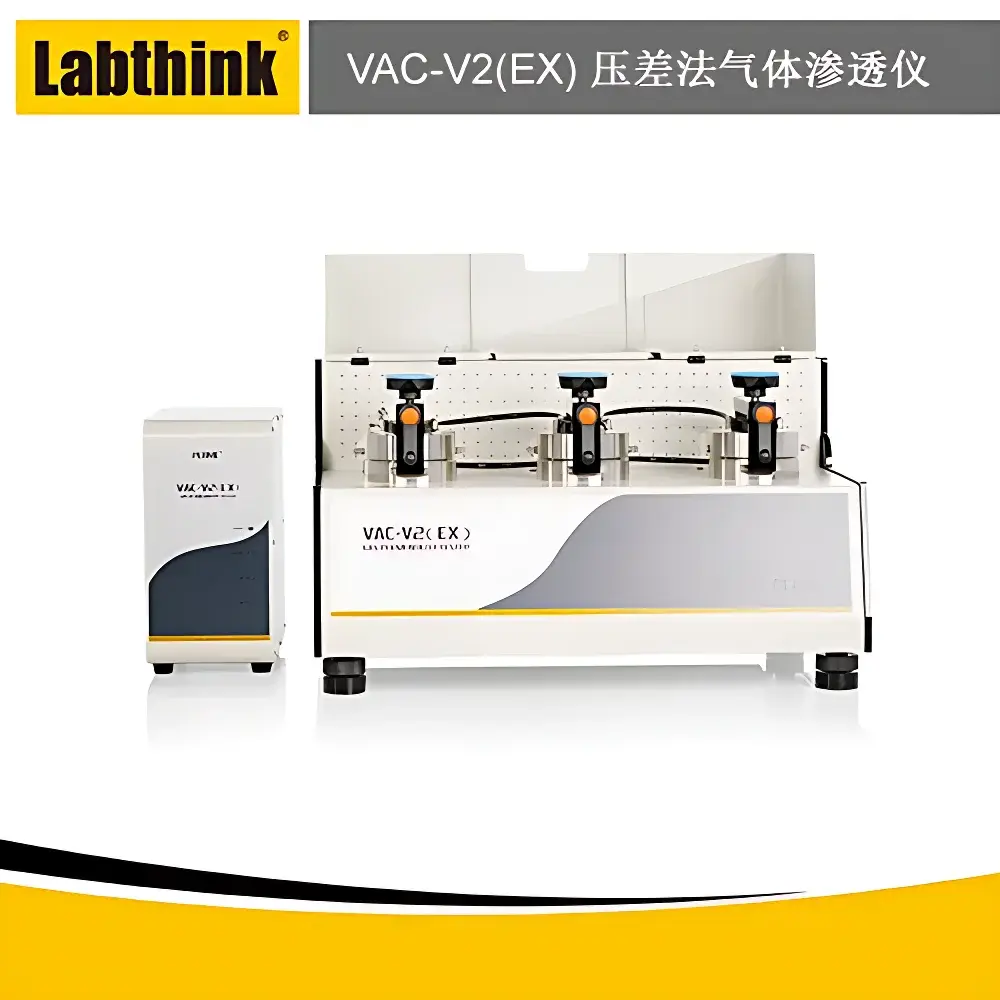
- Triple independent test cells—enabling concurrent evaluation of three distinct samples or replicate measurements under identical environmental conditions, significantly improving throughput and statistical robustness.
- Explosion-proof architecture certified by TÜV (IEC/EN 60079-0, -15), permitting safe testing with flammable (H₂, CH₄), toxic (NH₃, Cl₂), or asphyxiant (CO₂, N₂) gases without compromising operator safety or regulatory compliance.
- Modular control system: physically separated host unit and control console eliminate electromagnetic interference and thermal coupling—critical for long-duration, high-stability permeation experiments.
- Precision liquid-circulated temperature control (5–95 °C, ±0.1 °C uniformity) with PID-driven thermal management ensures reproducible kinetic conditions across wide operational ranges—from refrigerated pharmaceutical packaging to high-temperature aerospace composites.
- Dual-mode process logic: proportional control for rapid stabilization and fuzzy-logic adaptive regulation for ultra-low-flux detection, enhancing resolution at sub-0.1 cm³/m²·24h·0.1MPa levels.
- Expandable permeation range: standard configuration covers 0.05–50,000 cm³/m²·24h·0.1MPa; optional volumetric extension kits support quantification up to ≥500,000 cm³/m²·24h·0.1MPa—suitable for low-barrier films and porous substrates.
- Automated calibration routine using certified reference membranes (e.g., NIST-traceable PET or LDPE standards) ensures inter-laboratory comparability and metrological traceability per ISO/IEC 17025 requirements.
Sample Compatibility & Compliance
The VAC-V2(EX) accommodates rigid and flexible planar specimens—including monolayer and multilayer polymer films (e.g., PET, OPP, PE, EVOH, PVDC), metallized foils (Al, SiOₓ), paperboard laminates, rubber sheets (EPDM, butyl), fiberglass-reinforced composites, biodegradable matrices (PLA, starch-based films), and functional coatings (e.g., acrylic, fluoropolymer, silicone paints). All measurements adhere strictly to internationally harmonized test protocols: ISO 15105-1 (plastics—determination of gas transmission rate), ISO 2556 (gas permeability of plastics—manometric method), ASTM D1434 (standard test method for determining gas permeability of plastic film and sheeting), GB/T 1038-2000 (Chinese national standard), JIS K7126-1, and YBB 00082003 (Chinese pharmaceutical packaging standard). Its design supports GLP-compliant workflows, including electronic audit trails, user access control, and 21 CFR Part 11–ready data integrity features when integrated with Lystem™ Laboratory Data Management System.
Software & Data Management
Control and analysis are executed via Labthink’s proprietary PermeData™ software—validated for scientific computing and regulatory environments. The interface enables full automation of test sequences: vacuum conditioning, pressure equilibration, real-time permeation monitoring, nonlinear curve fitting (using exponential or linearized Fickian models), and multi-parameter regression (Arrhenius activation energy, temperature-dependent P/D/S estimation). Raw sensor outputs—including absolute pressure, temperature, elapsed time, and chamber status—are logged at ≥1 Hz resolution and stored in encrypted binary format with SHA-256 checksums. Export options include CSV, PDF reports (with embedded metadata, instrument ID, calibration history), and direct integration into Lystem™—a centralized platform supporting role-based permissions, cross-instrument trending, CAPA linkage, and automated report generation aligned with ISO 17025 clause 7.8.2.
Applications
- Pharmaceutical packaging: Quantifying OTR of blister lidding foils, cold-forming aluminum strips, and child-resistant pouches to ensure shelf-life prediction accuracy per ICH Q5C guidelines.
- Food packaging R&D: Benchmarking barrier performance of recyclable mono-material structures versus traditional multilayer laminates under accelerated aging conditions.
- Aerospace composites: Measuring helium leakage rates through inflatable habitat membranes and fuel bladder liners per NASA-STD-6002 and ECSS-Q-ST-70-02C.
- Medical device packaging: Validating microbial barrier integrity of Tyvek®-based sterile barriers and thermoformed trays per ISO 11607-1.
- Automotive elastomers: Assessing air retention in tire innerliners (butyl rubber blends) and fuel vapor permeation through fuel hose compounds per SAE J2260.
- Sustainable materials: Characterizing CO₂ permeability of compostable films for modified atmosphere packaging (MAP) applications governed by EN 13432.
FAQ
What gases can be tested with the VAC-V2(EX)?
Standard configurations support O₂, N₂, CO₂, H₂, air, and He. Custom gas train modules enable compatibility with NH₃, CH₄, SO₂, and other reactive or corrosive gases upon consultation with Labthink Applications Engineering.
Is the instrument suitable for regulatory submission data?
Yes. When operated within validated SOPs—including daily system suitability checks, reference membrane calibration, and full electronic record retention—the generated data meet ALCOA+ principles and are accepted in FDA, EMA, PMDA, and NMPA submissions.
Can diffusion and solubility coefficients be calculated independently?
Yes. By conducting tests at ≥3 discrete temperatures and applying the Arrhenius and van’t Hoff equations to the resulting permeability dataset, D and S values are decoupled using standard polymer physics models implemented in PermeData™.
What maintenance is required for long-term accuracy?
Routine tasks include quarterly vacuum pump oil replacement, semiannual transducer zero calibration, annual verification of temperature uniformity across the test chamber, and biannual validation against certified reference membranes—fully documented in the included Maintenance Logbook and supported by Labthink’s global service network.