
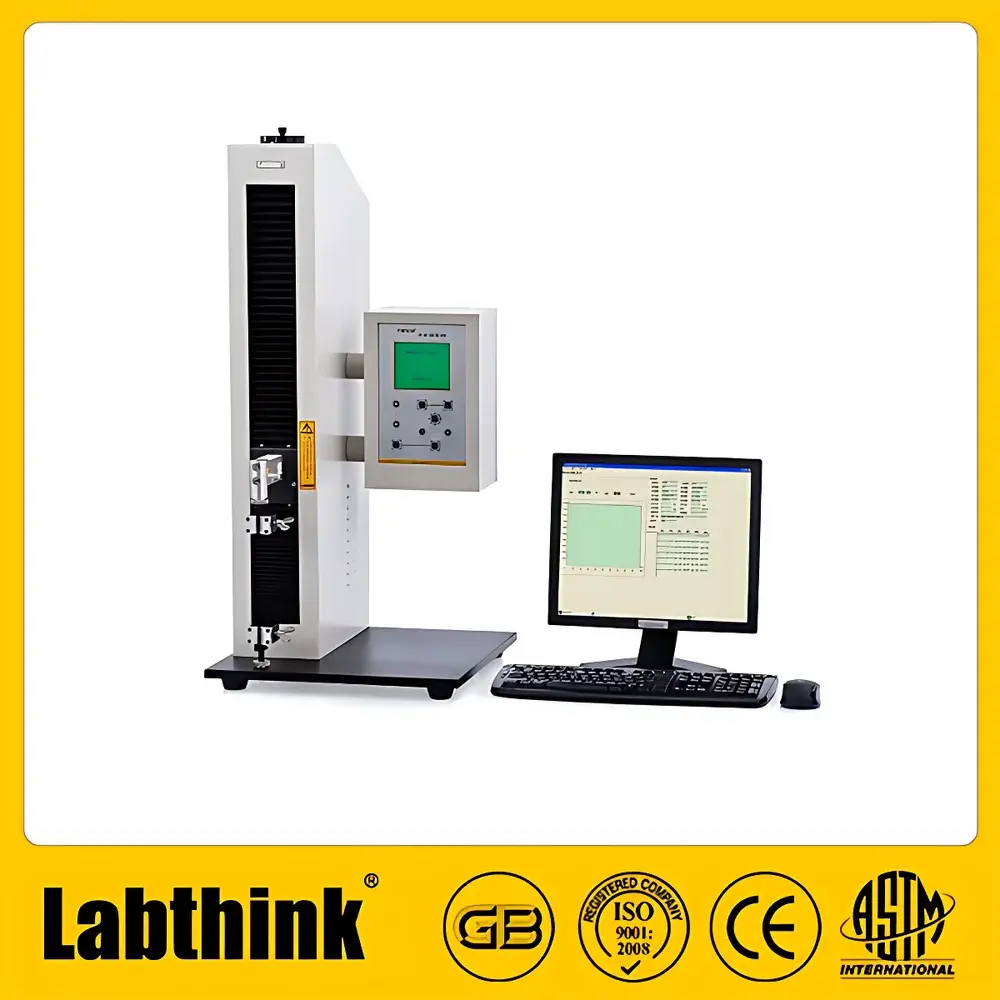
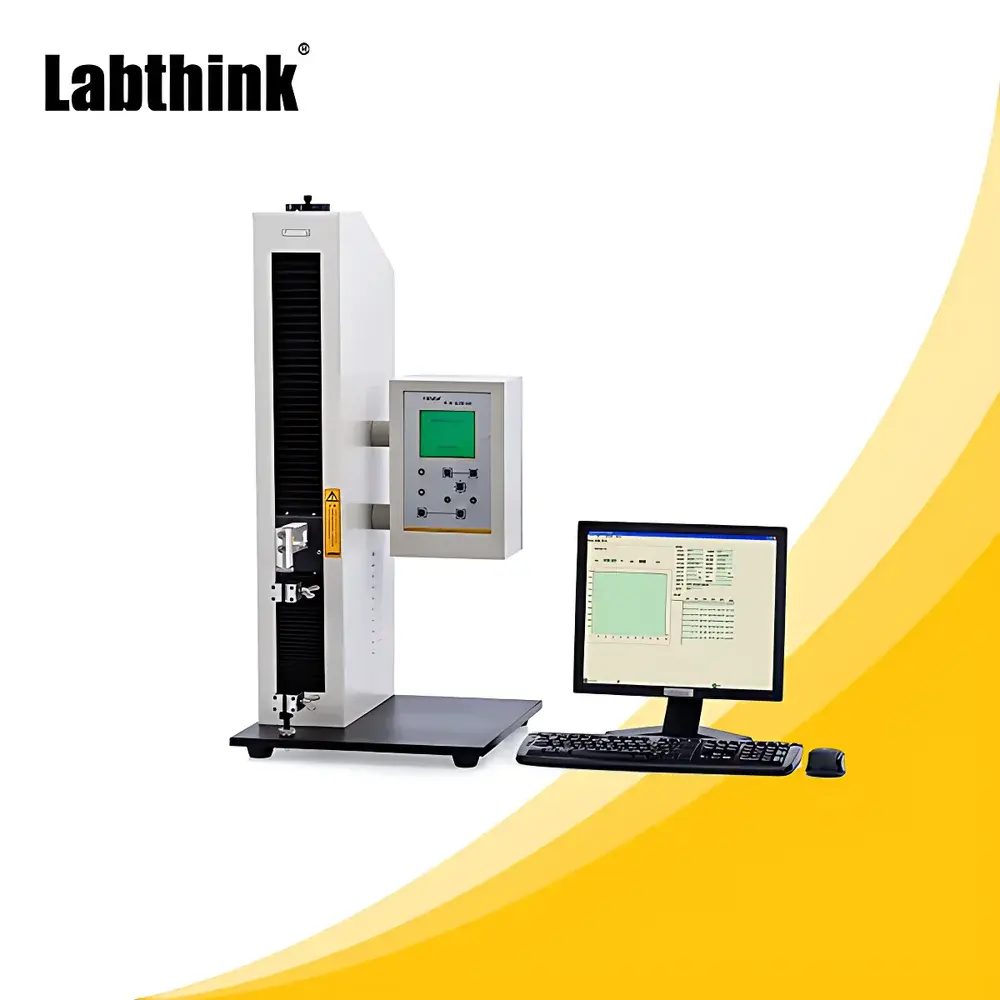
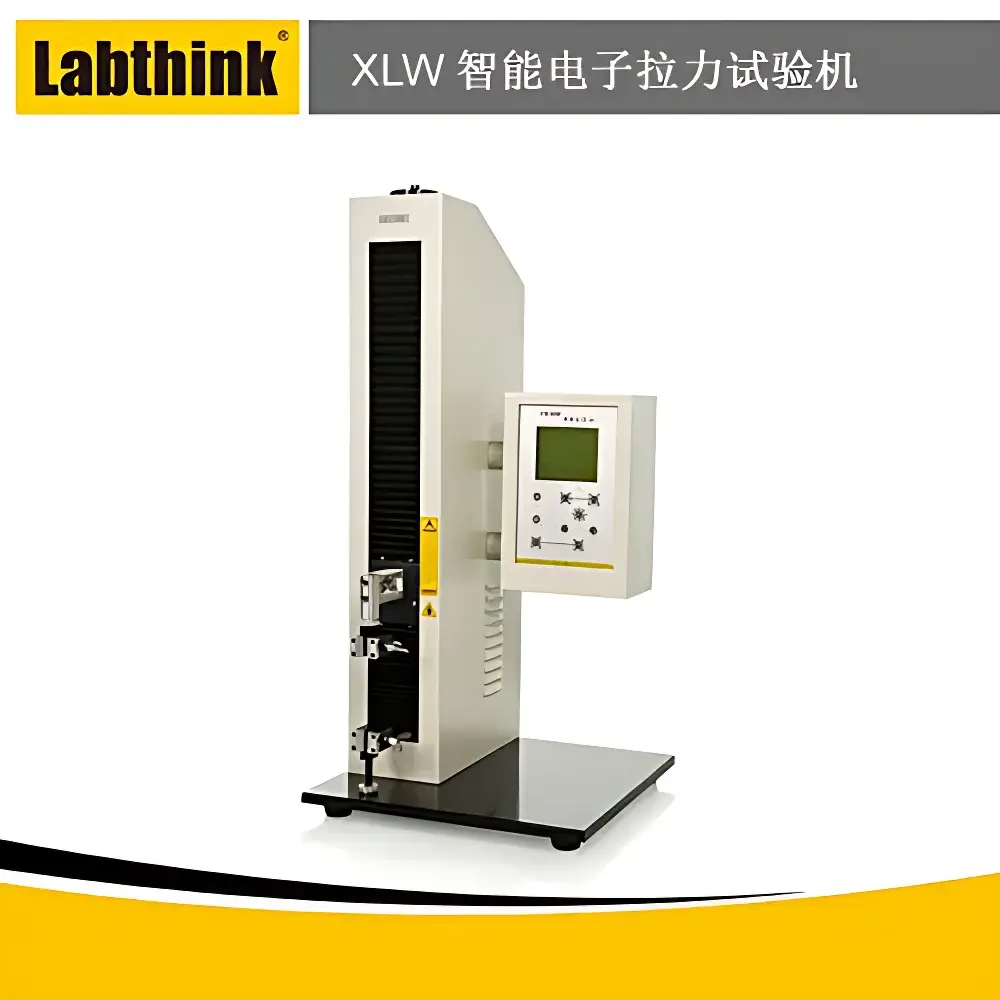
Labthink XLW Intelligent Electronic Tensile Testing Machine
| Brand | Labthink |
|---|---|
| Model | XLW |
| Type | Electromechanical Tensile Tester |
| Test Stroke | 600 mm |
| Displacement Resolution | 0.1 mm |
| Standard Load Capacity | 500 N |
| Optional Load Cells | 30 N, 50 N, 100 N, 200 N, 750 N, 1000 N |
| Test Speeds | 50, 100, 150, 200, 250, 300, 500 mm/min |
| Sample Width (Standard Fixture) | 30 mm |
| Sample Width (Optional Fixture) | 50 mm |
| Power Supply | 220 VAC 50 Hz / 120 VAC 60 Hz |
| Dimensions (L×W×H) | 450 × 450 × 980 mm |
| Net Weight | 65 kg |
| Compliance | ISO 37, ASTM D882, ASTM D1938, ASTM F88, GB/T 1040.1–2006, GB/T 1040.2–2006, GB/T 8808, GB/T 12914, JIS P8113, QB/T 2358 |
Overview
The Labthink XLW Intelligent Electronic Tensile Testing Machine is a precision-engineered electromechanical instrument designed for the quantitative mechanical characterization of flexible packaging materials and thin-film substrates. Based on the fundamental principle of uniaxial tensile loading—where a specimen is clamped between two parallel grips and subjected to controlled, linear displacement—the system simultaneously acquires force and displacement data via a high-stability load cell mounted on the moving crosshead and an integrated linear encoder. These real-time measurements enable calculation of critical mechanical parameters including tensile strength at break, elongation at break, Young’s modulus (via initial slope analysis of the stress–strain curve), tear resistance, peel adhesion, heat seal strength, puncture force, and opening force. The instrument is purpose-built for laboratories requiring traceable, repeatable, and standards-compliant mechanical testing across high-volume quality control (QC), research & development (R&D), and regulatory submission workflows in food packaging, medical device packaging, pharmaceutical blister lidding, and functional barrier film development.
Key Features
- Class 1 accuracy per ISO 7500-1 and ASTM E4, ensuring metrological integrity for GMP/GLP environments
- Seven pre-programmed test modes: tensile, peel, tear, heat seal, shear, puncture, and low-speed unwind—each with independent parameter presets and calibration protocols
- Modular load cell architecture supporting seven selectable ranges (30 N to 1000 N), enabling optimal signal-to-noise ratio across ultra-thin films (<10 µm) and reinforced laminates
- Seven fixed test speeds (50–500 mm/min), aligned with ISO 37, ASTM D882, and GB/T 1040 series requirements for consistent strain-rate control
- Microprocessor-based controller with PVC membrane keypad, large backlit LCD, and intuitive menu navigation—no PC dependency for routine operation
- Integrated safety systems: mechanical end-stop limit switches, electronic overload cutoff, automatic return-to-start after test completion, and power-loss position memory
- Comprehensive data handling: real-time curve plotting, elastic modulus derivation, group statistical analysis (mean, SD, CV%), curve superposition for comparative evaluation, and user-defined pass/fail thresholds
Sample Compatibility & Compliance
The XLW accommodates a broad spectrum of planar, flexible specimens up to 600 mm travel length and 50 mm width. Validated applications include polyethylene (PE), polypropylene (PP), polyester (PET), aluminum foil laminates, metallized films, paperboard composites, nonwovens, medical-grade adhesives, protective release liners, and pharmaceutical pouch seals. All test configurations comply with internationally recognized standards for mechanical property assessment—including ISO 37 (vulcanized rubber), ASTM D882 (thin plastic sheeting), ASTM F88 (heat seal strength), GB/T 1040.1–2006 (tensile testing of plastics), and JIS P8113 (paper and board tensile properties). Instrument validation documentation supports IQ/OQ protocols, and raw data files meet FDA 21 CFR Part 11 requirements for audit trail, electronic signature, and data integrity when used with Lystem™ Laboratory Data Management System.
Software & Data Management
The embedded firmware and optional PC-based Lystem™ software provide full lifecycle data governance. The system captures timestamped force–displacement datasets with 1 kHz sampling resolution, stores metadata (operator ID, sample ID, environmental conditions), and exports ASCII/CSV files compatible with third-party statistical packages (e.g., JMP, Minitab). Lystem™ enables centralized database management, role-based access control, automated report generation (PDF/Excel), trend charting across batches or time, and seamless integration with enterprise LIMS platforms via RS232 or TCP/IP. Audit trails record all parameter modifications, test executions, and data exports—fully compliant with GLP, ISO/IEC 17025, and pharmaceutical quality system regulations.
Applications
- Quantification of tensile strength and elongation of food-grade PE/PP bags per GB/T 8808 and ASTM D882
- Heat seal integrity evaluation of stand-up pouches and retort pouches per ASTM F88 and ISO 11607-2
- Peel strength measurement of pressure-sensitive labels and medical tape backing layers per ASTM D3330 and GB/T 2792
- Tear propagation resistance of high-barrier laminates using Elmendorf or trouser-tear methods per ASTM D1938 and GB/T 16578.1
- Puncture resistance of child-resistant packaging per ASTM D3475 and ISO 8317
- Opening force profiling of easy-open lids and peelable foils per ASTM F904 and QB/T 1130
- Adhesive bond strength validation for pharmaceutical blister lidding per USP and ISO 15378
FAQ
What standards does the XLW tensile tester support for food packaging compliance?
The instrument is pre-configured for ISO 37, ASTM D882, ASTM F88, GB/T 1040.1–2006, GB/T 8808, and GB/T 12914—covering tensile, seal, and peel performance verification required by FDA, EFSA, and China NMPA for food contact materials.
Can the XLW be used for non-standard specimen geometries?
Yes—custom fixtures (e.g., floating roller grips, pneumatic clamps, curved mandrels) are available as optional accessories to accommodate irregular shapes, textured surfaces, or low-modulus hydrogels.
Is the system compliant with 21 CFR Part 11 for regulated laboratories?
When operated with Lystem™ software and configured with user authentication, electronic signatures, and immutable audit trails, the system meets 21 CFR Part 11 requirements for electronic records and signatures.
What maintenance is required to sustain Class 1 accuracy?
Annual calibration against NIST-traceable reference loads and periodic verification using certified reference specimens (e.g., ISO 7500-1 Class 1 reference bars) are recommended; internal self-diagnostic routines verify sensor linearity and encoder resolution prior to each test sequence.
Does the XLW support multi-specimen batch testing without manual intervention?
While single-specimen loading is standard, optional auto-loader modules and programmable test sequences allow unattended execution of up to 20 specimens per batch with automatic result aggregation and outlier flagging.
Related Products



