
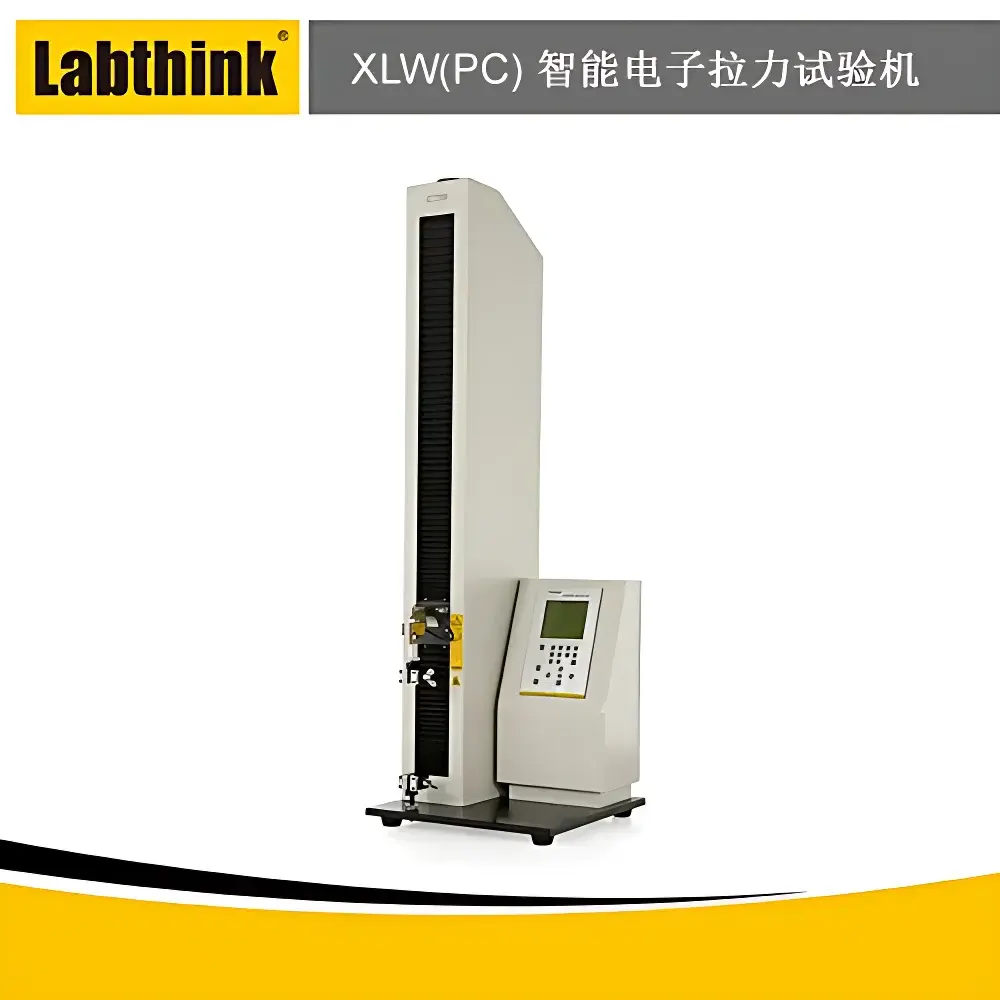
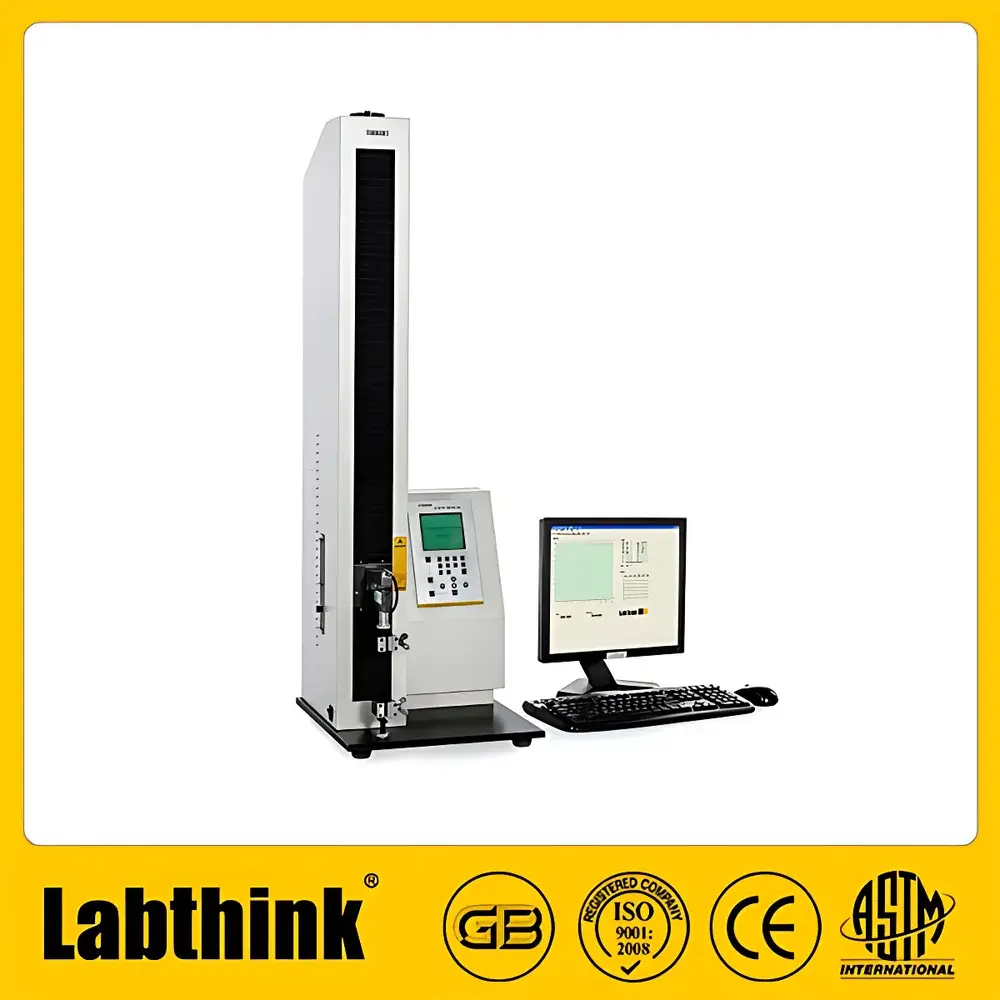
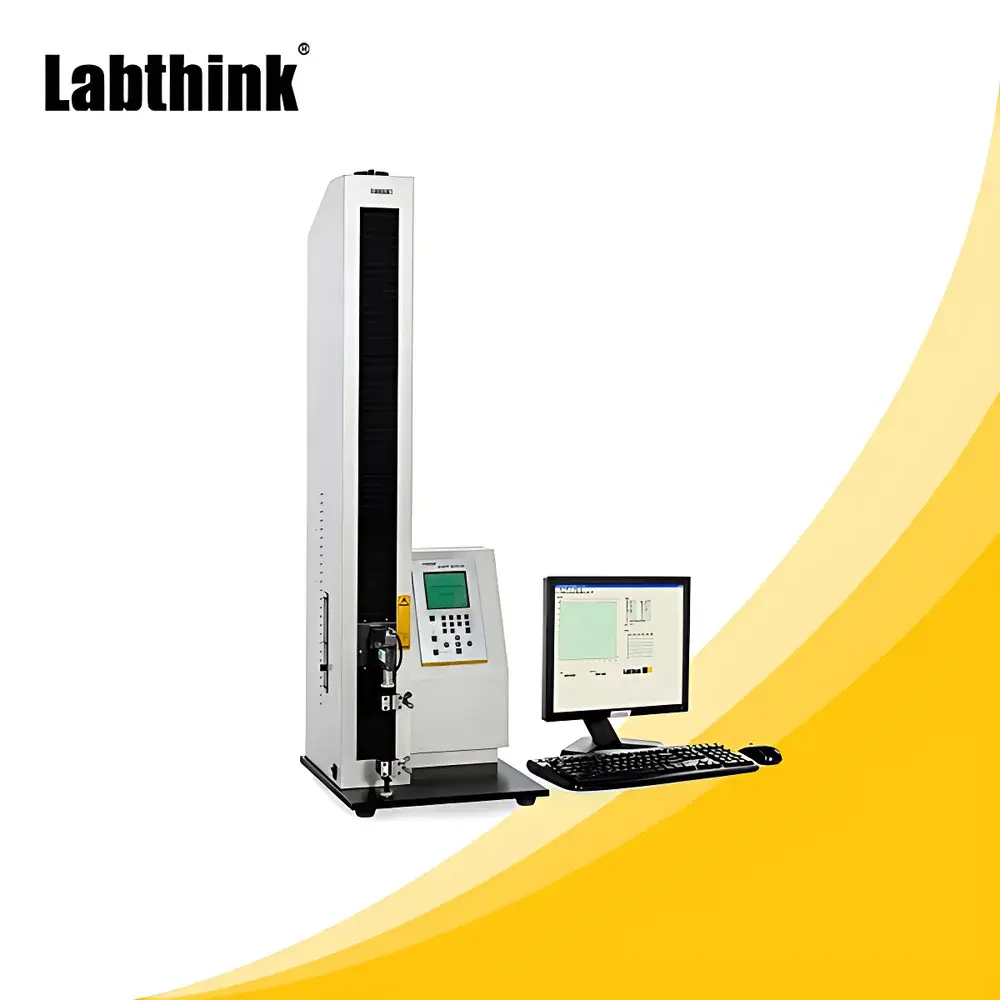
Labthink XLW-PC Intelligent Electronic Tensile Tester
| Brand | Labthink |
|---|---|
| Model | XLW-PC |
| Type | Universal Tensile & Mechanical Property Tester for Flexible Packaging Materials |
| Accuracy Class | 0.5 |
| Force Capacity Options | 50 N, 100 N, 250 N (standard), 500 N (default), 750 N, 1000 N (customizable) |
| Test Speeds | 50, 100, 150, 200, 250, 300, 500 mm/min |
| Maximum Travel | 1000 mm |
| Specimen Width | 30 mm (standard grip), 50 mm (optional) |
| Dimensions | 450 × 450 × 1410 mm (L×W×H) |
| Weight | 68 kg |
| Power Supply | 220 VAC 50 Hz / 120 VAC 60 Hz |
| Compliance | ISO 37, ASTM D882, ASTM D1938, ASTM D3330, ASTM F88, ASTM F904, GB/T 1040.1–1040.5, GB/T 4850, GB/T 12914, GB/T 16578.1, JIS P8113, QB/T 2358, QB/T 1130 |
Overview
The Labthink XLW-PC Intelligent Electronic Tensile Tester is a microprocessor-controlled universal testing system engineered for high-precision mechanical characterization of flexible packaging materials and thin-film substrates. Based on the fundamental principle of uniaxial tensile testing—where a specimen is clamped between two grips and subjected to controlled axial displacement—the instrument simultaneously acquires real-time force (via calibrated load cells) and displacement (via high-resolution linear encoder) data. These synchronized measurements enable direct calculation of key mechanical parameters including tensile strength, elongation at break, Young’s modulus (elastic modulus), yield point, tear resistance, peel adhesion, puncture force, seal integrity, and low-speed unwind torque. Designed specifically for the rigorous demands of QC laboratories in packaging, medical device, pharmaceutical, and polymer R&D environments, the XLW-PC delivers traceable, repeatable, and standards-compliant results under both static and dynamic loading conditions.
Key Features
- 0.5-class accuracy per ISO 7500-1 and ASTM E4—certified for metrological reliability in regulated testing workflows
- Seven pre-programmed test modes: tensile, peel, tear, heat seal strength, puncture, opening force, and slow unwind—each with independent parameter presets and pass/fail logic
- Modular force sensor architecture: interchangeable transducers (50 N to 1000 N) allow optimal resolution across material stiffness ranges—from ultra-thin PET films to reinforced laminates
- Seven discrete crosshead speeds (50–500 mm/min), all mechanically synchronized and verified per ISO 527-1 for strain-rate consistency
- 1000 mm vertical travel accommodates high-elongation specimens (e.g., elastomeric films, hydrogels, nonwovens) without repositioning or multi-stage testing
- Integrated safety architecture: dual hardware limit switches, overload cut-off, automatic return-to-start, and power-loss memory retention ensure operational continuity and personnel protection
- Intuitive human-machine interface: backlit LCD display, tactile PVC membrane keypad, and menu-driven navigation minimize operator training time and procedural error
Sample Compatibility & Compliance
The XLW-PC supports standardized specimen geometries per international regulatory frameworks. Standard 30 mm wide grips comply with ASTM D882 (thin plastic film), ISO 37 (vulcanized rubber), and GB/T 1040.3 (plastics—film and sheet). Optional 50 mm grips extend compatibility to wider laminates and composites. All test routines are fully aligned with method requirements in FDA-recognized standards—including 21 CFR Part 11-ready audit trails when paired with Lystem™ Lab Data Management Software. The system satisfies GLP/GMP documentation needs through timestamped raw data export, electronic signatures, and version-controlled test method libraries. Validated against reference standards traceable to NIST and CNAS-accredited calibration labs, it meets essential criteria for ISO/IEC 17025-accredited laboratories performing routine quality control or regulatory submission testing.
Software & Data Management
Lystem™ Lab Data Management Software (included) provides full lifecycle test data governance. It enables automated calculation of elastic modulus via initial linear slope analysis of stress–strain curves (per ISO 527-2), statistical grouping (n ≥ 5), curve overlay comparison across batches or formulations, and customizable report generation in PDF/Excel formats. All data files include embedded metadata: operator ID, environmental conditions (optional hygrothermally logged), calibration certificate IDs, and instrument firmware version. When deployed in networked lab environments, Lystem™ supports centralized database archiving, role-based access control, and seamless integration with LIMS platforms via ODBC or RESTful API. Audit trail functionality complies with FDA 21 CFR Part 11 requirements, recording every user action—including method edits, result modifications, and report approvals—with immutable timestamps and digital signatures.
Applications
- Quantification of Young’s modulus and tensile strength in BOPP, PET, PE, PA, and metallized films for packaging line qualification
- Peel strength validation of pressure-sensitive adhesives (PSAs) on medical tapes and transdermal patches per ASTM D3330
- Heat seal integrity assessment of pouches and blister lidding foils per ASTM F88 and ISO 11607-2
- Tear propagation resistance measurement in nonwovens and surgical drapes per ASTM D1938
- Puncture force evaluation of protective barrier films used in sterile packaging per ISO 11607-1
- Opening force verification of child-resistant closures and peelable lids per ASTM D3475
- Mechanical aging studies tracking modulus degradation after accelerated UV/thermal/humidity exposure
FAQ
What standards does the XLW-PC directly support out-of-the-box?
The instrument includes factory-loaded test methods for ISO 37, ASTM D882, ASTM D1938, GB/T 1040.1–1040.5, and ASTM F88, with all parameters preconfigured to match standard tolerances.
Can the XLW-PC be integrated into an existing LIMS environment?
Yes—via Lystem™ software’s ODBC driver or HTTP-based API, enabling bidirectional data exchange with major LIMS platforms including Thermo Fisher SampleManager, LabVantage, and STARLIMS.
Is calibration traceability provided with the system?
Each unit ships with a factory calibration certificate traceable to national metrology institutes (NIM, China; NIST, USA), valid for 12 months under normal use conditions.
What is the minimum measurable force resolution at 500 N capacity?
At full scale, resolution is ≤0.05 N (0.01% FS), meeting 0.5-class accuracy requirements per ISO 7500-1.
Does the system support custom夹具design for non-standard specimens?
Yes—Labthink offers engineering consultation and CNC-manufactured custom grips (e.g., floating roller, pneumatic, or serrated jaws) validated for specific substrate geometries and failure modes.



