
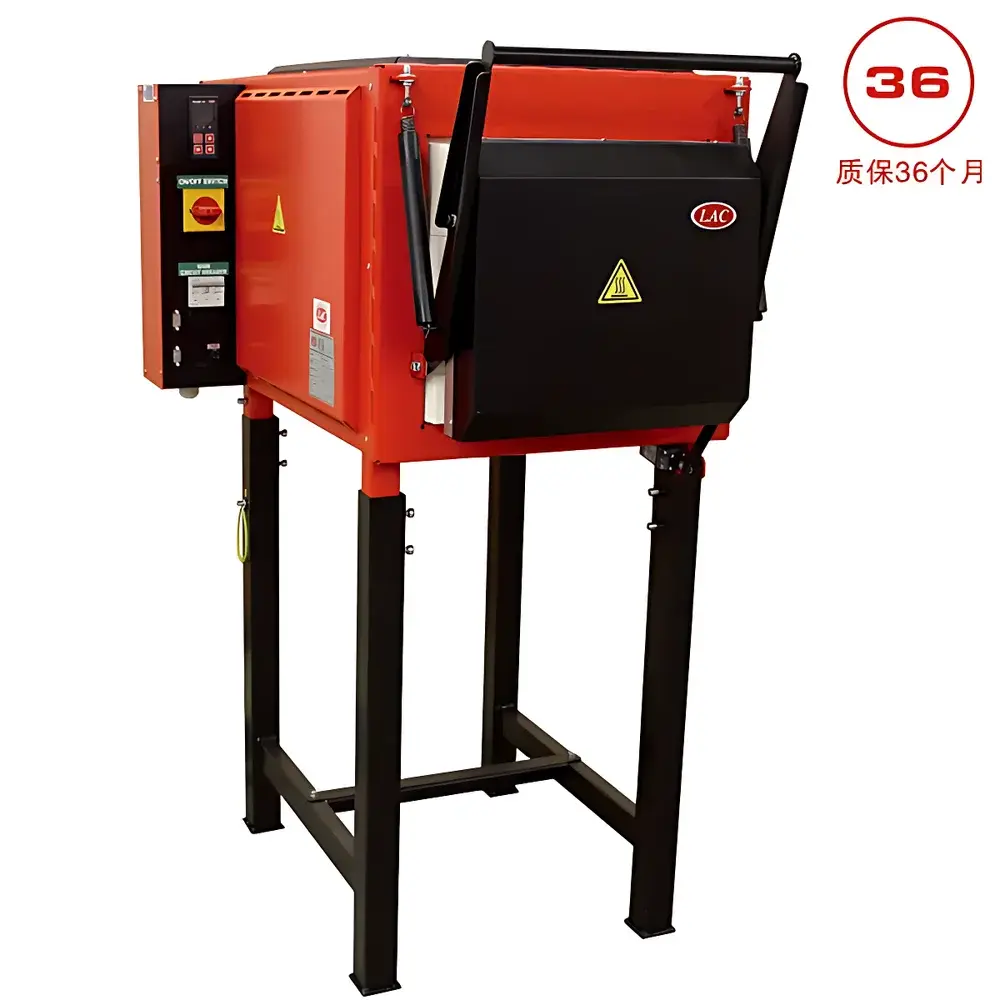
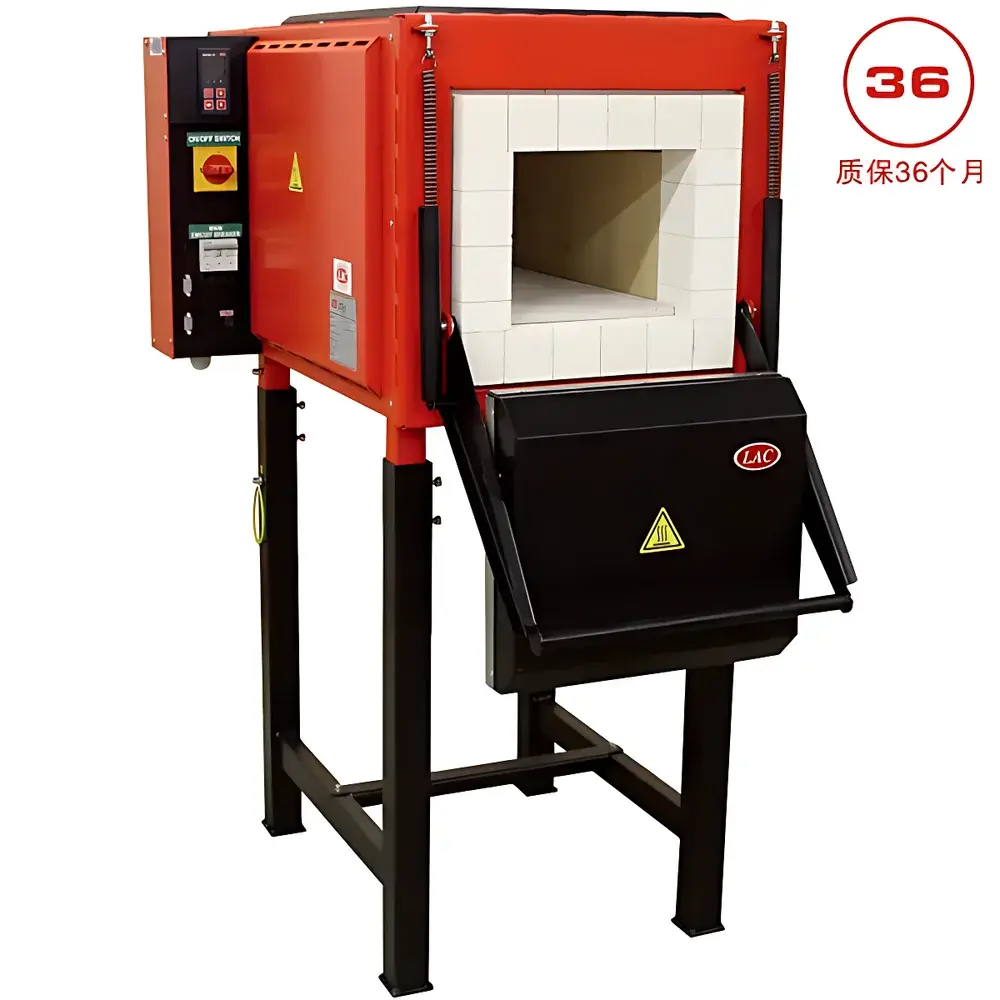
LAC PKE12/12 Benchtop Box-Type Quenching Furnace
| Brand | LAC (Czech Republic) |
|---|---|
| Origin | Czech Republic |
| Model | PKE12/12 |
| Max Operating Temperature | 1280 °C |
| Temperature Uniformity (per DIN 17052-1) | ±20 °C |
| Control Accuracy | ±1 °C |
| Heating Method | Resistance Wire (NiCr Alloy) |
| Internal Chamber Dimensions | 250 × 200 × 250 mm (W × H × D) |
| Rated Power | 3 kW |
| Time to Max Temperature | ≤125 min |
| Standard Controller | HT40P (10 programs, 15 segments each) |
| Thermocouple Type | Type S (Platinum/Rhodium) |
| Door Operation | Manual Downward-Swinging with Limit Switch |
| Safety Features | Interlocked Door Switch, Over-Temperature Protection |
Overview
The LAC PKE12/12 is a compact, benchtop box-type muffle furnace engineered for precise high-temperature thermal processing in research and quality control laboratories. Designed specifically for quenching applications—including solution heat treatment, austenitizing, and rapid thermal cycling—the furnace operates on the principle of resistive heating via high-purity NiCr alloy heating elements embedded in low-thermal-mass insulation. Its ceramic fiber chamber lining minimizes thermal inertia while enabling rapid heating and efficient heat retention, supporting frequent door opening without significant temperature deviation. With a maximum operating temperature of 1280 °C and a certified control accuracy of ±1 °C, the PKE12/12 meets stringent requirements for metallurgical specimen preparation, ceramic sintering, and thermal stability testing under controlled ambient conditions.
Key Features
- Robust ceramic fiber insulation system ensures fast ramp rates (≤125 min to 1280 °C) and stable thermal hold performance.
- Manually actuated downward-swinging door with integrated limit switch provides mechanical safety interlock and prevents operation when open.
- HT40P digital temperature controller supports up to 10 independent programs, each with 15 configurable segments—enabling complex multi-step thermal profiles for ASTM E8/E21 tensile specimen conditioning or ISO 6892-1 heat treatment protocols.
- Type S platinum–rhodium thermocouple (IEC 60584-2 compliant) mounted in the hot zone delivers long-term stability and traceable calibration against NIST-traceable reference standards.
- Standard exhaust port and optional forced-draft chimney assembly (with fan and airflow diverter) facilitate volatile byproduct removal during organic binder burnout or oxide reduction cycles.
- Optional inert atmosphere capability via gas inlet port (N₂, Ar, or forming gas), compatible with flowmeter and pressure gauge integration for ISO 9001-compliant process documentation.
Sample Compatibility & Compliance
The PKE12/12 accommodates standard crucibles (alumina, quartz, or silicon carbide), metallographic mounts, and small-scale ceramic green bodies within its 250 × 200 × 250 mm working volume. Temperature uniformity across the usable zone conforms to DIN 17052-1 Class 2 specifications (±20 °C at 1280 °C), verified using calibrated three-channel digital temperature recorders traceable to national metrology institutes. The furnace complies with EN 61000-6-3 (EMC emission limits) and EN 61000-6-2 (immunity), and its electrical architecture meets IEC 61010-1 requirements for laboratory electrical equipment. Optional HT205 controller upgrade enables uncontrolled forced cooling per ASTM E1111 for accelerated quench cycle validation.
Software & Data Management
When equipped with the HTMonit software suite and EIA-485 interface, the furnace supports real-time temperature logging, remote parameter adjustment, and automated report generation compliant with FDA 21 CFR Part 11 Annex 11 requirements. All thermal profiles, setpoint changes, and alarm events are timestamped and stored with user ID attribution. Calibration data—including thermocouple verification logs and loop tuning parameters—can be exported in CSV or PDF format for internal audit or GLP/GMP documentation. RS232 and EIA-485 interfaces support integration into centralized lab information management systems (LIMS) or SCADA platforms.
Applications
- Metallurgical heat treatment: solution annealing of stainless steels (ASTM A240), aging of aluminum alloys (AMS 2772), and martensitic transformation studies.
- Ceramic processing: sintering of ZrO₂-based dental crowns, densification of Si₃N₄ substrates, and pyrolysis of polymer-derived ceramics.
- Materials qualification: thermal shock resistance testing per ASTM C1525, ash content determination (ASTM D3174), and loss-on-ignition (LOI) analysis for geological samples.
- Calibration lab use: secondary standard furnace for thermocouple calibration (ISO/IEC 17025 accredited labs).
FAQ
What is the recommended maintenance interval for the heating elements and insulation?
Heating elements should be inspected visually every 200 operational hours; ceramic fiber lining requires replacement only after visible cracking or >15% dimensional shrinkage—typically beyond 5,000 h at 1200 °C.
Can the furnace be operated under vacuum or reducing atmospheres?
No—this model is not rated for vacuum or hydrogen-containing atmospheres. Only inert or mildly oxidizing gases (e.g., N₂, Ar, air) are permitted via the optional gas inlet port.
Is third-party calibration certification available?
Yes—LAC-certified calibration reports (including as-found/as-left data per ISO/IEC 17025) can be provided upon request, with traceability to Czech Metrological Institute (ČMI) standards.
Does the HT40P controller support ramp-soak programming with dwell time?
Yes—each of the 15 segments per program allows independent ramp rate (°C/min), soak duration (minutes or hours), and target temperature, with automatic transition logic.
What safety certifications does the PKE12/12 hold for EU deployment?
It carries CE marking per Machinery Directive 2006/42/EC and Low Voltage Directive 2014/35/EU, with full conformity assessment documented in the technical file available upon order confirmation.
Related Products



