
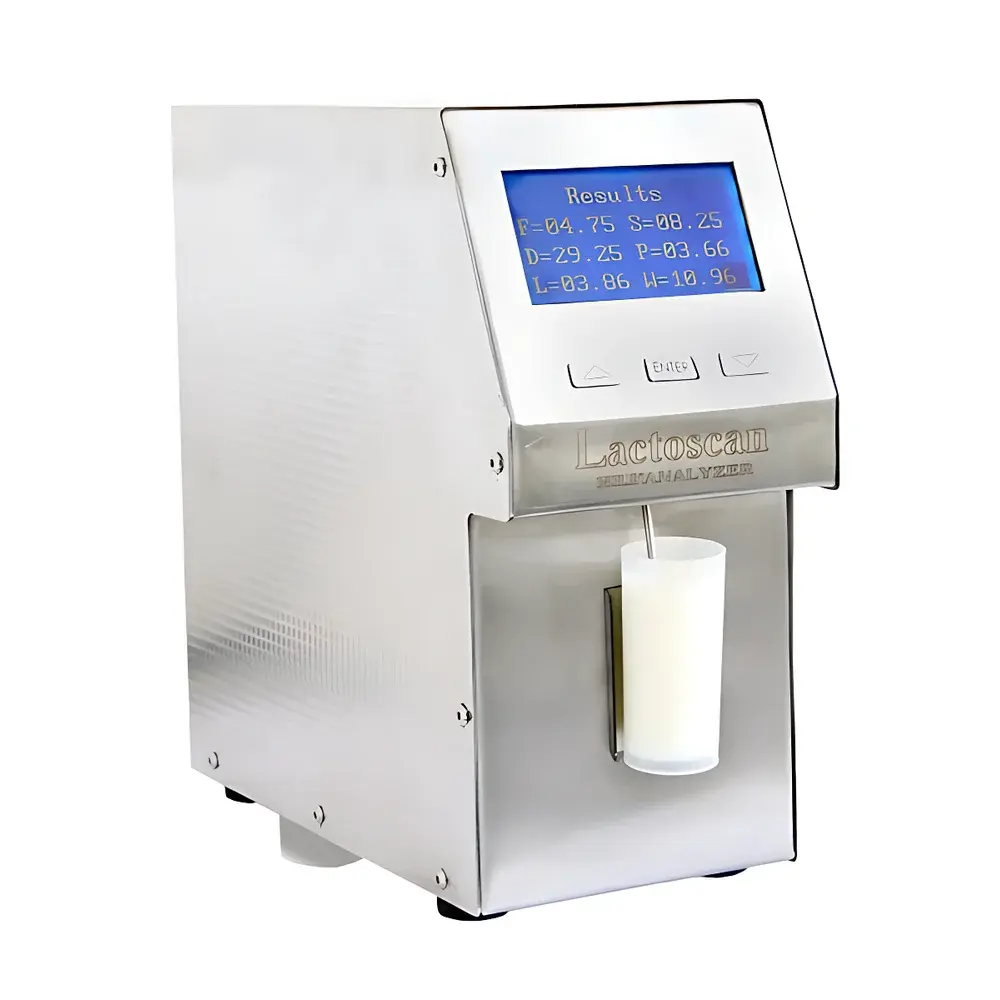
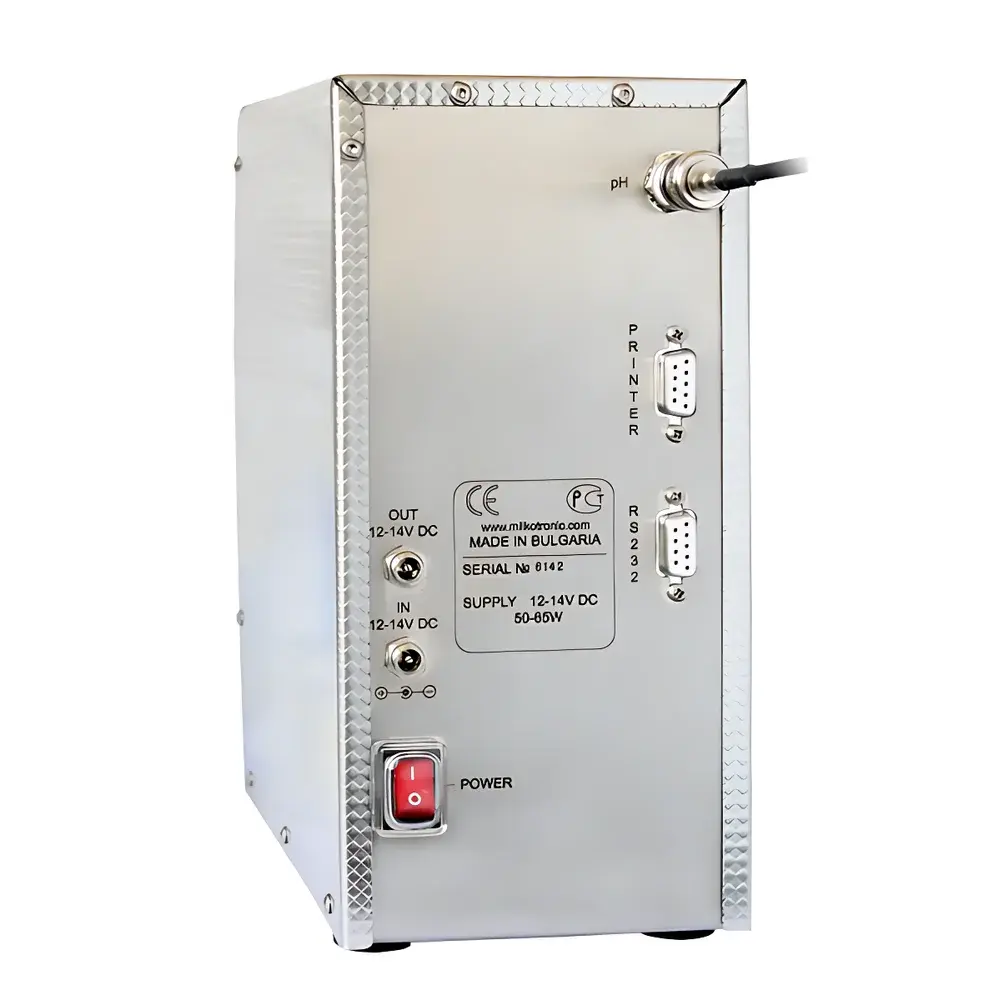
Lactoscan S Series Dairy Analyzer
| Brand | Lactoscan (Milkotronic, Bulgaria) |
|---|---|
| Origin | Bulgaria |
| Model | LACTOSCAN S |
| Automation | Fully Automatic |
| Analysis Speed | ≥60 samples/hour |
| Measurement Range | Fat 0.01–25%, Protein 2–7%, Lactose 0.01–6%, Non-Fat Solids 3–15%, Ash 0.4–1.5%, Water Adulteration 0–70%, Freezing Point –0.4 to –0.7 °C, Sample Temperature 1–40 °C, Density 1.000–1.160 g/cm³, pH 0–14, Conductivity 3–10 mS/cm |
| Repeatability | Fat ±0.10%, Protein ±0.15%, Lactose ±0.20%, Non-Fat Solids ±0.15%, Ash ±0.05%, Water Adulteration ±3%, Freezing Point ±0.001 °C, Sample Temperature ±1 °C, Density ±0.0003 g/cm³, pH ±0.05, Conductivity ±0.05 mS/cm |
| Precision | 0.01% |
| Sample Volume | 15 mL |
| Power Supply | 230 V AC, 50–60 Hz / 12 V DC |
| Dimensions | 10 × 24 × 22 cm (W × H × D) |
| Weight | 3.0 kg |
| Compliance | CE-marked, compliant with ISO 9001 manufacturing standards and applicable EU food safety directives |
Overview
The Lactoscan S Series Dairy Analyzer is a fully automated, benchtop near-infrared (NIR) and multi-sensor dairy composition analyzer engineered for rapid, reagent-free quantification of key physicochemical parameters in raw, pasteurized, and standardized milk. Operating on the principle of broadband NIR spectroscopy combined with integrated thermometric, conductometric, densimetric, and pH sensing modules, the instrument delivers simultaneous, non-destructive measurement of fat, protein, lactose, non-fat solids, ash, freezing point depression, water adulteration, density, sample temperature, pH, and electrical conductivity. Designed for high-throughput quality control environments—including dairy collection centers, processing plants, and regulatory laboratories—the Lactoscan S meets the operational demands of routine milk intake testing, supplier verification, and compliance screening against national and international dairy standards (e.g., Codex Alimentarius, ISO 9622, IDF Standard 141).
Key Features
- Fully automated analysis cycle: minimal operator intervention from sample loading to result export; includes auto-calibration, self-cleaning, and diagnostic self-checks.
- Multi-parameter detection platform: integrates NIR spectral analysis with real-time physical parameter acquisition—no chemical reagents, solvents, or consumable kits required.
- High throughput capability: processes ≥60 samples per hour with consistent 15 mL sample volume requirement, enabling efficient batch testing across multiple suppliers or production lines.
- Compact, portable design: footprint of only 10 × 24 × 22 cm and weight of 3.0 kg facilitates deployment in mobile labs, field stations, or space-constrained QC rooms.
- Dual power configuration: supports both 230 V AC (50–60 Hz) and 12 V DC operation, suitable for off-grid collection points or vehicle-mounted units.
- Embedded thermal stabilization: maintains optical path and sensor integrity across ambient temperatures from 1–40 °C, ensuring measurement stability without external climate control.
Sample Compatibility & Compliance
The Lactoscan S is validated for use with bovine, ovine, caprine, and buffalo milk—both chilled and ambient-temperature samples (1–40 °C). It accommodates variations in homogenization state, minor sedimentation, and moderate fat globule size distribution without pre-filtration. All measurements comply with ISO 9622:2013 (Milk — Determination of fat, protein, lactose, total solids and non-fat solids — Guidance on the use of mid-infrared spectrometry) and align with the performance criteria outlined in IDF Standard 141 (International Dairy Federation) for on-farm and receiving station analyzers. The system’s freezing point module adheres to ISO 5768:1999 for detection of water adulteration via cryoscopic depression, while conductivity and pH modules meet EN ISO 2173 and EN ISO 3104 specifications respectively. Data integrity protocols support GLP/GMP-aligned workflows, including user access logs and audit-ready calibration records.
Software & Data Management
Controlled via an embedded Linux-based interface with intuitive touchscreen navigation, the Lactoscan S provides real-time visualization of spectral overlays, trend charts, and pass/fail flags based on user-defined specification limits. Raw data and processed results are exportable in CSV, XML, or PDF formats via USB or RS-232 serial interface. Optional integration with LIMS (Laboratory Information Management Systems) is supported through ASCII protocol compatibility and configurable data fields. All calibration curves are traceable to certified reference materials (CRM) supplied by Milkotronic and are subject to periodic validation using internal reference standards. Firmware updates maintain alignment with evolving regulatory requirements—including EU Regulation (EC) No 853/2004 on hygiene rules for food of animal origin—and support full audit trails per FDA 21 CFR Part 11 when used with optional password-protected user roles and electronic signature modules.
Applications
- Raw milk acceptance testing at dairy cooperatives and collection hubs.
- Real-time monitoring of compositional consistency during standardization and blending operations.
- Adulteration screening for water dilution, reconstitution, or foreign fat addition.
- Supporting HACCP plans through rapid detection of deviations in freezing point, conductivity, or pH indicative of mastitis, spoilage, or contamination.
- Research applications requiring high-frequency longitudinal profiling of herd-level milk composition under feeding or management interventions.
- Regulatory compliance reporting for national dairy authorities enforcing compositional labeling and purity requirements.
FAQ
Does the Lactoscan S require daily recalibration?
No—its built-in auto-calibration routine executes prior to each analysis sequence using internal reference standards; full manual recalibration is recommended only after firmware updates or every 30 days of continuous operation.
Can the instrument analyze frozen or partially thawed milk samples?
The system accepts samples within 1–40 °C; frozen samples must be fully thawed and homogenized prior to analysis to ensure representative NIR signal capture and sensor accuracy.
Is method validation documentation available for regulatory submissions?
Yes—Milkotronic provides a comprehensive Validation Package including IQ/OQ documentation, linearity studies, precision reports per ISO 5725, and CRM traceability statements for all primary parameters.
What maintenance is required beyond routine cleaning?
Beyond daily rinse cycles and bi-weekly acid/alkaline cleaning (supplied), no scheduled mechanical servicing is required for the first 24 months; optical windows and flow cells are designed for >10,000 analyses before replacement.
How does the freezing point module detect water adulteration?
It measures cryoscopic depression relative to pure water baseline; a shift toward –0.500 °C or higher indicates proportional dilution, calculated per ISO 5768 using empirically derived correlation coefficients for species-specific milk matrices.






