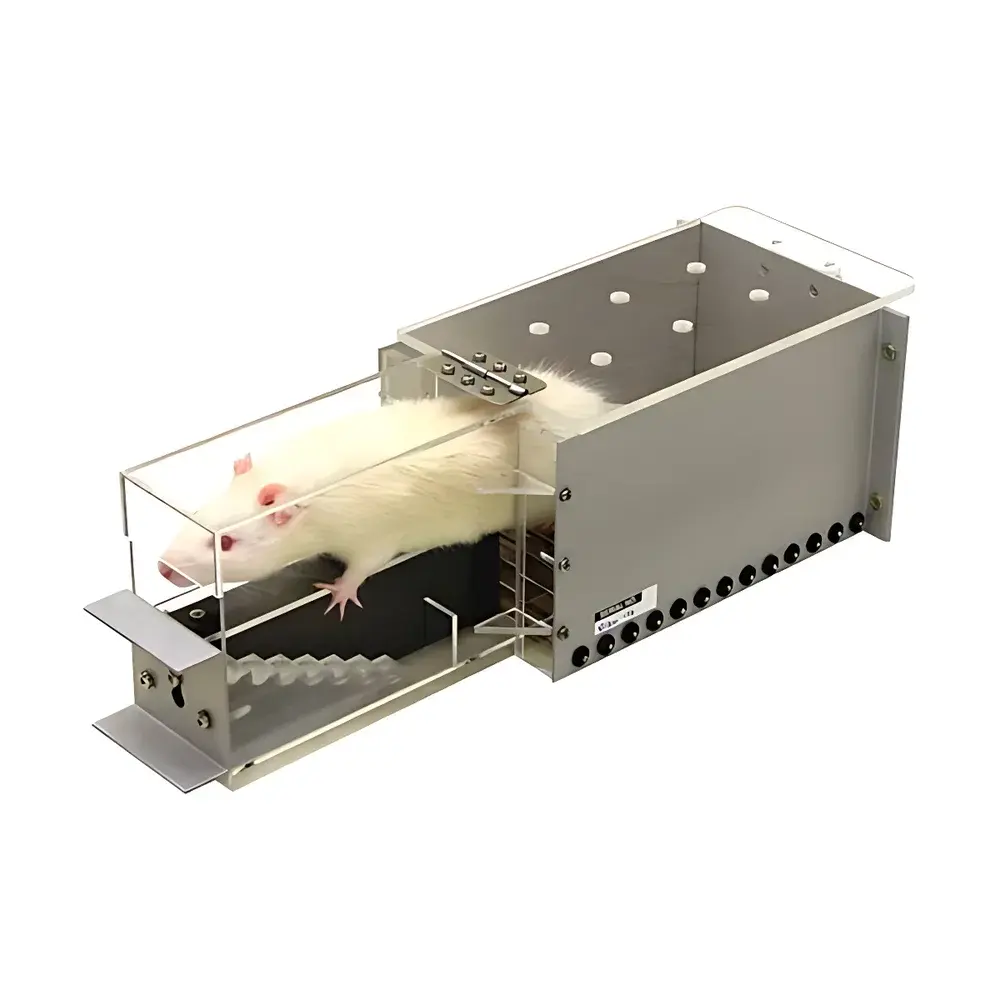
Lafayette Model 80300 & 80301 Staircase Skilled Reaching Test Apparatus
| Origin | USA |
|---|---|
| Manufacturer Type | Authorized Distributor |
| Origin Category | Imported |
| Models | 80300 (Rat), 80301 (Mouse) |
| Price | USD $14,500 (FOB) |
Overview
The Lafayette Model 80300 (rat) and Model 80301 (mouse) Staircase Skilled Reaching Test Apparatus is a validated, ethologically grounded behavioral assay platform engineered for quantitative assessment of forelimb dexterity, sensorimotor integration, and skilled reaching capacity in rodent models. Based on the established staircase paradigm originally developed to model human upper-limb motor recovery after cortical or subcortical injury, this apparatus leverages food-motivated operant behavior to elicit naturalistic grasping, supination, and retrieval movements. The core measurement principle relies on spatially resolved, unilateral task performance: animals are placed on a central platform and must reach laterally—without body rotation—to retrieve food pellets placed on ascending stair-like steps positioned at two distinct vertical heights on either side. Success is quantified by the number of pellets retrieved, displaced, or successfully transported to the mouth across repeated trials—providing objective, non-invasive metrics of reach accuracy, grip strength, digit coordination, and interlimb asymmetry. This paradigm is particularly sensitive to focal lesions affecting the striatum, dopaminergic nigrostriatal pathways, sensorimotor cortex, and internal capsule—making it a standard tool in preclinical studies of Parkinson’s disease, ischemic stroke, Huntington’s disease, and traumatic brain injury.
Key Features
- Asymmetric bilateral staircase design with independently adjustable step heights (6-step gradient per side) to differentiate distal vs. proximal reach demands
- Unidirectional confinement architecture prevents 180° body rotation during testing, ensuring isolated forelimb engagement and minimizing compensatory trunk movement
- No physical restraint required—intact contralateral limb remains freely mobile, enabling natural posture and reducing stress-induced behavioral artifacts
- Rat version (Model 80300): 360 mm × 120 mm × 120 mm (L × W × H); accommodates rodents up to 400 g with optimized step spacing for adult Sprague-Dawley or Long-Evans rats
- Mouse version (Model 80301): 145 mm × 55 mm × 51 mm (L × W × H); precision-scaled step dimensions (2.5 mm vertical increment) calibrated for C57BL/6, BALB/c, and transgenic mouse strains
- Opaque acrylic construction minimizes visual distraction while permitting unobstructed video recording from dorsal and lateral angles for automated motion tracking integration
- Modular base plate with standardized mounting holes compatible with commercial behavioral tracking systems (e.g., EthoVision XT, ANY-maze)
Sample Compatibility & Compliance
The Staircase Test Apparatus is validated for use in male and female Sprague-Dawley, Wistar, Fischer 344, and Lewis rats, as well as C57BL/6J, DBA/2, and FVB/N mice. Protocols align with NIH Guide for the Care and Use of Laboratory Animals and AAALAC International standards. Experimental designs incorporating this apparatus routinely satisfy requirements for IACUC protocol submissions involving motor function endpoints. Data generated support GLP-compliant preclinical neuropharmacology studies when paired with standardized training regimens (e.g., 5-day acclimation + 3-day baseline + 7-day post-intervention testing). The apparatus itself contains no electronic components, eliminating electromagnetic interference concerns in multi-modal setups (e.g., concurrent fMRI or electrophysiology).
Software & Data Management
While the apparatus operates manually, it is fully interoperable with third-party behavioral analysis software. Raw output consists of discrete event logs (pellet displacement time, retrieval latency, success/failure per step level, limb preference index) that can be exported as CSV or Excel-compatible files. When integrated with video-based pose estimation tools (e.g., DeepLabCut, SLEAP), frame-level kinematic parameters—including joint angle trajectories, reach velocity profiles, and grasp onset timing—can be extracted and statistically correlated with pellet retrieval outcomes. Audit trails, user-defined trial metadata tagging, and timestamp synchronization with external stimulus controllers comply with FDA 21 CFR Part 11 requirements when deployed within validated laboratory information management systems (LIMS).
Applications
- Quantification of motor asymmetry following unilateral 6-OHDA or MPTP lesioning in rat and mouse PD models
- Evaluation of functional recovery kinetics after photothrombotic or endothelin-1–induced focal cortical ischemia
- Pharmacodynamic profiling of dopaminergic agonists, D2 receptor modulators, and neurotrophic factor delivery systems
- Validation of cell-based therapies (e.g., dopaminergic neuron grafts) and biomaterial scaffolds in striatal repair paradigms
- Genetic screening of motor phenotypes in knock-in/knockout lines modeling basal ganglia circuit dysfunction
- Longitudinal assessment of age-related decline in fine motor control in senescence-accelerated mouse models
FAQ
Is food restriction required prior to testing?
Yes—standard protocols involve 12–16 hour overnight fasting followed by 1–2 g/day weight-maintained feeding to ensure motivation without compromising welfare.
Can both limbs be tested simultaneously?
No—the paradigm is designed for unilateral assessment; contralateral limb activity is monitored but not scored to preserve test specificity.
What is the recommended training duration before baseline data collection?
A minimum of five daily 10-minute sessions is required for stable performance; full habituation typically occurs by Day 3.
Are replacement pellets or calibration tools included?
Standard 45 mg dustless precision pellets (e.g., Bio-Serv F0165) are recommended; custom-machined calibration gauges for step height verification are available upon request.
Does the apparatus meet ISO 17025 traceability requirements for metrological validation?
Physical dimensions are certified to ±0.1 mm tolerance; dimensional certificates and material compliance documentation (FDA-compliant acrylic, RoHS-certified fasteners) are provided with each unit.