Lake Shore Custom Probe Station
| Brand | Lake Shore |
|---|---|
| Origin | USA |
| Manufacturer Status | Authorized Distributor |
| Product Origin | Imported |
| Model | Custom |
| Pricing | Upon Request |
Overview
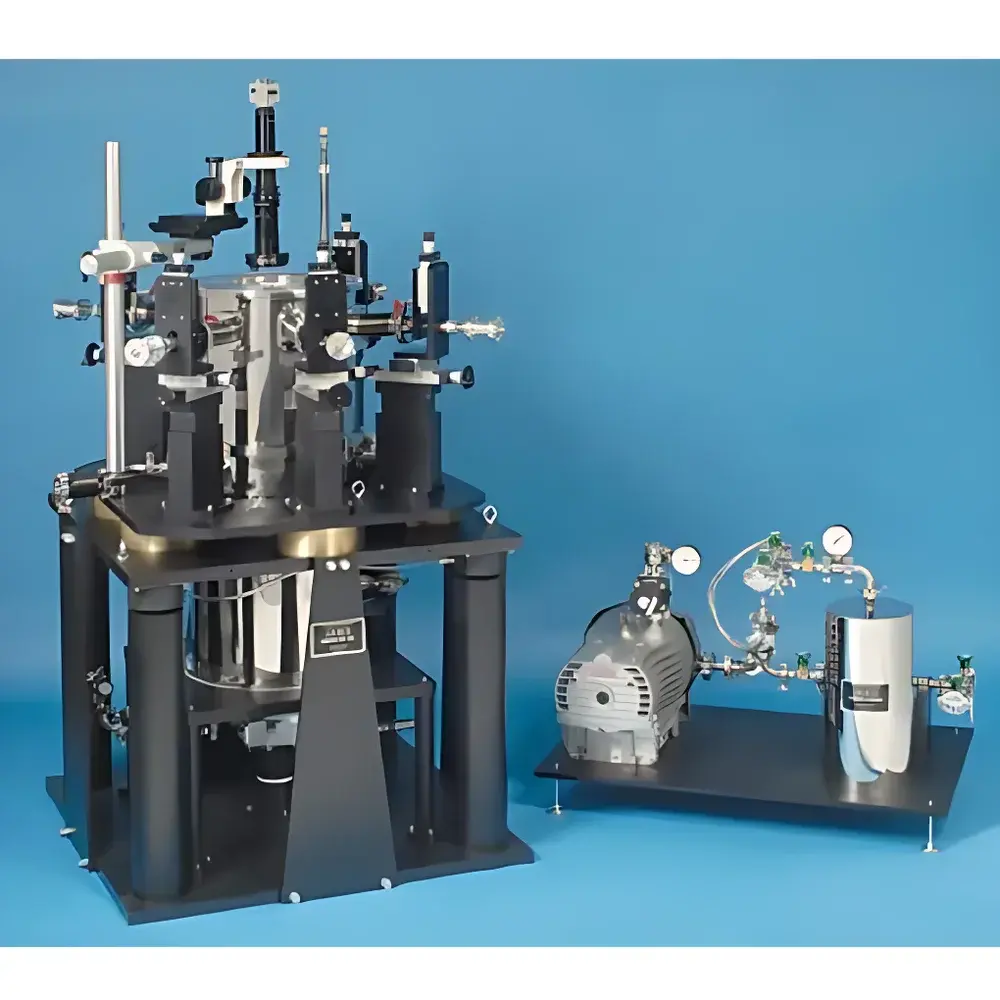
Lake Shore Custom Probe Stations are engineered for precision electrical, magnetic, and thermal characterization of semiconductor devices, quantum materials, and microfabricated structures under controlled cryogenic, vacuum, and magnetic field conditions. Built upon Lake Shore’s industry-proven platform architecture—originally developed for low-temperature physics and device metrology—these custom systems integrate high-stability mechanical design, ultra-low-vibration sample stages, and modular interfacing for electrical, optical, and RF signal routing. Unlike off-the-shelf probe stations, each custom configuration is co-developed with the end user to align with specific experimental constraints: temperature range, magnetic field orientation and strength, sample geometry, probe count and pitch, vacuum integrity, and compatibility with inert-atmosphere glovebox transfer protocols. The core measurement principle relies on direct DC/AC/frequency-domain electrical probing (e.g., IV, CV, Hall, 4-wire resistance) combined with synchronized thermal and magnetic field control—enabling reproducible data acquisition in environments ranging from 2 K to 675 K and up to 5 T vertical fields.
Key Features
- Modular cryogenic integration: Support for both helium-free superconducting magnet systems and liquid helium/liquid nitrogen-cooled configurations
- Temperature range flexibility: Standard operation from 2 K to 420 K (with magnetic field); extended range options up to 675 K available for non-magnetic or zero-field applications
- Ultra-low vibration performance: Sample stage stability maintained below 1 µm RMS at base temperature; sub-25 nm positional drift at room-temperature vacuum conditions
- High-field compatibility: Vertical magnetic fields up to 5 T with homogeneity optimized across standard 6.5-inch diameter sample platforms
- Scalable electrical interface: Up to eight independent probe arms with configurable spacing, high-voltage capability (up to 3 kV), and shielded cabling for low-noise measurements
- Glovebox-integrated transport solution: Patented portable vacuum chamber (Ø50 mm × 25 mm) enabling contamination-free transfer of wafers or substrates between inert-atmosphere gloveboxes and vacuum/cryogenic probe stations—no gate valve required
Sample Compatibility & Compliance
Custom probe stations accommodate a broad spectrum of semiconductor and advanced material samples—including full 200 mm wafers, diced die, MEMS devices, 2D material flakes, and epitaxial heterostructures. All mechanical and vacuum components comply with ISO 8573-1 Class 4 clean dry air standards for internal chamber surfaces, and vacuum chambers meet UHV-compatible material specifications (304/316 stainless steel, oxygen-free copper, ceramic insulators). Systems designed for production or regulated R&D environments support documentation packages aligned with GLP and GMP principles, including IQ/OQ protocols, calibration traceability to NIST standards, and optional audit-ready electronic logbooks compliant with FDA 21 CFR Part 11 requirements for data integrity.
Software & Data Management
Lake Shore’s CryoSoft™ platform provides native instrument control, real-time parameter logging, and synchronized multi-channel data acquisition. The software supports scripting via Python API for automated temperature/magnetic field sweeps, probe positioning routines, and conditional measurement triggers. All acquired datasets include embedded metadata (timestamp, setpoints, environmental conditions, user ID), ensuring FAIR (Findable, Accessible, Interoperable, Reusable) data practices. Export formats include HDF5, CSV, and MATLAB-compatible binaries—facilitating integration into institutional data lakes or third-party analysis pipelines such as Igor Pro, OriginLab, or custom Python-based quantum transport modeling tools.
Applications
- Low-temperature transport studies of topological insulators, superconductors, and van der Waals heterostructures
- DC and RF characterization of GaN HEMTs, SiC MOSFETs, and GaAs MMICs across temperature and bias stress conditions
- Magnetotransport mapping (Hall bar, Corbino disk, Van der Pauw) under variable field and temperature
- In-situ annealing and thermal cycling experiments with real-time electrical monitoring
- Integration with external optical excitation (confocal PL, Raman) via side-access optical ports and low-stray-light chamber design
- Reliability testing of MEMS resonators and NEMS devices under cryogenic vacuum
FAQ
What lead time should be expected for a fully custom probe station?
Typical development and fabrication cycles range from 20–32 weeks, depending on magnet integration complexity, vacuum chamber customization, and qualification testing scope.
Can existing Lake Shore probe stations be retrofitted with custom modules?
Yes—many custom features (e.g., specialized sample stages, additional feedthroughs, vacuum transport adapters) are designed as drop-in upgrades compatible with current-generation TTPX and CRX-6.5 platforms.
Is remote commissioning and operator training supported?
All systems include virtual commissioning sessions, SOP documentation, and on-demand technical support via secure remote access—complementing on-site installation where required.
Are calibration certificates provided for temperature and magnetic field sensors?
Each system ships with factory calibration reports traceable to NIST standards for all primary sensors (Cernox™, RuO₂, Hall probes), with optional annual recalibration services available under service agreement.
How is electromagnetic interference mitigated during high-frequency or low-current measurements?
Standard configurations include mu-metal shielding enclosures, filtered electrical feedthroughs, and twisted-pair/shielded coaxial routing—configurable per application-specific EMI profile requirements.