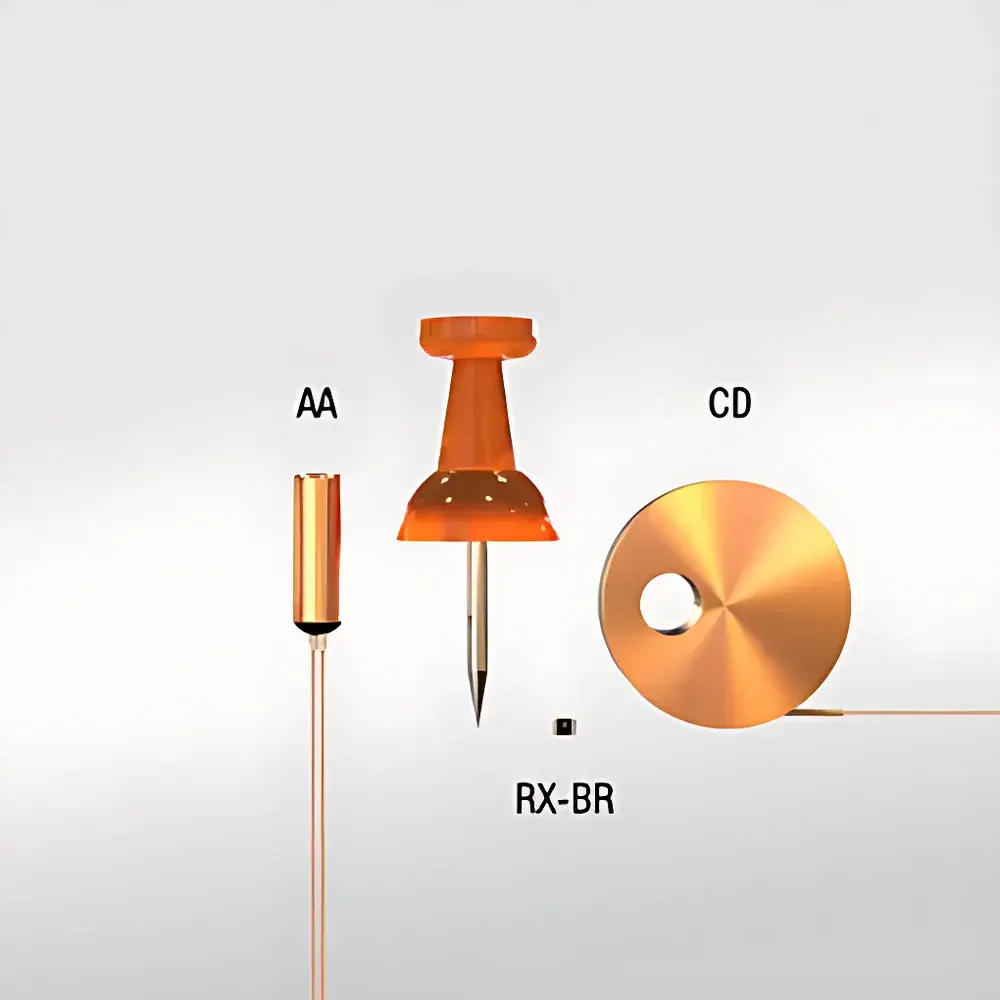
Lake Shore Rox™ Interchangeable Ruthenium Oxide Temperature Sensors
| Brand | Lake Shore |
|---|---|
| Origin | USA |
| Model | Rox™ Series (RX-102A, RX-202A, RX-103A) |
| Temperature Range | 0.05 K to 40 K (RX-102A/RX-202A) |
| Resistance at 300 K | 1 kΩ (RX-102A), 2 kΩ (RX-202A), 10 kΩ (RX-103A) |
| Calibration Accuracy | ±16 mK @ 4.2 K (RX-102A/RX-202A) |
| Magnetic Field Tolerance | < 0.1% resistance shift in ≤ 12 T fields |
| Radiation Hardness | Qualified for neutron/gamma irradiation environments up to 1 × 10¹⁵ n/cm² (E > 1 MeV) |
| Thermal Dissipation | 7.5 × 10⁻⁸ W @ 4.2 K (RX-102A/RX-202A) |
| Time Constant | 0.5 s @ 4.2 K, 2.5 s @ 77 K |
| Repeatability | ±15 mK @ 4.2 K |
| Long-Term Stability | ±30 mK @ 4.2 K (RX-102A), ±50 mK (RX-202A), ±15 mK (RX-103A) |
| Compliance | NIST-traceable calibration, ISO/IEC 17025 accredited lab reporting, GLP-compliant documentation available |
Overview
Lake Shore Rox™ interchangeable ruthenium oxide (RuO₂) temperature sensors are precision thin-film resistive thermometers engineered for ultra-low-temperature cryogenic applications where high accuracy, magnetic field immunity, and long-term stability are critical. Based on a proprietary thick-film composite of bismuth ruthenate, ruthenium oxide, glass frit, and tailored organic binders, each Rox™ sensor exhibits a rigorously controlled, monotonic negative temperature coefficient (NTC) resistance–temperature relationship. Unlike conventional RuO₂ sensors whose resistance curves may deviate significantly below 1 K or invert near room temperature, the Rox™ series maintains strict adherence to a single, factory-defined calibration curve across its operational range—enabling true interchangeability without recalibration. This traceable standard curve is certified per ISO/IEC 17025 and supported by NIST-traceable calibration reports. The sensors operate from 50 mK (RX-102A and RX-202A) or 1.4 K (RX-103A) up to 40 K, with minimal self-heating (< 10 nW at base temperature) and sub-second thermal response times—making them ideal for dynamic cryostat monitoring, dilution refrigerator stage control, and quantum device characterization under high magnetic fields.
Key Features
- True interchangeability: All Rox™ sensors of the same model (e.g., RX-102A-AA) conform to identical resistance vs. temperature (R–T) curves per Lake Shore’s master calibration standard—eliminating unit-to-unit fitting or software compensation during system integration.
- Superior magnetic field immunity: RX-202A delivers up to 4× lower magnetoresistive error than comparable RuO₂ sensors in fields up to 12 T; RX-102A exhibits reduced field-induced drift below 1 K relative to RX-202A.
- Broad cryogenic coverage with monotonic response: RX-202A provides continuous, strictly decreasing R(T) from 0.05 K to 300 K; RX-103A offers optimized linearity and low uncertainty between 1.4 K and 40 K—ideal for helium-3 cryostats and adiabatic demagnetization refrigerators.
- Radiation-tolerant construction: Validated for operation in neutron and gamma radiation environments exceeding 1 × 10¹⁵ n/cm² (E > 1 MeV), supporting use in accelerator facilities, fusion diagnostics, and space-qualified cryogenic payloads.
- Ultra-low power dissipation: Optimized excitation protocols (e.g., 20 µV below 0.1 K) ensure thermal loading remains below 100 pW at 50 mK—preserving sample thermal equilibrium in sensitive quantum experiments.
- Long-term metrological stability: Certified drift performance: ±30 mK at 4.2 K over 12 months (RX-102A), ±15 mK (RX-103A), supporting GLP-compliant instrumentation lifecycles in regulated research labs.
Sample Compatibility & Compliance
Rox™ sensors are compatible with all standard cryogenic mounting methods—including epoxy bonding, spring-loaded clamping, and indium soldering—and feature chemically inert alumina substrates and gold-plated copper leads for compatibility with UHV, liquid helium, and dry cryocooler environments. Each sensor is supplied with individual calibration data sheets traceable to NIST Standard Reference Materials (SRMs) and issued by an ISO/IEC 17025-accredited calibration laboratory. Documentation meets requirements for FDA 21 CFR Part 11 audit trails when integrated with compliant DAQ systems. Full compliance with ASTM E1142 (Standard Specification for Cryogenic Thermometers) and IEC 60751 (Industrial platinum resistance thermometers, adapted for RuO₂ behavior) is verified through third-party validation. RoHS and REACH declarations are provided upon request.
Software & Data Management
Lake Shore’s CryoSoft™ suite (v8.5+) includes native support for Rox™ sensors via preloaded R–T tables (ITS-90 referenced), automatic curve interpolation, and real-time error correction for lead-wire resistance and thermal EMF. Sensor configuration files embed full calibration metadata—including date, operator ID, uncertainty budget per point, and environmental test conditions—ensuring full traceability. When deployed with Lake Shore’s Model 372 AC resistance bridge or third-party lock-in amplifiers, Rox™ sensors interface seamlessly with LabVIEW™, Python (via PyVISA), and MATLAB® toolchains using standardized SCPI commands. Audit logs record all measurement sessions, including excitation level, filtering settings, and temperature stability thresholds—meeting GLP/GMP data integrity requirements.
Applications
- Primary and secondary thermometry in dilution refrigerators (mK-stage monitoring)
- Magnetic resonance imaging (MRI) and NMR cryomagnet temperature mapping
- Quantum computing hardware: qubit chip substrate and cold plate thermal profiling
- Fusion plasma diagnostics: cryopump and superconducting magnet cooling loop monitoring
- Space-based infrared telescope focal plane assemblies (e.g., JWST heritage qualification)
- Accelerator beamline cryogenic targets and collimators
- Low-temperature material property studies (specific heat, thermal conductivity, Hall effect)
FAQ
What does “interchangeable” mean for Rox™ sensors?
Interchangeability signifies that any two sensors of the same model and calibration suffix (e.g., RX-102A-AA) exhibit resistance values within ±0.1% across the full 0.05–40 K range—enabling direct replacement without system recalibration or firmware updates.
Can Rox™ sensors be used above 40 K?
RX-102A and RX-202A maintain usable output up to ~300 K but with rapidly degrading accuracy beyond 40 K; RX-103A is optimized for 1.4–40 K and not recommended above this range due to diminishing sensitivity and increased nonlinearity.
How is magnetic field error quantified?
Magnetoresistive shift is measured as %ΔR/R₀ at fixed temperature under applied field (up to 12 T). RX-202A demonstrates < 0.05% shift at 4.2 K / 9 T—four times better than legacy RuO₂ sensors meeting ASTM E1142 Class B tolerances.
Is custom calibration available?
Yes. Lake Shore offers application-specific calibrations—including multi-point ITS-90 traceable curves, matched-pair sets for differential measurements, and radiation-damaged unit requalification—subject to ISO/IEC 17025 scope approval.
What excitation levels minimize self-heating at 100 mK?
For RX-102A/RX-202A, 20 µV RMS excitation yields dissipation < 1 pW at 100 mK. For optimal signal-to-noise, 4-terminal sensing with low-noise current sources and synchronous detection is recommended.