
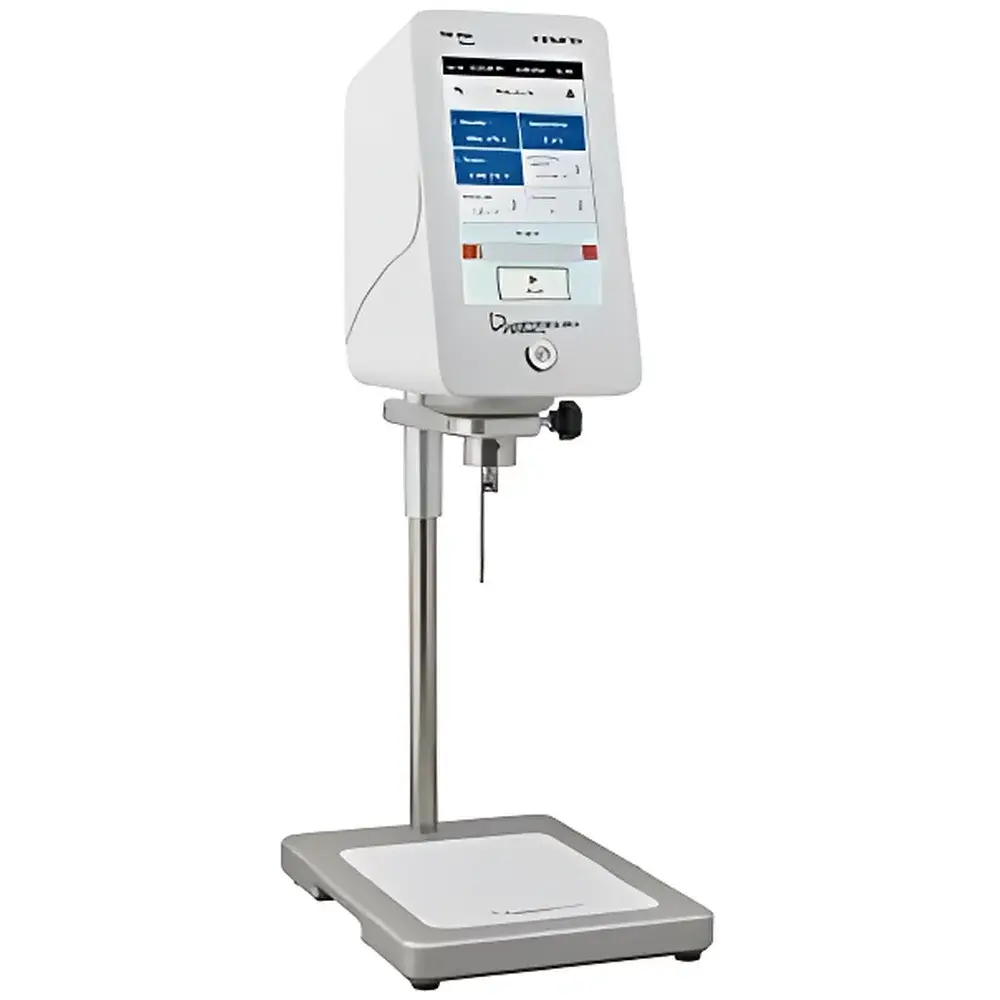
Lamy Rheology RM200 TOUCH Advanced Rotational Rheometer
| Brand | Lamy Rheology |
|---|---|
| Origin | France |
| Model | RM200 TOUCH |
| Instrument Type | Rotational Rheometer |
| Sample Viscosity Range | 1–540,000,000 mPa·s |
| Rotational Speed Range | 0.3–1500 rpm |
| Torque Range | 0.05–40 mN·m (AC 115 version) |
| Temperature Range | −50 °C to 300 °C |
| Accuracy | ±1% of full scale |
| Repeatability | ±0.2% |
| Torque Resolution | 100 µN·m |
| Display | 7″ capacitive touchscreen |
| Power Supply | 90–240 VAC, 50/60 Hz |
| Interface | RS232, USB, 4–20 mA analog output |
| Dimensions (head) | 180 × 135 × 250 mm |
| Weight | 6.7 kg |
Overview
The Lamy Rheology RM200 TOUCH is a benchtop rotational rheometer engineered for precision viscoelastic characterization of complex fluids and soft solids under controlled shear conditions. Based on Couette or cone-plate geometry principles, it applies controlled rotational stress or strain to quantify fundamental rheological properties—including apparent viscosity, yield stress, thixotropy, and flow curves—without requiring external computing hardware during routine operation. Designed and manufactured in France, the instrument integrates an embedded real-time operating system with a high-resolution 7″ capacitive touchscreen interface, enabling fully autonomous measurement execution, visualization, and parameter configuration. Its brushless electromagnetic motor eliminates mechanical spring dependencies, ensuring long-term torque stability, zero drift over time, and immunity to leveling errors—critical for GLP-compliant QC labs where operator-independent reproducibility is mandatory.
Key Features
- Self-contained operation: All measurements—including flow sweeps, yield stress determination, and thixotropic loop analysis—are executed and visualized directly on the integrated 7″ touchscreen, eliminating dependency on PC software for basic workflows.
- Shear-rate-controlled mode: Users define target shear rates (not rotational speed alone), enabling direct generation of true flow curves (η vs. γ̇) compliant with ISO 3219 and ASTM D2196 standards.
- Spring-free electromagnetic drive: A maintenance-free, wear-resistant motor architecture with no mechanical springs or slip clutches ensures consistent torque delivery across the full speed range (0.3–1500 rpm) and eliminates annual recalibration cycles associated with legacy torsion-spring systems.
- Integrated Pt100 temperature sensor: Factory-calibrated resistance thermometer enables precise thermal monitoring; optional integration with EVA MS-R Peltier or DIN-PAGES 46–51 circulating baths supports temperature-dependent rheology (e.g., gelation kinetics, melting profiles).
- Multi-parameter real-time display: Simultaneous readout of viscosity, shear rate, torque, elapsed time, measurement system ID, sensitivity setting, date/time, unit selection (cP, Pa·s, mPa·s), and language—configurable without host software.
- Security and traceability: User authentication via customizable username and 4-digit PIN ensures role-based access control; all measurements store operator ID, timestamp, and system configuration for audit-ready documentation.
Sample Compatibility & Compliance
The RM200 TOUCH accommodates a broad spectrum of sample states—from low-viscosity Newtonian liquids (e.g., solvents, syrups) to structured semi-solids (e.g., gels, pastes, polymer melts, pharmaceutical ointments). Its modular geometry support includes standard concentric cylinder (Couette), cone-and-plate, and parallel-plate configurations—each calibrated per ISO 16520 Annex B. The instrument meets CE marking requirements and operates within the electrical safety framework of IEC 61010-1. For regulated environments, its data export capabilities (CSV via USB/RS232) and user-access logs align with FDA 21 CFR Part 11 readiness when paired with validated RHEOMATIP software for electronic signature and audit trail management. It supports compliance with USP , ISO 14682, and ASTM D445/D1092 methodologies for kinematic viscosity derivation when density input is provided.
Software & Data Management
RHEOMATIP—the official Windows-based control and analysis suite—enables advanced protocol scripting, multi-step oscillatory testing (amplitude sweeps, frequency sweeps, time sweeps), and automated report generation (PDF/Excel). Raw torque and angular displacement data are logged at ≥100 Hz sampling resolution. All datasets include embedded metadata: instrument serial number, firmware version, transducer calibration ID, environmental temperature, and operator credentials. Export formats comply with ASTM E1447 and ISO/IEC 17025 data integrity guidelines. USB-printer connectivity supports direct hardcopy output of flow curves and yield point reports—essential for production line verification in food, cosmetics, and pharma manufacturing.
Applications
The RM200 TOUCH serves as a primary rheological workstation in quality control laboratories across regulated and research-intensive sectors. In food science, it quantifies creaming stability in dairy emulsions and yield behavior in chocolate mass. Cosmetic formulators use it to benchmark shear-thinning profiles of surfactant gels and suspension stability of pigment-loaded foundations. Pharmaceutical labs apply it to characterize injectable hydrogels, topical semisolids (per USP ), and granule flowability pre-compression. Coating and paint manufacturers rely on its thixotropy index calculation for sag resistance validation. Petrochemical and polymer R&D teams deploy it for melt index correlation studies and crosslinking kinetics under controlled thermal ramps.
FAQ
Does the RM200 TOUCH require annual spring replacement or mechanical recalibration?
No. Its electromagnetic torque transduction system contains no physical springs, eliminating wear-related drift and scheduled replacement intervals. Calibration is performed digitally using factory-traceable reference standards.
Can yield stress be determined without oscillatory testing?
Yes. The instrument implements both controlled-stress ramp and controlled-rate flow methods per ASTM D2196 Annex A, delivering yield value estimates directly from steady-state shear data.
Is temperature control mandatory for accurate viscosity measurement?
While ambient measurements are valid for screening, temperature stabilization is required for comparative or specification-driven testing per ISO 2555 and ASTM D1200, particularly for thermosensitive materials like polymers or biologics.
What level of data traceability does the system provide for GMP audits?
Each measurement file embeds operator ID, timestamp, instrument configuration, calibration status, and environmental metadata. When used with RHEOMATIP under validated IT infrastructure, full 21 CFR Part 11 compliance—including electronic signatures and immutable audit trails—is achievable.



