
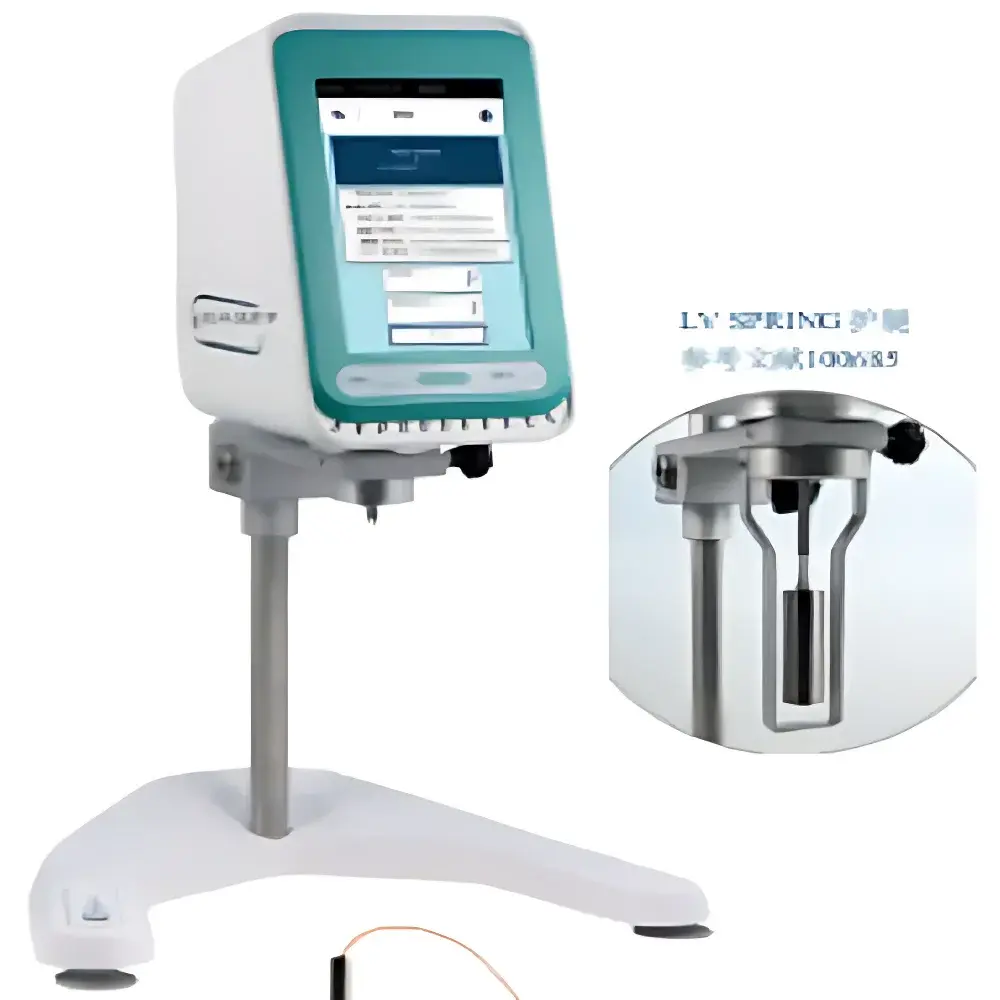
Lamy RV-SPRING Spring-Based Rotational Viscometer
| Brand | JHX (Distributor) |
|---|---|
| Origin | France |
| Model | RV-SPRING |
| Display | 7-inch capacitive touchscreen |
| Measured Parameters | Viscosity, Torque, Speed, Time, Temperature |
| Viscosity Units | cP, P, mPa·s, Pa·s |
| Shear Rate Control | Yes |
| Temperature Control Interface | Direct integration with external temperature units |
| Operating Languages | English, French, Spanish, Russian |
| User Authentication | 4-digit operator ID |
| Power Supply | 90–240 VAC, 50/60 Hz |
| Analog Output | 4–20 mA (user-configurable torque output) |
| Digital Interfaces | RS232, USB (data export & printer connectivity) |
| Software Compatibility | RheoTex™ |
| Compliance Features | LIMS-ready, QC limit setting, audit trail support for GLP/GMP environments |
Overview
The Lamy RV-SPRING Spring-Based Rotational Viscometer is a precision-engineered instrument designed for routine and quality-critical viscosity measurements in industrial QC laboratories, R&D facilities, and contract testing organizations. Unlike electromagnetic or servo-controlled rheometers, the RV-SPRING employs a calibrated mechanical torsion spring system to directly transduce rotational resistance into torque—providing inherent stability, long-term calibration retention, and immunity to electromagnetic interference. This analog-mechanical core is digitized via high-resolution angular position sensing and synchronized timing circuits, enabling accurate determination of dynamic viscosity (η) under controlled shear rate conditions per ISO 2555 and ASTM D2196. The device operates on the principle of steady-state rotational viscometry: a spindle rotates at a defined speed within the sample, and the resulting deflection of the calibrated spring corresponds linearly to applied torque, which—combined with geometric constants of the spindle and rotational speed—yields absolute viscosity values. Its architecture prioritizes operational robustness, ease of validation, and seamless integration into regulated workflows where traceability and repeatability are mandated.
Key Features
- Calibrated torsion spring sensor with no motor feedback loop, eliminating drift associated with electronic torque transducers
- 7-inch capacitive touchscreen interface supporting multi-language operation (English, French, Spanish, Russian) with intuitive icon-driven navigation
- Dual-mode operation: User Mode for flexible method development and Locked Mode enforcing pre-defined measurement protocols via 4-digit operator authentication
- Real-time display of viscosity, torque, rotational speed, elapsed time, and bath temperature—simultaneously rendered on-screen with configurable refresh rate
- Multi-step programmable methods supporting ramped speed profiles, timed dwell intervals, and conditional stop criteria (e.g., “stop after 60 s at 12 rpm”)
- Integrated data logging with timestamped records stored internally; exportable via USB flash drive or direct PC transfer over RS232/USB virtual COM port
- Configurable 4–20 mA analog output for torque signal routing to PLCs or SCADA systems in continuous process monitoring applications
- Native support for RheoTex™ software (Windows-based), enabling advanced curve fitting, comparative analysis across batches, and automated report generation compliant with 21 CFR Part 11 requirements
Sample Compatibility & Compliance
The RV-SPRING accommodates standard DIN, ASTM, and ISO spindles (including LV, RV, HA, HB geometries) and is compatible with jacketed sample holders for temperature-controlled measurements between 0 °C and 100 °C when paired with certified circulating baths. Its mechanical design ensures minimal inertia and rapid response to viscosity transitions—making it suitable for non-Newtonian fluids exhibiting yield stress, thixotropy, or shear-thinning behavior. All firmware and software modules adhere to IEC 61508 functional safety principles for laboratory instrumentation. Data integrity safeguards include automatic audit trail logging (user ID, timestamp, parameter changes, result exports), password-protected method editing, and configurable QC alert thresholds that trigger visual/audible warnings upon deviation from preset limits. The system supports full validation documentation packages aligned with ISO/IEC 17025 and FDA-regulated environments requiring GLP or GMP compliance.
Software & Data Management
RheoTex™ software provides bidirectional communication with the RV-SPRING, enabling remote instrument control, real-time graphing of viscosity vs. time/speed, and statistical evaluation of replicate measurements. It includes built-in tools for Newtonian verification, flow curve interpolation, and comparison against reference standards. Export formats include CSV (for Excel/LIMS ingestion), PDF (print-ready certificates), and XML (structured metadata for enterprise LIMS integration). All data files contain embedded digital signatures verifying origin, modification history, and user attribution—fulfilling ALCOA+ (Attributable, Legible, Contemporaneous, Original, Accurate, Complete, Consistent, Enduring, Available) data governance criteria. USB-connected thermal printers generate tamper-evident hard copies with embedded instrument ID, method name, and operator code.
Applications
This viscometer is routinely deployed for viscosity verification of coatings, adhesives, pharmaceutical suspensions, food emulsions, lubricants, and polymer solutions prior to release or formulation adjustment. Its spring-based transduction delivers consistent performance in environments with variable ambient temperatures or electrical noise—common in production-floor QC labs. Regulatory users leverage its locked-mode functionality and RheoTex™ audit trail to satisfy inspection requirements for USP , ISO 1628-1, and paint industry standards such as ISO 2555. Multi-step methods facilitate standardized procedures like “spindle immersion → equilibration delay → ramped shear rate sweep → hold at target rate → auto-stop,” reducing inter-operator variability in routine testing.
FAQ
Is the RV-SPRING suitable for yield stress measurement?
No—it performs steady-state rotational viscosity measurements only and does not implement controlled-stress ramping or oscillatory modes required for yield stress quantification.
Can calibration be performed in-house?
Yes, using NIST-traceable silicone oil standards and the built-in calibration wizard; full calibration reports are exportable and include uncertainty budgets.
Does the instrument support 21 CFR Part 11 compliance?
When used with RheoTex™ v3.2+, it supports electronic signatures, role-based access control, and immutable audit trails—meeting core technical requirements for Part 11 adherence.
What spindle geometries are supported out-of-the-box?
Standard LV (low-viscosity), RV (medium-viscosity), and HA/HB (high-viscosity) spindles conforming to ASTM D1896 and ISO 3219 are fully compatible.
Is temperature control integrated or external?
Temperature sensing is internal (RTD probe in spindle shaft), but active temperature regulation requires connection to an external circulator via the dedicated bath interface port.



