
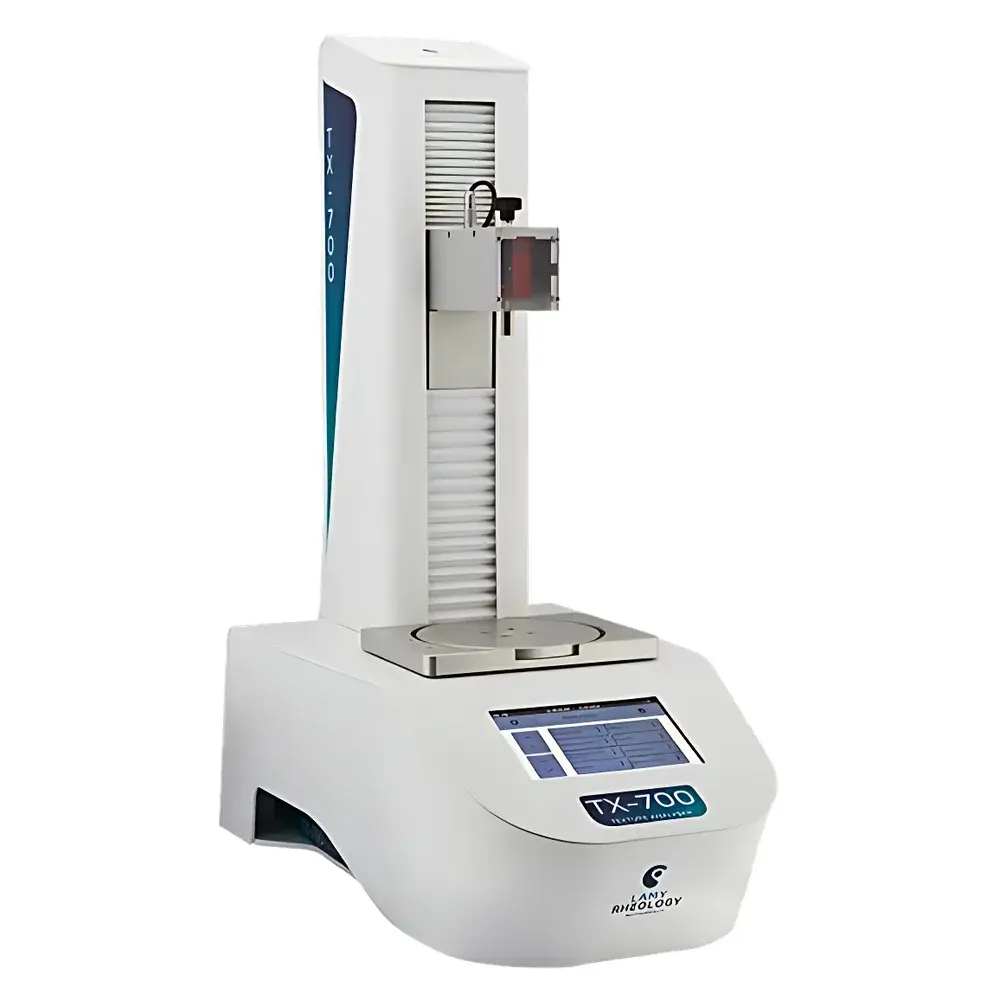
LAMY TX-700 Texture Analyzer
| Key | Brand: LAMY |
|---|---|
| Origin | France |
| Model | TX-700 |
| Force Range | 500 N |
| Force Resolution | 0.001 N (for ≤50 N sensors), 0.01 N (for ≥250 N sensors) |
| Force Accuracy | ±0.05 % of full scale |
| Speed Range | 0.1–10 mm/s (±0.2 %) |
| Maximum Travel Distance | 240 mm |
| Displacement Resolution | 0.1 mm (0.01 mm with RheoTex software) |
| Temperature Probe | PT100, –50 to +300 °C |
| Display | 7-inch color touchscreen |
| Power Supply | 90–240 VAC, 50/60 Hz |
| Dimensions | 610 × 340 × 710 mm |
| Weight | 25 kg |
Overview
The LAMY TX-700 Texture Analyzer is a high-precision, motorized mechanical testing system engineered for objective quantification of mechanical properties—including hardness, adhesiveness, cohesiveness, springiness, chewiness, and fracturability—across solid, semi-solid, and viscoelastic materials. Based on the fundamental principle of controlled uniaxial compression, tension, puncture, extrusion, and cyclic TPA (Texture Profile Analysis), the instrument applies programmable force profiles while simultaneously recording real-time load, displacement, velocity, time, and temperature data. Its modular architecture supports interchangeable load cells (10 N to 500 N), calibrated PT100 temperature sensing, and a fully adjustable test platform—enabling reproducible, GLP-compliant texture evaluation in regulated environments such as food R&D labs, pharmaceutical formulation units, cosmetic stability testing suites, and packaging material validation facilities.
Key Features
- Integrated 7-inch color touchscreen interface with intuitive icon-driven navigation and real-time multi-parameter display (force, speed, distance, temperature, time, probe ID, sensor status, sensitivity, date/time, unit selection in g or N)
- Modular load cell system: six selectable ranges (10 N, 20 N, 50 N, 100 N, 250 N, 500 N), each factory-calibrated and traceable to national standards; resolution up to 0.001 N (for ≤50 N) and 0.01 N (for ≥250 N)
- Precision motion control: programmable speed range 0.1–10 mm/s with ±0.2 % linearity; maximum vertical travel 240 mm; displacement resolution 0.1 mm (enhanced to 0.01 mm when paired with RheoTex software)
- Embedded PT100 temperature probe (–50 °C to +300 °C) enables concurrent thermal monitoring during texture tests—critical for studying temperature-dependent rheological transitions in dairy, chocolate, or hydrogels
- Operator authentication via 4-digit numeric code ensures method integrity and audit trail compliance in multi-user laboratories
- Adjustable test platform (Ø160 mm, insert area 120 × 220 mm) with height adjustment mechanism accommodates diverse sample geometries and fixture configurations
- Comprehensive test mode library: compression, relaxation, tension, TPA double-compression cycles, penetration, and relative compression—each configurable with pre-set dwell times, trigger thresholds, and return speeds
Sample Compatibility & Compliance
The TX-700 accommodates samples ranging from soft gels and baked goods to rigid confectionery, tablets, films, and laminated packaging—provided within the dimensional constraints of the test chamber and load cell capacity. Standard accessories include cylindrical probes (P/2, P/36), spherical tips, Kramer shear cells, and custom-designed fixtures for ASTM F3108 (chewiness), ISO 11357-3 (thermal-mechanical behavior), and USP (hardness of oral solid dosage forms). All hardware and firmware are designed to support 21 CFR Part 11-compliant electronic records when used with RheoTex software, including user authentication, audit trails, electronic signatures, and secure data export. The system meets IEC 61000-6-2 (EMC immunity) and IEC 61010-1 (safety for laboratory equipment) requirements.
Software & Data Management
RheoTex software serves as the central analytical and regulatory interface for the TX-700. It enables remote instrument control, advanced method scripting (including conditional logic and looped sequences), real-time graph overlay, statistical parameter extraction (e.g., peak force, work of shear, slope at yield), and automated report generation compliant with ISO/IEC 17025 documentation standards. Raw data (CSV, TXT) and processed results are exportable via USB or RS232; optional LIMS integration allows direct upload to laboratory information management systems using standard HL7 or ASTM E1461 protocols. Data backups, method versioning, and encrypted storage ensure traceability across validation batches and regulatory inspections.
Applications
- Food science: quantifying firmness of fruits, crispness of snacks, spreadability of cheeses, gumminess of noodles, and melt-in-mouth behavior of chocolates
- Pharmaceuticals: tablet hardness testing per USP , capsule shell elasticity, gel disintegration kinetics, and transdermal patch adhesion profiling
- Cosmetics: viscosity recovery of creams, break point analysis of lipsticks, and tensile strength of hydrogel masks
- Packaging: seal strength of pouches, puncture resistance of blister foils, and peel adhesion of labels
- Academic research: correlating microstructure (via SEM/XRD) with macroscopic mechanical response under controlled thermal conditions
FAQ
What load cell options are available for the TX-700, and how do I select the appropriate one?
The TX-700 supports six interchangeable load cells: 10 N, 20 N, 50 N, 100 N, 250 N, and 500 N. Selection depends on expected peak force—ideally operating between 10 % and 90 % of full scale for optimal signal-to-noise ratio and resolution. For example, 10–50 N cells are recommended for soft foods and pharmaceutical tablets; 250–500 N cells suit meat tenderness, cheese texture, or rigid packaging.
Is the TX-700 compliant with FDA or EU regulatory requirements for GMP/GLP environments?
Yes—when configured with RheoTex software, the system supports 21 CFR Part 11 compliance (user access control, electronic signatures, audit trails) and aligns with ISO/IEC 17025 documentation practices. Calibration certificates are NIST-traceable and include uncertainty budgets.
Can the TX-700 perform temperature-controlled texture testing?
Yes—the integrated PT100 probe continuously monitors sample or ambient temperature during testing. While the instrument itself does not provide active heating/cooling, it synchronizes temperature data with mechanical measurements, enabling post-hoc correlation analysis of thermal effects on texture parameters.
How is data security and method integrity ensured during multi-user operation?
The operator lock feature requires a unique 4-digit PIN to access or modify test methods. All method changes, measurement executions, and data exports are timestamped and logged in RheoTex’s immutable audit trail, supporting internal audits and regulatory inspections.
What types of probes and fixtures are compatible with the TX-700?
Standard offerings include Warner-Bratzler blades, cylinder probes, ball probes, Kramer shear cells, and wire mesh fixtures. Custom probes (e.g., tooth-shaped, multi-point arrays) can be fabricated to match industry-specific standards (ASTM, ISO, DIN) or proprietary product geometries.
Related Products





