
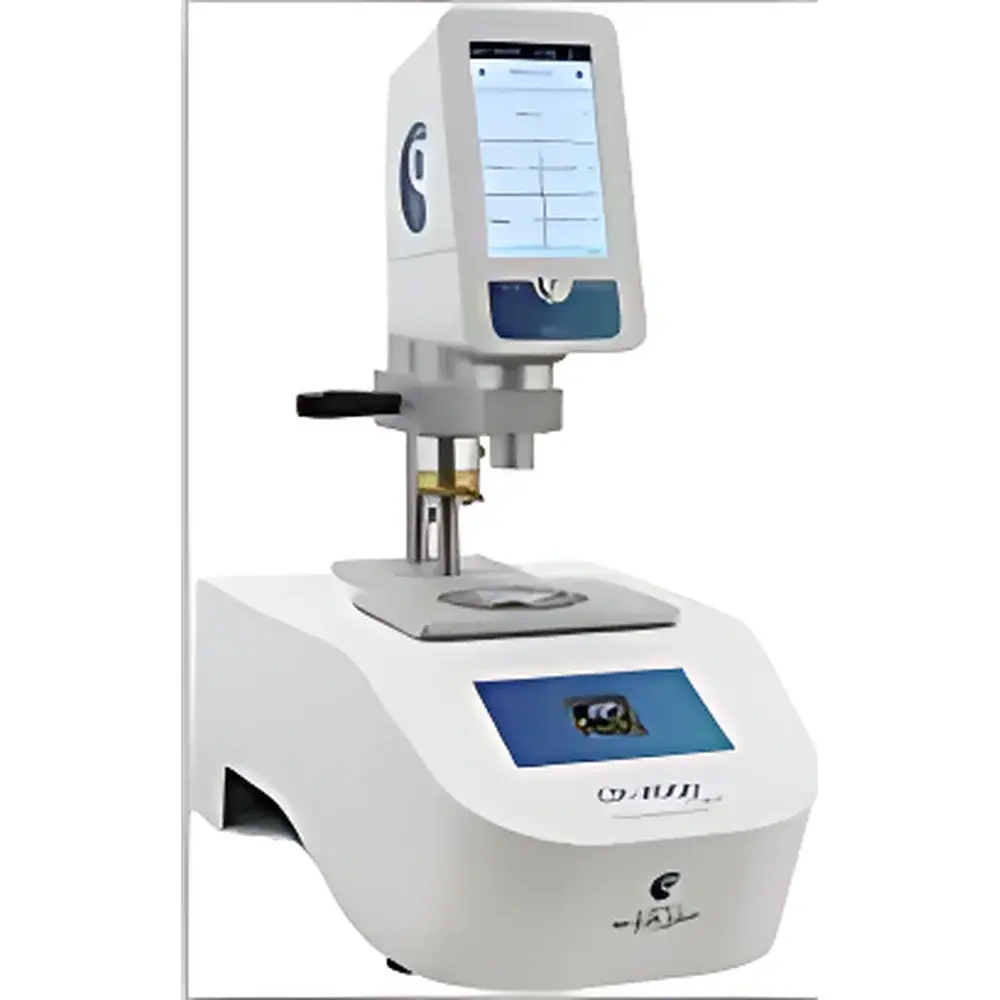
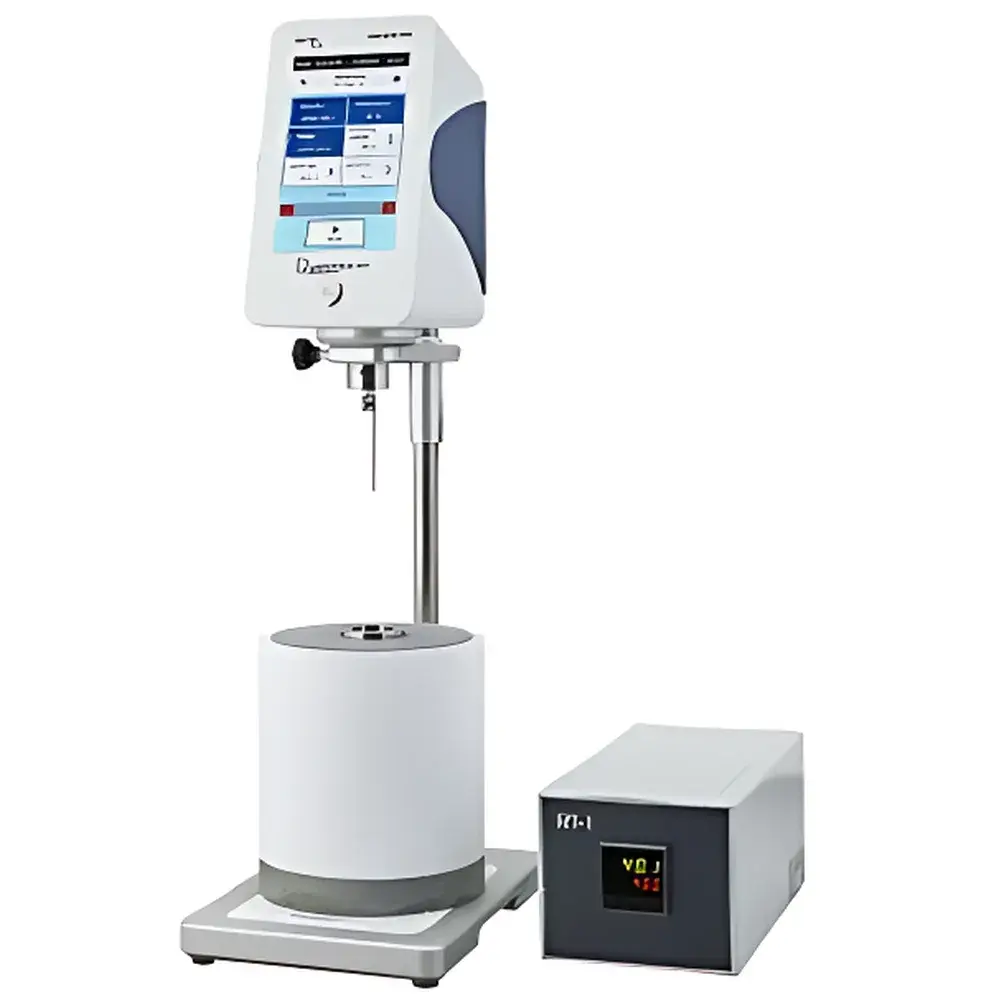
Lamyrheology RM100 CP2000 PLUS Cone-Plate Rotational Viscometer
| Brand | Lamyrheology |
|---|---|
| Origin | France |
| Model | RM100 CP2000 PLUS |
| Instrument Type | Benchtop Cone-Plate Rotational Viscometer |
| Viscosity Range | 5–8,000,000 mPa·s |
| Shear Rate Range | 0.1–20,000 s⁻¹ |
| Rotational Speed | 0.3–1500 rpm |
| Torque Range | 0.05–30 mN·m |
| Temperature Range | −20 °C to +300 °C (with external bath or Peltier module) |
| Temperature Accuracy | ±0.1 °C |
| Repeatability | ±0.2% of full scale |
| Display | 7-inch touchscreen interface |
| Connectivity | RS232, USB, 4–20 mA analog output |
| Compliance | GLP-compliant data logging, ASTM D2196/D1084, ISO 2555/3219, USP <911> |
| Language Support | English, French, Spanish, Russian |
| Operator Access Control | 4-digit user ID lock |
Overview
The Lamyrheology RM100 CP2000 PLUS is a high-precision benchtop cone-plate rotational viscometer engineered for accurate, reproducible viscosity and shear-dependent rheological characterization under controlled thermal conditions. Utilizing the fundamental principles of Couette flow geometry, this instrument applies defined rotational shear stress across a precisely engineered cone-and-plate gap—typically 1° or 2°—to generate uniform shear rates up to 20,000 s⁻¹. Its design eliminates edge effects and ensures homogeneous shear distribution, making it especially suitable for non-Newtonian fluid analysis, including thixotropic, pseudoplastic, and yield-stress materials. With a minimum sample volume requirement of less than 1 mL, the system addresses critical constraints in R&D laboratories handling expensive, hazardous, or difficult-to-clean formulations—such as high-solids coatings, polymer melts, pharmaceutical suspensions, and nanocomposite dispersions.
Key Features
- 7-inch high-resolution touchscreen interface with intuitive graphical navigation and real-time parameter visualization (viscosity, shear rate, torque, temperature, time)
- Full-range rotational speed control from 0.3 to 1500 rpm, enabling continuous or stepped shear rate profiles with no predefined speed step limitations
- High-sensitivity torque sensor (0.05–30 mN·m) delivering ±0.2% repeatability and ±1% full-scale accuracy across the entire viscosity range (5–8×10⁶ mPa·s)
- Integrated temperature control compatibility: supports external circulating baths or optional Peltier-based CP2000 temperature-controlled stage with ±0.1 °C stability over −20 °C to +300 °C
- Dual communication architecture: native RS232 and USB ports for direct PC connection; 4–20 mA analog output for integration into industrial SCADA or PLC environments
- Operator-level security protocol: 4-digit numeric user ID assignment enforces measurement condition locking and traceable session attribution per GLP requirements
- Multi-language firmware support (English, French, Spanish, Russian) for international laboratory deployment and multilingual operator training
Sample Compatibility & Compliance
The RM100 CP2000 PLUS is optimized for low-volume, high-value, or residue-prone samples—particularly where cleaning between measurements is impractical or contamination-sensitive. Its cone-plate geometry minimizes sample retention and enables rapid thermal equilibration, critical for temperature-dependent studies in paints, adhesives, and biopolymer solutions. The system conforms to internationally recognized standards for viscosity measurement: ASTM D2196 (non-Newtonian fluids), ASTM D1084 (latex viscosity), ISO 2555 (resin solutions), ISO 3219 (polymer solutions), and USP (pharmaceutical viscosity testing). All measurement data—including timestamps, operator IDs, instrument settings, and environmental parameters—are logged in audit-trail format compliant with FDA 21 CFR Part 11 and EU Annex 11 requirements when used with validated VISCO RM software.
Software & Data Management
The VISCO RM control and analysis software (Windows-based, included) provides full instrument automation, method programming, and post-acquisition rheogram generation. Users can define complex test sequences—including ramped shear rate sweeps, time-dependent thixotropy recovery protocols, and oscillatory pre-shear conditioning—while maintaining full metadata capture. Raw data export is supported in CSV, Excel, and universal ASCII formats. Software-generated reports include statistical summaries (mean, SD, CV%), curve fitting (Power Law, Herschel-Bulkley, Casson models), and comparative overlay functionality for batch-to-batch consistency evaluation. Optional IQ/OQ documentation packages are available for GMP-regulated environments requiring formal instrument qualification.
Applications
This viscometer serves core analytical needs across multiple regulated and industrial sectors. In coatings and inks, it quantifies sag resistance, leveling behavior, and spray atomization performance via high-shear viscosity profiling. Within chemical R&D, it characterizes associative thickeners, crosslinking kinetics, and emulsion stability under shear. In pharmaceutical development, it supports formulation screening of topical gels, ophthalmic suspensions, and injectable depots per USP . Academic and national metrology labs utilize its precision for reference material certification and inter-laboratory round-robin studies. Its robust mechanical architecture and thermal stability also support long-duration creep-recovery experiments and temperature ramping protocols relevant to polymer processing simulation.
FAQ
What is the minimum required sample volume for accurate measurement?
Less than 1 mL is sufficient for reliable cone-plate measurements due to the fixed 1° or 2° geometry and minimal gap volume.
Can the instrument perform time-dependent thixotropy analysis?
Yes—VISCO RM software supports programmable rest-shear-recovery cycles with user-defined timing and shear history, enabling quantitative assessment of structural breakdown and rebuild kinetics.
Is temperature control integrated or external?
The RM100 base unit does not include active heating/cooling; temperature regulation is achieved via the optional CP2000 Peltier-controlled stage or external recirculating bath connected to the cone-plate head.
Does the system meet regulatory requirements for quality-controlled environments?
When operated with validated VISCO RM software and configured with operator ID locking and audit-trail logging, it satisfies GLP, GMP, and 21 CFR Part 11 electronic record integrity criteria.
What viscosity units are supported in real-time display and reporting?
cP, P, mPa·s, and Pa·s are selectable directly on the touchscreen interface and preserved in all exported datasets.



