
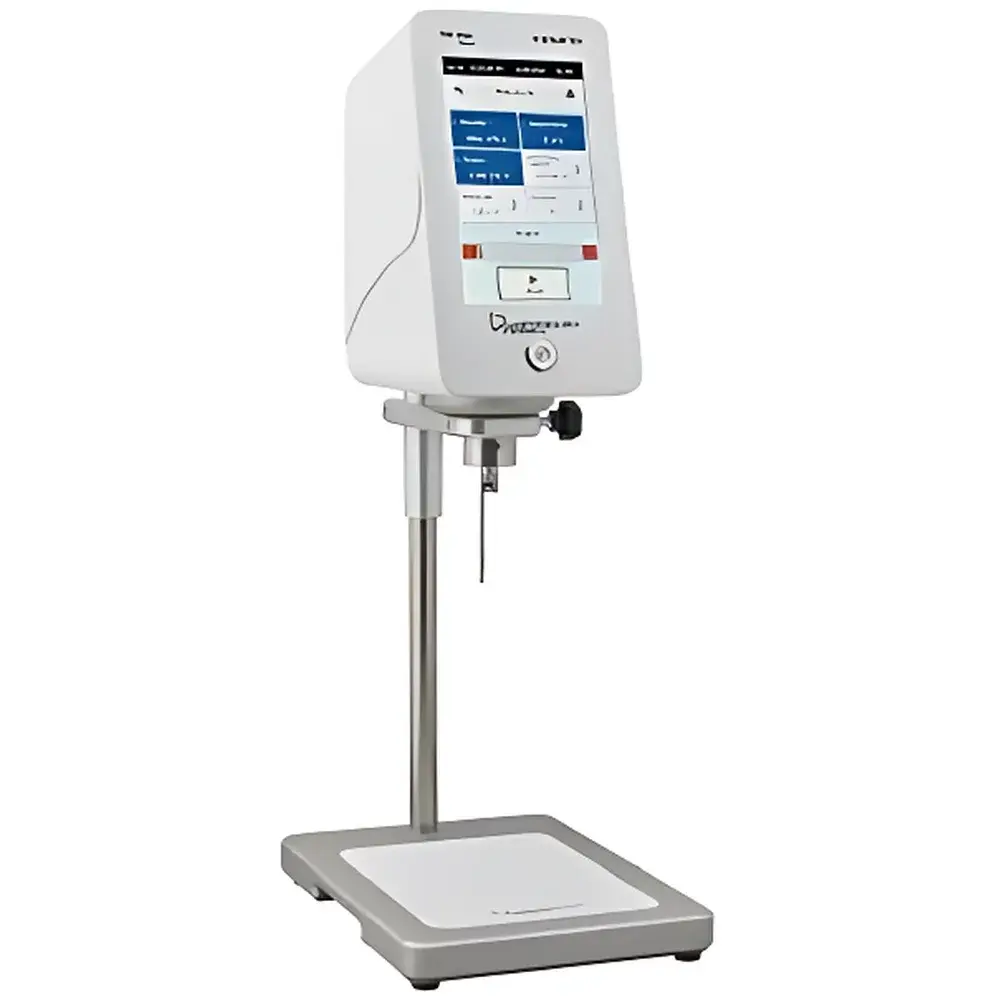
Lamyrheology B-ONE TOUCH Direct-Drive Rotational Viscometer RM100
| Brand | Lamyrheology |
|---|---|
| Origin | France |
| Model | RM100 |
| Instrument Type | Fixed Rotational Viscometer |
| Operating Environment | Ambient Temperature |
| Viscosity Range | 15–6,000,000 mPa·s (L1–L4 spindles) / 100–180,000,000 mPa·s (R2–R7 spindles) |
| Rotational Speed | 0.3–250 rpm |
| Torque Range | 0.05–13 mN·m (Standard) / 0.005–0.8 mN·m (LR Version) |
| Accuracy | ±1% of Full Scale |
| Repeatability | ±0.2% |
| Display | 7" Capacitive Touchscreen |
| Power Supply | 90–240 VAC, 50/60 Hz |
| Weight | 6.7 kg |
| Security | User Authentication via 4-digit PIN |
Overview
The Lamyrheology B-ONE TOUCH RM100 is a precision-engineered direct-drive rotational viscometer designed for high-reliability viscosity measurement across industrial and research laboratories. Unlike traditional spring-based or gear-driven viscometers, the RM100 employs a brushless DC motor coupled directly to the measuring spindle—eliminating mechanical backlash, torque transmission losses, and spring fatigue. This architecture implements Couette flow rheometry principles, where shear rate is precisely controlled by rotational speed and geometry, and shear stress is derived from real-time torque measurement. The instrument conforms to ISO 2555, ASTM D2196, and DIN 53019 standards for rotational viscosity testing, ensuring data traceability and regulatory acceptability in GLP-compliant environments. Its fixed-frame configuration provides mechanical stability essential for low-noise torque detection, particularly critical when characterizing weakly structured gels, thixotropic suspensions, or ultra-high-viscosity polymer melts.
Key Features
- Direct-drive motor system with zero-spring architecture—no annual recalibration or spring replacement required.
- High-torque output (up to 13 mN·m) maintains constant rotational speed across the full viscosity range, even under load-induced deceleration typical in non-Newtonian fluids.
- Integrated 7-inch capacitive touchscreen interface displaying real-time viscosity, shear rate, shear stress, torque, elapsed time, spindle identification, temperature input field, and unit selection (mPa·s, cP, Pa·s).
- Quick-lock bayonet-style spindle mounting system enables tool-free, repeatable attachment of L1–L4 and R2–R7 geometry sets—minimizing setup variability and cross-contamination risk.
- User authentication protocol: configurable username and mandatory 4-digit PIN access control ensures audit-ready operator accountability per FDA 21 CFR Part 11 requirements.
- Programmable timed measurements support thixotropy analysis (e.g., recovery curves, step-shear protocols) without external scripting.
- Auto-calculation of kinematic viscosity upon entry of sample density—enabling seamless transition between dynamic and kinematic reporting formats.
Sample Compatibility & Compliance
The RM100 accommodates a broad spectrum of Newtonian and non-Newtonian samples, including emulsions, suspensions, pastes, molten thermoplastics, pharmaceutical gels, and food matrices (e.g., ketchup, chocolate, dairy creams). Its modular spindle library—comprising low-shear L-series (cylindrical, small-diameter) and high-torque R-series (vane, coaxial cylinder)—ensures appropriate shear field generation across 8 orders of magnitude in viscosity. All spindle geometries comply with ISO 3219 and ASTM D1084 specifications for geometric definition and calibration traceability. The instrument’s mechanical design meets IEC 61010-1 safety standards for laboratory electrical equipment. Data integrity safeguards—including timestamped measurement logs, user ID tagging, and immutable parameter recording—support compliance with GMP documentation practices and internal quality audits.
Software & Data Management
While the RM100 operates autonomously via its embedded touchscreen OS, optional PC connectivity (USB or RS-232) enables export of raw and processed data in CSV format for integration into LIMS or statistical process control platforms. Measurement sequences—including ramped speed profiles, dwell-time intervals, and multi-point viscosity sweeps—can be preconfigured and stored onboard. All data fields are timestamped and associated with operator credentials. Audit trails record parameter changes, login/logout events, and calibration status—fulfilling ALCOA+ (Attributable, Legible, Contemporaneous, Original, Accurate, Complete, Consistent, Enduring, Available) data governance criteria. No proprietary software installation is required for basic operation; firmware updates are delivered via USB flash drive with cryptographic signature verification.
Applications
- Quality control of polymer solutions and adhesives in chemical manufacturing.
- Rheological profiling of topical pharmaceutical formulations (creams, ointments) per USP guidelines.
- Stability assessment of oil-in-water emulsions in food R&D (e.g., mayonnaise, dressings).
- Process optimization of drilling muds and fracturing fluids in petroleum engineering.
- Characterization of yield stress and thixotropic breakdown/recovery in architectural coatings and inkjet inks.
- Academic research on soft matter dynamics, including wormlike micelle systems and colloidal gels.
FAQ
Does the RM100 require leveling before each measurement?
No. Its rigid monolithic base and direct-drive architecture eliminate sensitivity to minor surface inclination—no bubble-level adjustment is needed.
Can the instrument measure yield stress?
Yes, when used with vane or coaxial cylinder geometries (R-series), and combined with controlled-stress ramp protocols enabled via timed measurement mode.
Is temperature control integrated?
The RM100 does not include built-in Peltier heating/cooling, but it features a dedicated temperature input field for manual entry of bath or jacket temperature—enabling viscosity correction and Arrhenius analysis.
What spindle calibration documentation is provided?
Each spindle set ships with a factory-issued calibration certificate traceable to NIST or COFRAC-accredited reference oils, including geometry dimensions, effective radius ratios, and torque conversion factors.
How is data security enforced during multi-user operation?
User accounts are isolated at the firmware level; no measurement history, settings, or passwords are shared between profiles. Session timeouts and failed-login lockouts further mitigate unauthorized access.



