
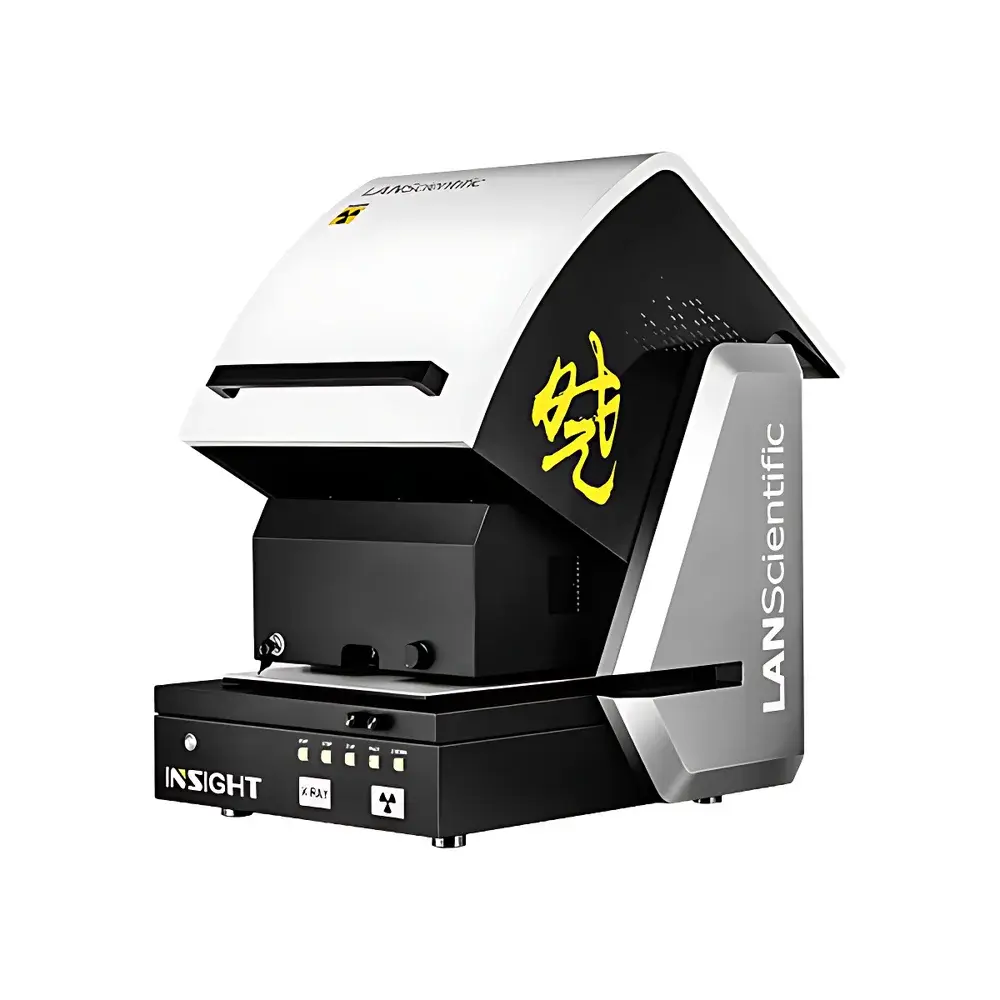
LANScientific INSIGHT 300/330/360 Benchtop X-Ray Fluorescence Coating Thickness Analyzer
| Brand | LANScientific |
|---|---|
| Origin | Jiangsu, China |
| Manufacturer Type | Direct Manufacturer |
| Model Series | INSIGHT 300 / INSIGHT 330 / INSIGHT 360 |
| Measurement Principle | Energy-Dispersive X-Ray Fluorescence (ED-XRF) |
| Geometry | Upright (Top-Down) Configuration |
| Detector Type | High-Resolution Silicon Drift Detector (SDD) |
| Spot Size Options | Multiple Motorized Collimators (100 µm to 1 mm) |
| Sample Chamber | C-Shaped Open Design |
| Focus System | Auto-Focus with Live Video Imaging & Crosshair Overlay |
| Software | Fully Integrated ED-XRF Analysis Suite with GLP/GMP-Compliant Audit Trail |
| Compliance | ASTM B568, ISO 3497, ISO 20876, IPC-4552A, USP <232>/<233>, FDA 21 CFR Part 11 Ready |
| Optional Automation | Programmable XY Stage with Pattern Recognition and Multi-Point Routine Support |
| Safety | Interlocked Cabinet, <1 µSv/h Leakage Radiation |
Overview
The LANScientific INSIGHT 300/330/360 is a benchtop energy-dispersive X-ray fluorescence (ED-XRF) coating thickness analyzer engineered for high-precision, non-destructive elemental quantification and layer-thickness measurement of metallic and alloy coatings on conductive and non-conductive substrates. Operating on the principle of characteristic X-ray emission following primary X-ray excitation, the system employs a micro-focused X-ray tube with variable collimation to generate sub-millimeter excitation spots—enabling spatially resolved analysis of heterogeneous, irregular, or micro-scale features. Its upright (top-down) optical geometry, combined with real-time video imaging and motorized auto-focus, ensures precise positioning over complex topographies without physical contact. Designed for laboratory, QC/QA, and R&D environments, the INSIGHT series delivers trace-level detection limits (sub-ppm for heavy elements), excellent inter-laboratory reproducibility, and robust performance across diverse industrial applications—from printed circuit board (PCB) finish verification to precious metal plating in jewelry manufacturing.
Key Features
- Micro-focused X-ray source with motorized multi-collimator selection (100 µm, 250 µm, 500 µm, 1 mm)—software-switched for optimal signal-to-noise ratio per feature size
- High-resolution silicon drift detector (SDD) with <125 eV Mn Kα resolution and ultra-low background noise—superior to gas-proportional counters in count rate linearity and long-term stability
- C-shaped open sample chamber accommodating large flat specimens (e.g., PCBs up to 300 × 300 mm) and irregular 3D parts with height clearance up to 120 mm
- Real-time HD video imaging with digital crosshair overlay, 10× optical zoom, and closed-loop auto-focus—enabling rapid alignment on micron-scale targets
- Fully integrated ED-XRF analysis software supporting fundamental parameter (FP) and empirical calibration methods, with embedded uncertainty estimation per measurement
- Optional programmable XY stage with pattern recognition algorithms for automated multi-point mapping, batch analysis, and statistical process control (SPC) reporting
Sample Compatibility & Compliance
The INSIGHT analyzer supports a broad range of sample types—including rigid PCBs, flexible circuits, connector pins, semiconductor lead frames, jewelry components, fuel cell bipolar plates, and miniature mechanical assemblies. It meets international standards for coating metrology: ASTM B568 (XRF standard for metallic coatings), ISO 3497 (electroplated and electroless coatings), ISO 20876 (multi-layer analysis), and IPC-4552A (ENIG, ENEPIG, and immersion tin specification). All firmware and software modules are designed for regulatory compliance: audit trail logging, user access levels, electronic signatures, and data integrity safeguards align with FDA 21 CFR Part 11 and EU Annex 11 requirements. Routine calibration verification and drift correction protocols support GLP and GMP documentation workflows.
Software & Data Management
The proprietary INSIGHT Analysis Suite provides a unified interface for instrument control, spectral acquisition, quantitative modeling, and report generation. Calibration models can be built using certified reference materials (CRMs) or matrix-matched standards; FP-based quantification eliminates the need for exhaustive standard sets in multi-layer configurations. Data files include full spectral metadata (tube voltage/current, live time, detector temperature, collimator ID), enabling retrospective reprocessing and method validation. Export formats include CSV, PDF (with embedded spectra), and XML for LIMS integration. The software supports SOP-driven operation—locking parameters such as dwell time, peak deconvolution settings, and interference corrections—to ensure analytical consistency across operators and shifts.
Applications
- PCB surface finish verification: ENIG (Au/Ni), ENEPIG (Au/Pd/Ni), immersion Sn, OSP thickness and composition
- Jewelry quality control: Rhodium, ruthenium, or palladium plating over white gold; karat gold alloy verification
- Electrical connectors: Ni underlayer + Au flash thickness on copper alloys; solderability assessment via Cu diffusion barrier integrity
- Fuel cell components: Pt loading quantification on carbon-supported catalyst layers; TiN corrosion barrier thickness on titanium bipolar plates
- Micromechanical parts: Cr or DLC coatings on stainless steel watch springs; Zn-Ni alloy thickness on automotive fasteners
- Research & development: Thin-film stack characterization (e.g., Cu/Ta/TaN/SiO₂ in advanced packaging); interdiffusion studies in thermal aging experiments
FAQ
What coating thickness ranges can the INSIGHT series measure?
Typical measurable thicknesses span from ~0.005 µm (e.g., Au flash) to >50 µm (e.g., thick Ni electroplating), depending on element pair, substrate, and matrix absorption effects.
Is vacuum or helium purge required for light element analysis?
No—ambient air operation suffices for elements Na (Z=11) and heavier; optional He flush mode improves sensitivity for Mg–F when needed.
Can the system analyze multi-layer stacks with interdiffused interfaces?
Yes—advanced FP algorithms account for attenuation between layers and partial fluorescence yield suppression; depth profiling is supported via variable take-off angle measurements (optional tilt stage).
How is measurement repeatability ensured across different operators?
Through SOP-enforced parameter locking, automated collimator selection based on ROI size, and stage-positioning repeatability better than ±1 µm with motorized XY option.
Does the INSIGHT comply with radiation safety regulations for lab use?
Yes—the fully interlocked cabinet meets IEC 61010-1 and GB/Z 20985 requirements; measured leakage radiation is <0.5 µSv/h at 5 cm from any surface during operation.



