
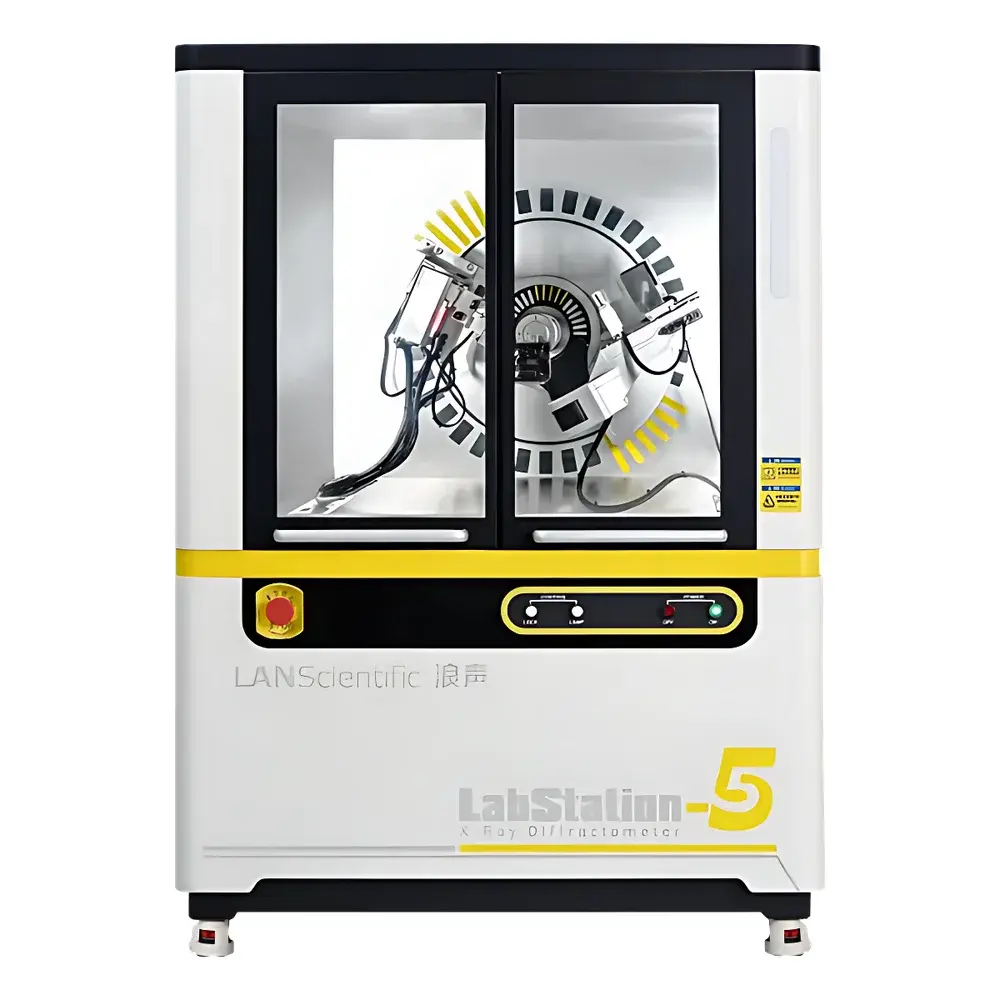
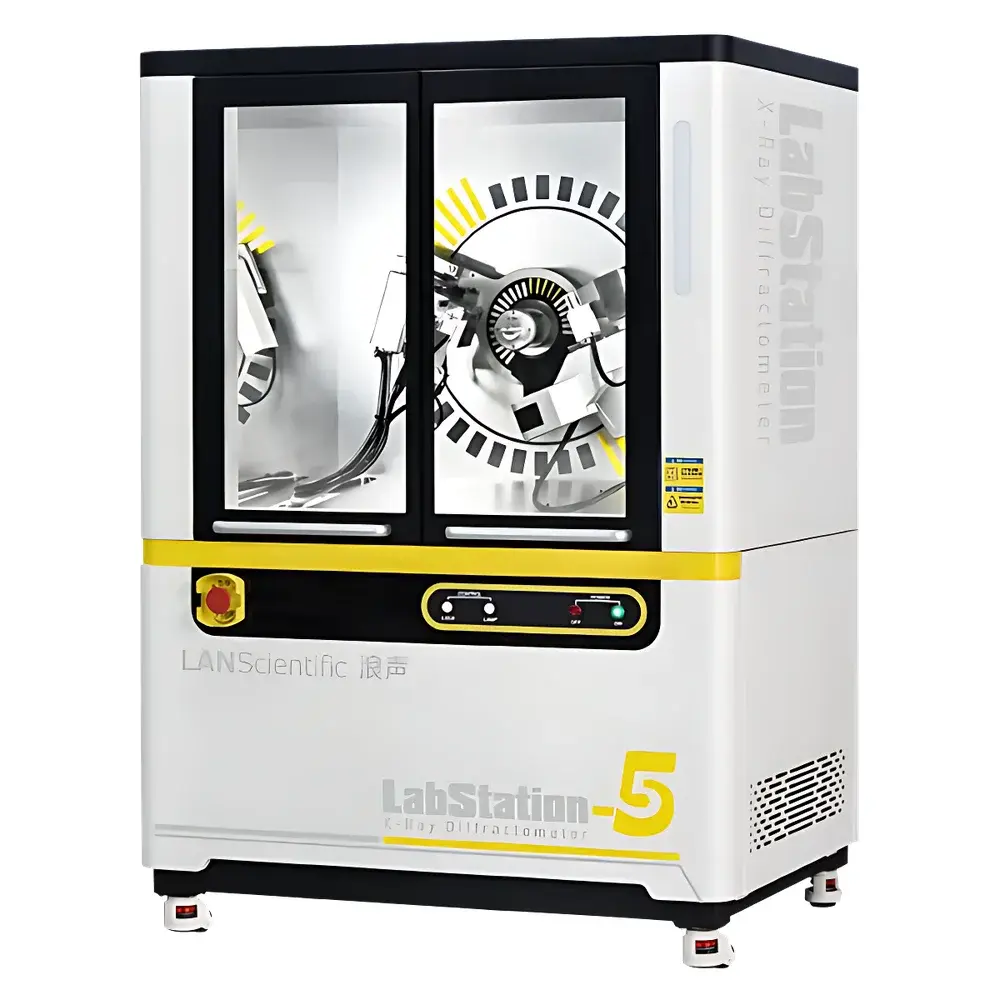
LANScientific LabStation-5 Floor-Standing X-ray Diffractometer
| Brand | LANScientific |
|---|---|
| Origin | Jiangsu, China |
| Manufacturer Type | Manufacturer |
| Product Category | Domestic |
| Model | LabStation-5 |
| Instrument Type | Powder X-ray Diffractometer |
| Instrument Configuration | Floor-standing |
| Detector | High-Performance Photon-Counting (HPC) Pixelated Detector |
| Goniometer | θ/θ Closed-Loop Drive System |
| Optical Geometry | Switchable Bragg-Brentano & Parallel-Beam Configurations |
| Sample Stage | Modular, Tool-Free Quick-Release Sample Holder System |
| Diffractometer Radius | ≥300 mm |
| Beam Path Architecture | Non-Coplanar Arm Design |
| Slit System | Motorized Variable Aperture |
Overview
The LANScientific LabStation-5 Floor-Standing X-ray Diffractometer is a high-precision, multi-configuration analytical platform engineered for rigorous structural characterization of crystalline and semi-crystalline materials. Based on Bragg’s law and the fundamental principles of X-ray diffraction (XRD), the system delivers quantitative phase identification, lattice parameter refinement, crystallite size and microstrain analysis, preferred orientation (texture), residual stress mapping, and thin-film structural assessment. Its floor-standing architecture provides mechanical stability essential for long-duration scans and high-resolution angular measurements, while the non-coplanar arm design enables true in-plane and out-of-plane diffraction geometries—critical for epitaxial film analysis, grazing-incidence XRD (GIXRD), and reciprocal space mapping (RSM). The instrument operates with Cu Kα radiation (λ = 1.5418 Å) as standard, with optional anode upgrades (e.g., Co, Fe, Mo) available to optimize scattering contrast for specific elemental systems.
Key Features
- High-Performance Photon-Counting (HPC) pixelated detector: Delivers simultaneous improvements in detection efficiency, signal-to-noise ratio (>10⁴:1 dynamic range), time resolution (sub-millisecond frame rates), spatial resolution (<100 µm pixel pitch), and count-rate linearity (up to 10⁷ cps), enabling rapid acquisition of high-fidelity diffraction patterns.
- θ/θ closed-loop goniometer: Precision stepper-motor-driven dual-theta stage with optical encoder feedback ensures angular reproducibility better than ±0.0005° over full 2θ range (up to 160°), minimizing systematic drift and supporting Rietveld refinement-grade data quality.
- Automated optical configuration switching: Seamless, software-controlled transition between Bragg-Brentano (for powders, bulk solids) and parallel-beam (for thin films, coatings, fibers, and low-absorption samples) geometries—no manual realignment or component repositioning required.
- Modular, tool-free sample stage system: Interchangeable holders—including flat-plate, capillary, transmission, humidity-controlled, heating (up to 1000°C), and cryogenic stages—are secured via positive-locking bayonet mounts, enabling sub-minute setup changes without calibration loss.
- Motorized variable divergence and receiving slits: Dynamically optimized slit widths (0.05–2.0 mm) maintain optimal beam intensity/resolution trade-offs across scan ranges and sample types, adhering to ISO 17873:2016 recommendations for slit-based XRD quantification.
- Diffractometer radius ≥300 mm: Expands accessible 2θ range while improving angular dispersion and peak separation resolution—particularly advantageous for distinguishing closely spaced reflections in complex oxides, layered perovskites, and nanocrystalline pharmaceuticals.
Sample Compatibility & Compliance
The LabStation-5 accommodates diverse physical forms: free-flowing powders, pressed pellets, liquids (in capillaries), thin films (Si/SiO₂, ITO, perovskite PV layers), bulk metals, polymers, geological specimens, and biological macromolecular crystals. It supports ASTM E975 (residual stress measurement), ISO 13126 (crystallinity determination in polymers), USP (pharmaceutical polymorph screening), and EN 13822 (cementitious phase analysis). All firmware and control logic comply with IEC 61508 functional safety standards; data integrity protocols align with FDA 21 CFR Part 11 requirements for electronic records and signatures when paired with CrystalX v3.x software audit trail modules.
Software & Data Management
CrystalX Intelligent Analysis Suite (v3.2+) provides fully automated workflow execution—from auto-sample recognition and geometry selection to background subtraction, peak search, phase matching (ICDD PDF-4+ database integration), Rietveld refinement (TOPAS engine), and publication-ready reporting. Raw data are stored in vendor-neutral HDF5 format with embedded metadata (instrument parameters, calibration logs, environmental conditions). Batch processing, scriptable macros (Python API), and secure LDAP/Active Directory authentication support GLP/GMP laboratory environments. Audit trails record all user actions, parameter modifications, and result exports with timestamped, non-erasable entries.
Applications
- Materials science: Quantitative phase analysis of battery cathodes (NMC, LFP), catalyst supports (Al₂O₃, CeO₂), and high-entropy alloys.
- Pharmaceutical development: Polymorph screening, hydrate/anhydrate differentiation, and crystallinity monitoring during lyophilization and milling.
- Semiconductor R&D: Strain mapping in SiGe heterostructures, thickness and relaxation analysis of III–V epitaxial layers, and interfacial reaction product identification.
- Nanotechnology: Crystallite size distribution modeling (Scherrer + Williamson–Hall), amorphous fraction quantification, and lattice distortion assessment in quantum dots and MOFs.
- Quality control: Incoming raw material verification, batch-to-batch consistency checks, and stability-indicating assays per ICH Q5A guidelines.
FAQ
What X-ray tube options are supported on the LabStation-5?
Standard configuration includes a sealed-tube Cu anode (2.2 kW); optional upgrade paths include Co, Fe, Mo, and Cr anodes—each requiring corresponding monochromator and detector calibration.
Is the LabStation-5 compatible with third-party Rietveld refinement software?
Yes—raw .h5 and .xy files are exportable in ASCII and CIF formats, fully interoperable with GSAS-II, FullProf, MAUD, and BGMN.
Does the system meet CE and RoHS certification requirements?
Yes—certified to EN 61000-6-3 (EMC), EN 61000-6-4 (immunity), and Directive 2011/65/EU (RoHS II) with full technical documentation available upon request.
Can the non-coplanar arm be used for texture analysis?
Yes—the independent χ and φ rotation axes enable full pole figure acquisition and ODF reconstruction per ASTM E1191 and ISO 14488 standards.
What maintenance intervals are recommended for the HPC detector?
Detector vacuum integrity and gain calibration are verified quarterly; annual recalibration against NIST-traceable Si SRM 640e is advised for metrology-critical applications.





