
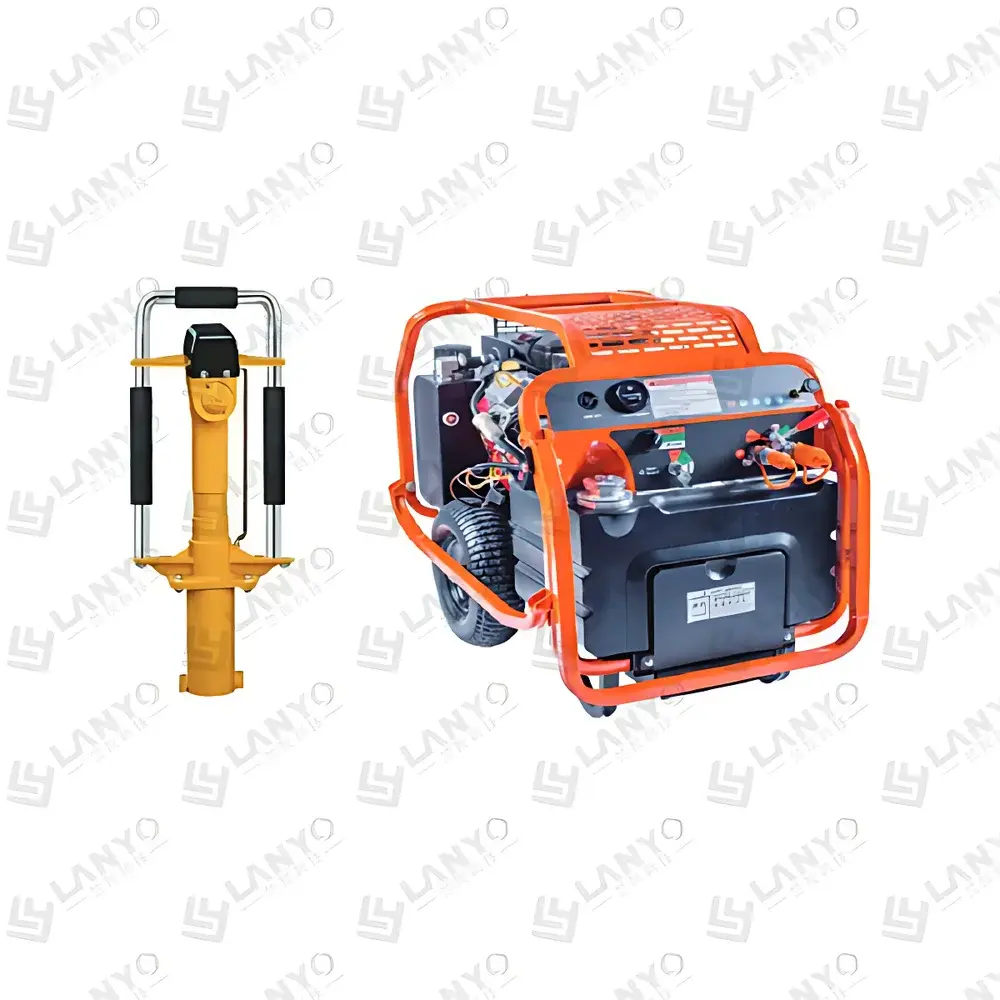
LANYO RT-S300 Hydraulic Soil Sampler
| Brand | LANYO |
|---|---|
| Origin | Beijing, China |
| Model | RT-S300 |
| Sampling Depth | 0–15 m (up to 20 m in soft soils) |
| Host Weight | 27 kg |
| Sampling Method | Hydraulic Impact |
| Core Diameter | 36 mm |
| Outer Diameter | 51 mm |
| Sample Recovery Rate | >97% |
| Hammering Frequency | 1400 bpm |
| Hydraulic Oil Capacity | 6.5 L |
| Pull-Out Force | 16.5 tonnes |
| Sampling Speed | up to 1.5 m/min |
| Sampling Principle | Single-Use Liner-Based Impact Coring |
| Mobility | Integrated Wheeled Cart System |
| Compliance | Designed for ASTM D1586, ISO 22475-1, and GB/T 50123-2019 soil sampling protocols |
Overview
The LANYO RT-S300 Hydraulic Soil Sampler is an engineered field-deployable coring system designed for high-integrity, depth-resolved soil sampling in environmental, geological, agricultural, and archaeological investigations. It operates on a hydraulic impact principle—utilizing controlled, high-frequency hammering (1400 blows per minute) to drive a split-spoon or liner-equipped core barrel into the ground without requiring water injection or rotary torque. This methodology preserves stratigraphic integrity, minimizes sample disturbance, and ensures representative recovery of undisturbed soil columns—critical for accurate geotechnical classification, contaminant profiling, and paleoenvironmental analysis. The system’s modular architecture integrates a self-contained hydraulic power unit, a wheeled transport cart, and a vertically aligned mast with automatic pull-out capability (16.5 tonnes force), enabling rapid deployment and retrieval across variable terrain and soil consistency—from dense clays to loose sands and organic-rich topsoil.
Key Features
- Hydraulic Impact Drive: Eliminates need for external water supply or auger-based torque; delivers consistent energy transfer for reproducible penetration in heterogeneous strata.
- Single-Use Liner Integration: Standard 36 mm internal diameter core liners (51 mm OD) are pre-inserted prior to driving; enable direct extrusion post-retrieval without sample handling or cross-contamination risk.
- High Recovery Efficiency: Achieves >97% sample recovery rate across standard soil types per ASTM D1586 Annex A1 guidelines—validated through comparative laboratory testing on cohesive and cohesionless soils.
- Depth-Scalable Operation: Rated for routine sampling to 15 m; extends to 20 m in low-density, non-gravelly formations via optimized hammer stroke modulation and liner support geometry.
- On-Site Mobility & Ergonomics: Integrated wheeled cart with locking casters, telescoping mast, and quick-connect hydraulic couplings reduce setup time to under 8 minutes and eliminate manual lifting of the 27 kg host unit.
- Automated Pull-Out System: Dual-stage hydraulic actuation ensures controlled, vibration-dampened extraction—preserving core continuity and minimizing shearing at interface boundaries.
Sample Compatibility & Compliance
The RT-S300 is validated for use with ASTM D1586 (Standard Test Method for Penetration Tests and Split-Barrel Sampling of Soils), ISO 22475-1 (Geotechnical Investigation and Testing – Sampling Methods and Equipment), and China’s GB/T 50123-2019 (Standard for Soil Test Methods). It accommodates standard 36 mm inner-diameter polyvinyl chloride (PVC) or polycarbonate liners compliant with EPA SW-846 Method 5035A (soil vapor extraction compatibility) and GLP-compliant chain-of-custody workflows. The system supports both dry and saturated soil matrices, excluding highly gravelly (>15% particles >19 mm) or bedrock-intercepted profiles without pre-drilling assistance. Liner-based collection meets trace metal and VOC preservation requirements when paired with appropriate field sealing and cold-chain logistics.
Software & Data Management
While the RT-S300 is a hardware-centric field instrument without embedded digital controls, it interfaces seamlessly with industry-standard logging platforms including Geolog™, Strater®, and ESRI ArcGIS Field Maps via optional Bluetooth-enabled depth encoder (sold separately). Each sampling event can be geotagged, depth-stamped, and annotated with real-time metadata—including hammer count, penetration resistance estimation, and liner batch ID—for integration into LIMS or environmental data management systems (EDMS). Audit trails comply with ISO/IEC 17025 documentation requirements, supporting regulatory submissions to EPA, EEA, or provincial environmental authorities under GLP-aligned quality assurance frameworks.
Applications
- Environmental Site Assessment (ESA): Vertical profiling of petroleum hydrocarbons, heavy metals, PFAS, and chlorinated solvents across vadose and saturated zones.
- Geotechnical Engineering: In-situ classification of fine-grained soils per USCS and AASHTO standards; correlation with CPT and SPT datasets.
- Agricultural Soil Health Monitoring: Stratified sampling for nutrient mapping, bulk density assessment, and microbial community analysis down to sub-plow layers.
- Archaeological Stratigraphy: Non-invasive column extraction for pollen, phytolith, and radiocarbon dating sequences with minimal lateral displacement.
- Regulatory Compliance Drilling: Support for RCRA Corrective Action, Brownfield redevelopment, and landfill post-closure monitoring programs.
FAQ
What soil types are compatible with the RT-S300?
The system is optimized for cohesive soils (clays, silts), granular soils (sands, silty sands), and organic-rich loams. It is not recommended for gravels exceeding 15% by volume or intact bedrock without pilot-hole assistance.
Is the RT-S300 suitable for VOC-sensitive sampling?
Yes—when used with certified VOC-clean liners, field-blank-controlled procedures, and immediate headspace-sealing per EPA Method 5035A, it satisfies stringent volatile organic compound preservation criteria.
Does the system meet FDA or ISO 17025 traceability requirements?
While the sampler itself does not generate analytical data, its operational logs, liner batch records, and georeferenced depth metadata fully support ISO/IEC 17025 audit trails when integrated into a documented QA/QC workflow.
Can the RT-S300 be operated by a single technician?
Yes—the wheeled cart design, automatic pull-out function, and intuitive hydraulic control panel allow safe, efficient operation by one trained field technician following manufacturer-provided SOPs.
What maintenance is required between sampling events?
Routine inspection includes hydraulic fluid level verification (6.5 L reservoir), O-ring integrity checks on cylinder seals, and liner guide alignment calibration—typically completed in <10 minutes using onboard tool kit.
Related Products







