
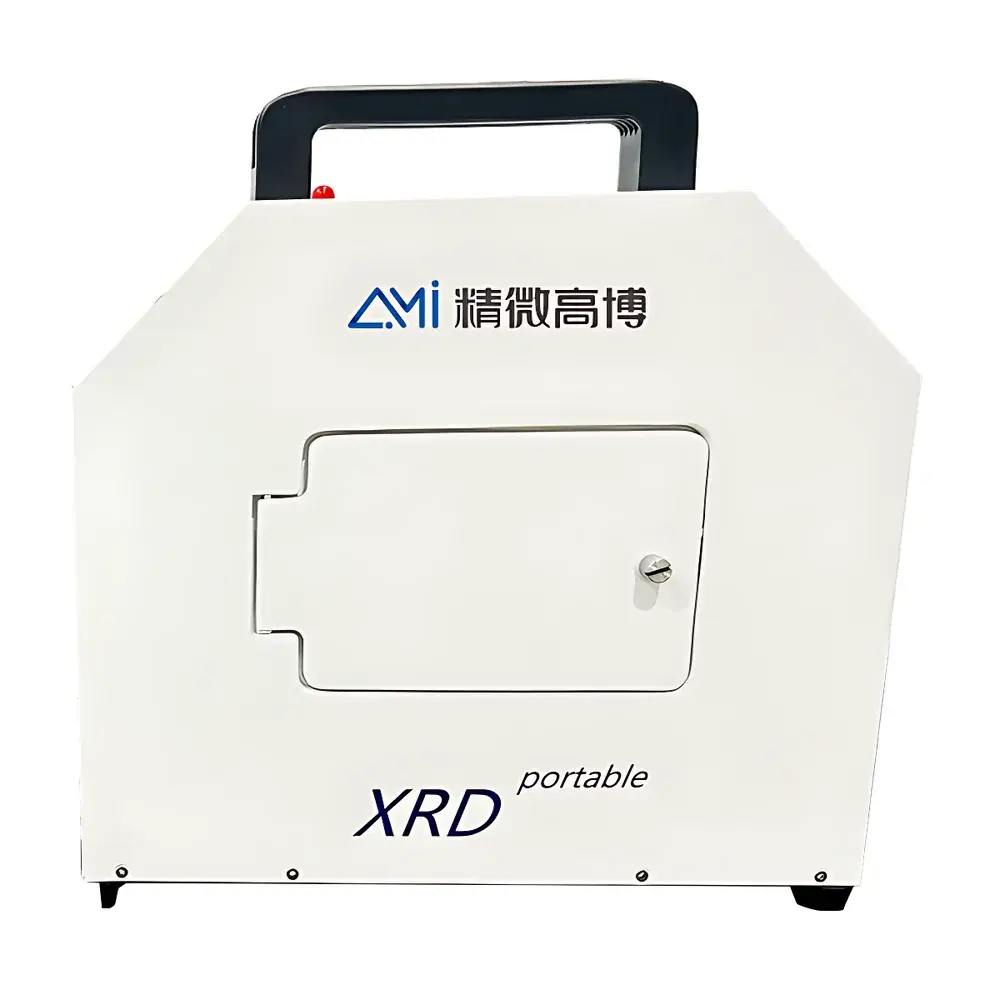
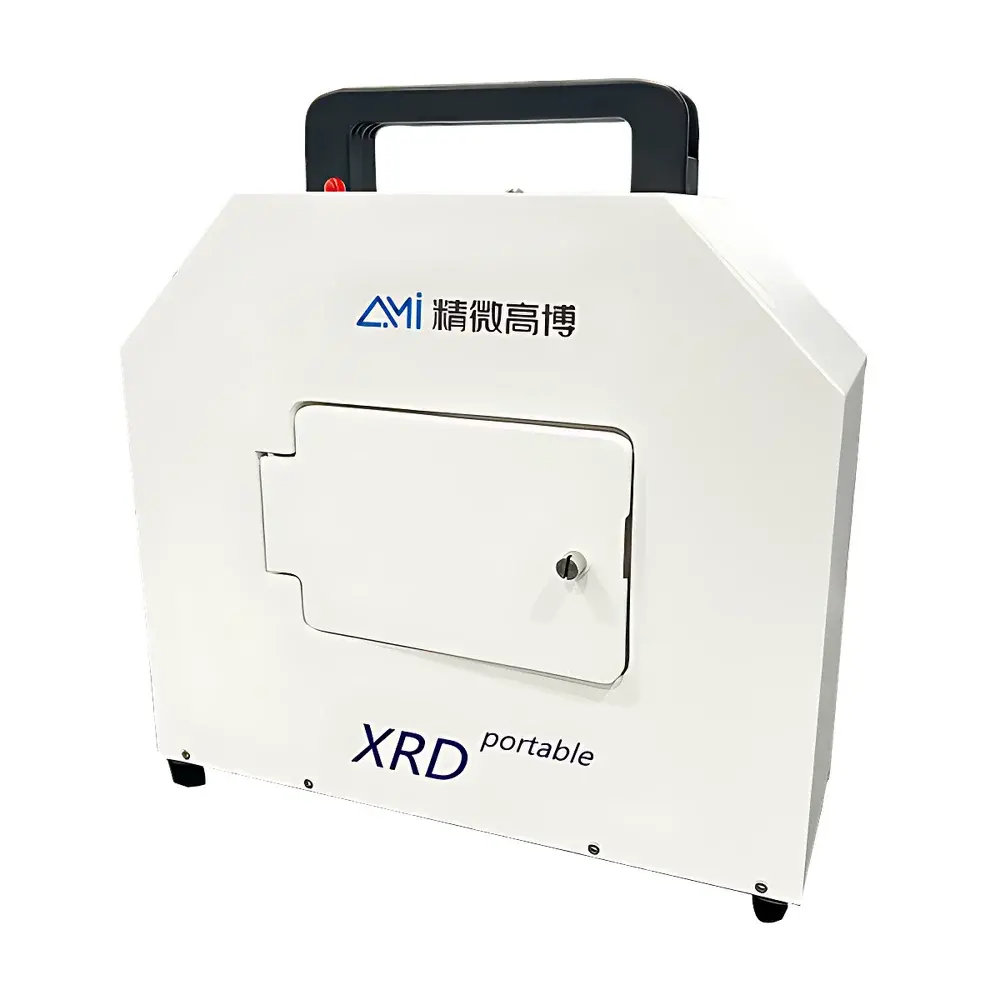
Lattice GO Portable X-ray Diffractometer
| Brand | JWGB (Jingwei Gaobo) |
|---|---|
| Origin | Beijing, China |
| Manufacturer Type | Direct Manufacturer |
| Product Category | Domestic |
| Model | Lattice GO |
| Instrument Type | Powder X-ray Diffractometer |
| Instrument Configuration | Portable |
| X-ray Tube Power | 30 W |
| Angular Accuracy | ±0.01° |
| Angular Resolution | 0.2° |
| Dimensions (L×W×H) | 120 mm × 300 mm × 305 mm |
| Weight | 12 kg |
| X-ray Tube | Cu anode, 30 kV / 1 mA |
| Goniometer Geometry | Vertical θ–2θ Bragg–Brentano |
| Goniometer Radius | 110 mm |
| Detector | Photon-counting 2D array detector |
| Scan Speeds | 6°/min or 13°/min (selectable) |
| 2θ Range | 0°–130° |
| Battery Runtime | 3 hours |
Overview
The Lattice GO Portable X-ray Diffractometer is an engineered solution for field-deployable and benchtop powder X-ray diffraction (XRD) analysis. It operates on the fundamental principle of Bragg’s law, where monochromatic Cu-Kα radiation (λ = 1.5418 Å) interacts with crystalline lattices to produce characteristic diffraction patterns—unique “fingerprint” signatures for each phase. Leveraging a compact Bragg–Brentano θ–2θ geometry, a high-stability microfocus X-ray tube (30 kV, 1 mA), and a photon-counting 2D array detector, the system delivers high-intensity, low-noise diffraction data with angular accuracy of ±0.01° and resolution of 0.2° across a full 0°–130° 2θ range. Its design prioritizes metrological integrity: intensity reproducibility, peak position fidelity, and background stability are validated against NIST SRM 1976 (corundum) and certified silicon standards—ensuring data compatibility with laboratory-scale diffractometers for both qualitative phase identification and quantitative Rietveld refinement.
Key Features
- True portable architecture: 12 kg mass, 120 × 300 × 305 mm footprint—designed for desktop deployment, mobile labs, and field use without external cooling or high-power infrastructure.
- Integrated 30 W microfocus X-ray source with Cu anode and optimized beam collimation for enhanced signal-to-noise ratio in minimal sample volumes (≤ 10 mg).
- Vertical θ–2θ goniometer with 110 mm radius and precision stepper motor control ensures mechanical rigidity and long-term angular repeatability.
- Photon-counting 2D array detector enables simultaneous acquisition across multiple 2θ angles—reducing measurement time without sacrificing resolution or dynamic range.
- Onboard rechargeable battery supports up to 3 hours of continuous operation, enabling uninterrupted analysis at remote sites, crime scenes, or cultural heritage locations.
- Pre-aligned optical path and factory-calibrated detector response eliminate routine recalibration requirements—maintaining traceability per ISO/IEC 17025 calibration guidelines.
Sample Compatibility & Compliance
The Lattice GO accepts standard 13 mm or 25 mm diameter powder samples, thin films, fragments, and irregular solids—requiring no mounting or grinding for many applications. Its non-destructive nature preserves evidentiary integrity, satisfying forensic chain-of-custody protocols. The instrument complies with IEC 61000-6-3 (EMC emissions) and IEC 61000-6-2 (immunity), and meets Class 1 laser safety requirements per IEC 60825-1. For regulated environments—including pharmaceutical quality control, environmental monitoring, and forensic laboratories—the system supports audit-ready data export (raw .xy, .csv, .raw) and metadata logging aligned with GLP/GMP documentation practices. While not FDA 21 CFR Part 11–certified out-of-the-box, its software architecture permits integration with validated electronic lab notebook (ELN) systems supporting electronic signatures and audit trails.
Software & Data Management
Bundled analytical software includes real-time pattern acquisition, automatic peak detection, database matching against ICDD PDF-4+ (2023 edition), and full-profile Rietveld refinement using TOPAS Academic engine. All processing workflows—phase identification, quantitative phase analysis (QPA), crystallite size/strain estimation, and lattice parameter extraction—are scriptable and exportable in ASTM E1361-compliant formats. Raw data files retain full detector frame metadata (exposure time, voltage, current, temperature), enabling retrospective reprocessing and inter-instrument comparability. Data security is enforced via local storage only; no cloud transmission occurs unless explicitly configured by the user. Export options include PDF reports with embedded spectra, CIF file generation, and batch processing for multi-sample screening.
Applications
- Forensic Science: On-scene identification of illicit drugs (e.g., heroin hydrochloride), explosives residues, toxicants (e.g., potassium cyanide), and trace minerals in soil, paper, or paint—supporting criminal investigations under ISO 17025-accredited methodologies.
- Cultural Heritage: In situ phase analysis of corrosion products on bronze/iron artifacts, pigment identification in mural plasters, and provenance determination of ceramic bodies and geological pigments—without sampling or transport.
- Geoscience & Mining: Real-time mineralogical logging of drill cuttings, ore grade estimation (e.g., sphalerite content in zinc concentrates), and lithological discrimination in complex sedimentary sequences—enabling rapid field decisions during exploration.
- Materials R&D: Rapid pre-screening of synthetic intermediates, catalysts, and battery electrode materials—accelerating iterative synthesis cycles while maintaining analytical rigor equivalent to core facility instruments.
- Regulatory & Environmental Monitoring: Field quantification of hazardous phases such as asbestos in cosmetics, borax or talc in food matrices, and crystalline silica in ambient aerosols—supporting compliance with EPA Method IO-3.2 and EU REACH Annex XVII.
FAQ
Is the Lattice GO suitable for quantitative Rietveld analysis?
Yes—its angular accuracy (±0.01°), intensity linearity, and low-background detector performance enable robust whole-pattern fitting with uncertainties comparable to benchtop systems when calibrated using NIST SRM standards.
Can it analyze samples in air, or is vacuum/helium required?
All standard measurements are performed in ambient air. Optional He-flushed sample chamber accessories are available for enhanced low-angle sensitivity (< 5° 2θ) in specialized applications.
What sample preparation is required for forensic or archaeological specimens?
Minimal preparation: flat-surface fragments, powders, or loose granules can be loaded directly. No pressing or dilution is needed for most inorganic phases; organic-rich matrices may benefit from gentle grinding to improve particle statistics.
Does the system support third-party software integration?
Yes—raw data exports in ASCII (.xy) and binary (.raw) formats are fully compatible with GSAS-II, FullProf, MAUD, and DIFFRAC.SUITE, allowing method portability across institutional platforms.
How is calibration maintained during extended field deployment?
The goniometer and detector are factory-aligned and thermally stabilized. A built-in corundum (NIST 1976) reference scan is included for periodic verification; no user-accessible mechanical adjustments are required between calibrations.






