
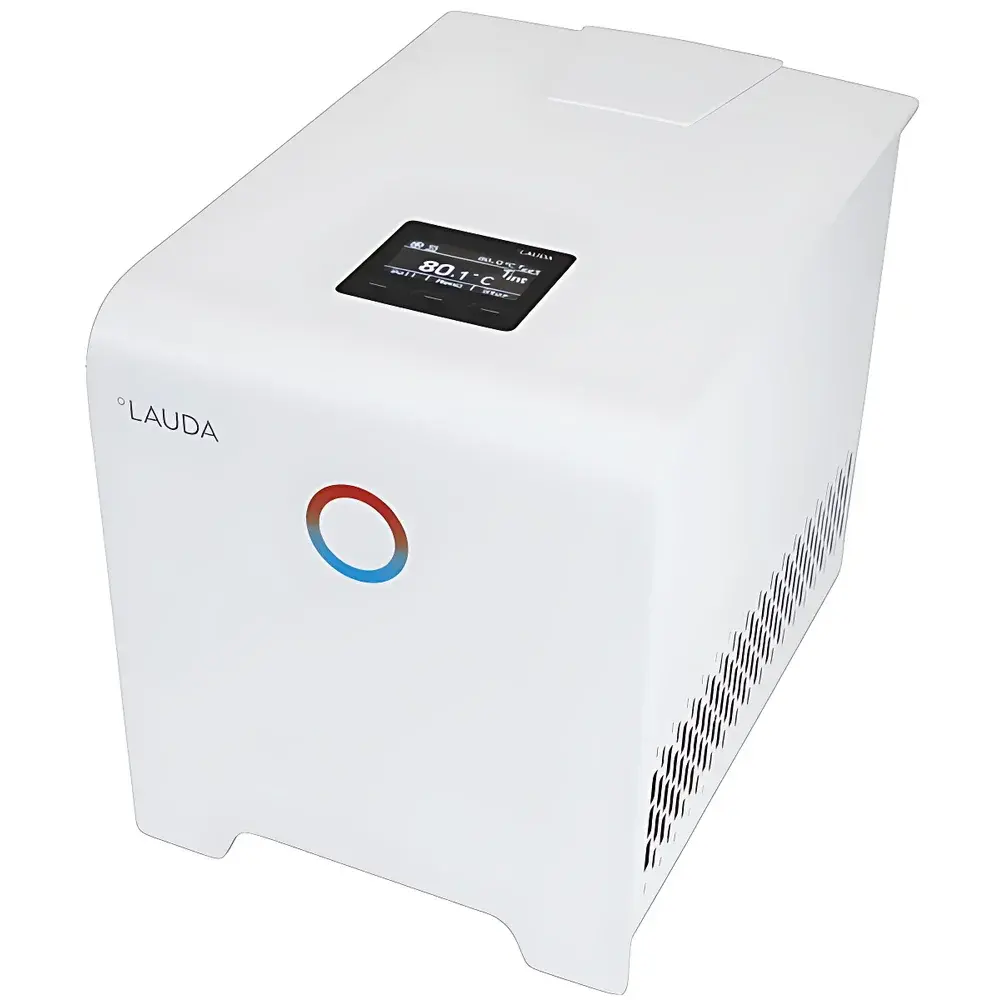
LAUDA LOOP L100 Semiconductor-Based Circulating Chiller
| Brand | LAUDA |
|---|---|
| Origin | Germany |
| Model | LOOP L100 |
| Instrument Type | Integrated Circulating Chiller |
| Cooling Method | Air-Cooled |
| Temperature Range | 4–80 °C |
| Temperature Stability | ±0.1 K |
| Refrigeration Capacity (at 20 °C) | 0.12 kW |
| Circulating Pump Pressure | 0.8 bar |
| Flow Rate | 3 L/min |
| Bath Volume | 0.28 L |
| Power Supply | 100–240 V AC, 50/60 Hz |
| Operating Mode | Plug-and-Play |
| Refrigerant-Free Operation | Yes |
| Compatible Heat Transfer Fluids | Water, Water-Glycol Mixtures (Non-Flammable) |
| Dimensions (W×D×H) | 175 × 301 × 266 mm |
| Weight | ~6.2 kg |
Overview
The LAUDA LOOP L100 is an integrated, semiconductor-based circulating chiller engineered for precision temperature control in analytical and life science instrumentation. Unlike conventional vapor-compression chillers, the LOOP L100 employs thermoelectric (Peltier) technology to deliver refrigeration without hydrofluorocarbon (HFC) or other regulated refrigerants—eliminating ozone depletion potential (ODP), global warming potential (GWP), and associated regulatory compliance burdens. Its solid-state architecture ensures silent, vibration-free operation critical for sensitive optical, spectroscopic, and electrophoretic systems where mechanical noise or thermal micro-disturbances compromise measurement integrity. Designed for seamless integration, the unit operates across universal mains input (100–240 V AC, 50/60 Hz) and delivers stable thermal conditioning from 4 °C to 80 °C with ±0.1 K stability—meeting stringent requirements for UV/VIS spectrophotometers, polarimeters, refractometers, electrophoresis tanks, and X-ray source cooling.
Key Features
- Refrigerant-free thermoelectric cooling: Compliant with EU F-Gas Regulation (EU No. 517/2014) and aligned with ISO 14001 environmental management principles.
- High-precision temperature control: Digital PID algorithm with real-time feedback from a Pt100 sensor immersed directly in the fluid path ensures reproducible setpoint accuracy and minimal overshoot.
- Compact footprint and lightweight design: Dimensions of 175 × 301 × 266 mm and mass under 6.2 kg enable benchtop deployment in space-constrained labs or mobile analytical platforms.
- Low-noise, zero-vibration operation: Absence of compressors, fans (beyond minimal airflow for heatsink dissipation), and moving refrigerant circuits preserves signal fidelity in interferometric, laser-based, and high-resolution imaging applications.
- Plug-and-play functionality: Pre-configured firmware, factory-calibrated sensors, and auto-sensing flow detection minimize setup time and eliminate field calibration dependencies.
- Chemically compatible fluid handling: Stainless steel pump head and EPDM-sealed wetted parts support aqueous and water-glycol mixtures—validated per ASTM D1384 corrosion resistance standards.
Sample Compatibility & Compliance
The LOOP L100 is designed for closed-loop circulation with external instruments requiring active thermal management. It interfaces with devices via standardized 6 mm quick-connect fittings (ISO 8434-1 compliant), supporting flow rates up to 3 L/min at 0.8 bar maximum backpressure. Fluid compatibility includes deionized water and aqueous glycol solutions (up to 30% v/v), verified for non-reactivity with common lab materials (e.g., borosilicate glass, PTFE, stainless steel 316). The unit conforms to IEC 61010-1:2010 for electrical safety in laboratory equipment and carries CE marking under the EU Low Voltage Directive and EMC Directive. Its refrigerant-free architecture inherently satisfies US EPA SNAP program eligibility and supports facilities pursuing LEED EBOM v4.1 Energy & Atmosphere credits.
Software & Data Management
While the LOOP L100 operates autonomously via its front-panel interface, optional RS485 (Modbus RTU) and analog 0–10 V outputs enable integration into centralized lab infrastructure. When connected to LAUDA’s optional LabView-compatible drivers or third-party SCADA systems, users can log temperature setpoints, actual bath temperature, pump status, and fault codes with timestamped audit trails—supporting GLP/GMP-aligned data integrity frameworks. All internal logging meets FDA 21 CFR Part 11 requirements for electronic records when deployed with validated system configurations and appropriate access controls.
Applications
- UV/VIS spectrophotometers: Maintaining cuvette compartment temperature during kinetic assays or thermal denaturation studies.
- Polarimeters and refractometers: Stabilizing optical path length and minimizing index-of-refraction drift in concentration-sensitive measurements.
- Electrophoresis systems: Preventing gel overheating during high-voltage runs; compatible with SDS-PAGE and Western blot transfer modules.
- X-ray generators and CCD detectors: Dissipating heat from high-power anodes and sensor arrays without introducing electromagnetic interference.
- Viscometers and rheometers: Providing consistent sample temperature for viscosity-temperature profiling per ASTM D445 and ISO 3104.
- LED-based light sources: Enabling stable spectral output in fluorescence microscopy and hyperspectral imaging setups.
FAQ
Does the LOOP L100 require routine refrigerant servicing or recharging?
No. As a thermoelectric chiller, it contains no compressible refrigerant and requires zero periodic refrigerant maintenance.
Can the LOOP L100 be used with organic solvents such as ethanol or acetone?
No. Only water and water-glycol mixtures are approved. Organic solvents may degrade seals and compromise pump integrity.
Is the unit suitable for continuous 24/7 operation?
Yes. Rated for indefinite duty cycle under ambient conditions ≤30 °C and relative humidity ≤80% non-condensing.
What is the minimum recommended flow rate for stable temperature control?
A minimum flow of 0.8 L/min is required to ensure adequate heat exchange and avoid thermal stratification in the reservoir.
How does ambient temperature affect cooling capacity?
Cooling capacity decreases gradually above 30 °C ambient; derating curves are provided in the technical manual per ISO 5151 methodology.



