
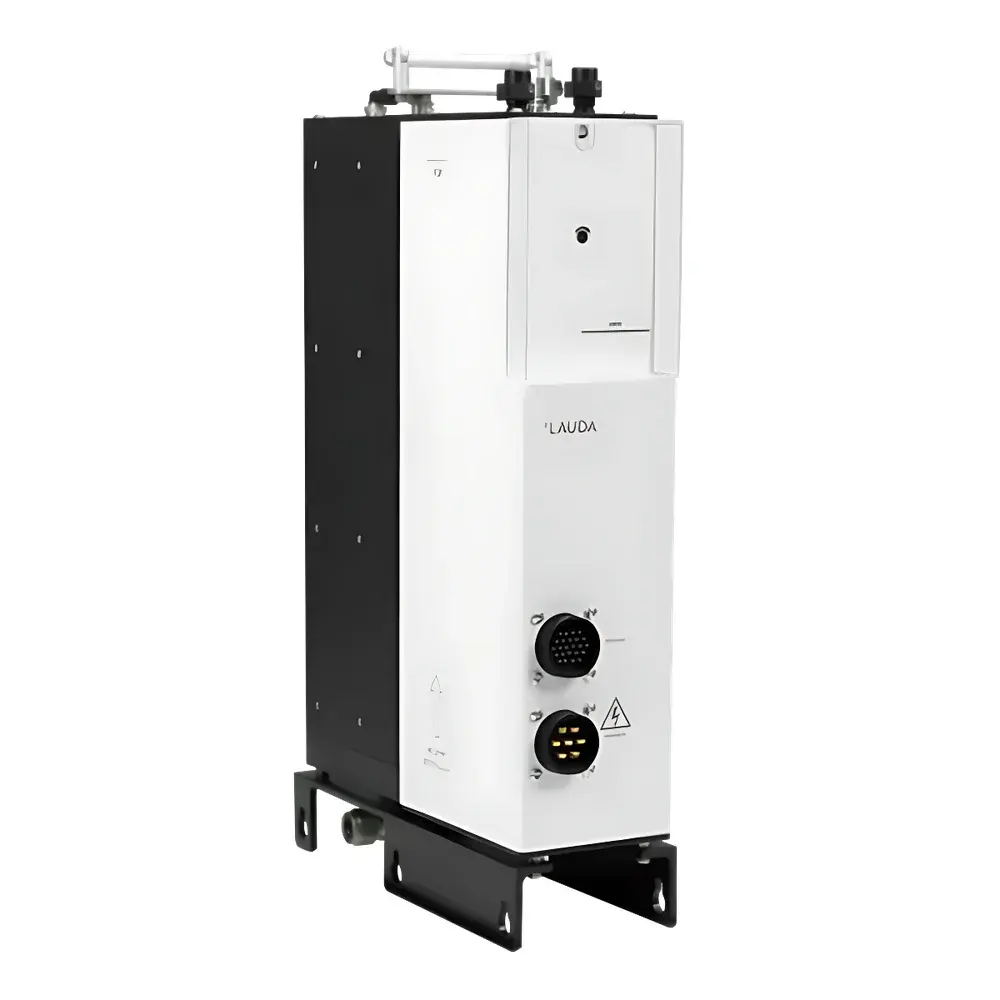
LAUDA Semistat Thermoelectric Process Thermostat
| Brand | LAUDA |
|---|---|
| Origin | Germany |
| Model | Semistat Thermoelectric Process Thermostat |
| Temperature Control Principle | Peltier-based active heating/cooling |
| Communication Interface | RS-485 |
| Footprint | Compact, floor-mountable (zero above-floor footprint option) |
| Heat Transfer Fluid Volume | Minimal (typically < 100 mL) |
| Application Domain | Plasma etch process temperature control for semiconductor manufacturing |
| Compliance Context | Designed for integration into ISO 9001-certified cleanroom toolsets |
Overview
The LAUDA Semistat Thermoelectric Process Thermostat is an engineered thermal management solution specifically developed for precision temperature stabilization of electrostatic chucks (ESCs) in plasma etching tools used in semiconductor front-end fabrication. Unlike conventional chiller-based or immersion-bath thermostats, the Semistat employs solid-state thermoelectric (Peltier) modules as its primary heat transfer mechanism—enabling bidirectional, compressor-free, and refrigerant-free temperature regulation across a defined operational range (typically −20 °C to +120 °C, dependent on system configuration and heat load). Its core architecture leverages the Seebeck–Peltier effect to achieve rapid thermal response times (< 3 s to 90% setpoint settling under nominal ESC thermal mass), high repeatability (±0.1 °C over 24 h under stable ambient conditions), and microsecond-level dynamic control resolution when integrated with real-time process controllers. The unit is not a standalone laboratory bath but rather a purpose-built subsystem designed for OEM integration or retrofitted deployment into 200 mm and 300 mm wafer processing platforms.
Key Features
- Thermoelectric (Peltier) temperature control architecture—eliminates compressors, refrigerants, and associated maintenance cycles
- Minimal heat transfer fluid volume (< 100 mL typical), reducing thermal inertia and enabling faster ramp rates
- Compact mechanical footprint; configurable for under-floor mounting to preserve cleanroom floor space
- RS-485 serial interface compliant with Modbus RTU protocol for seamless integration into factory automation networks (SECS/GEM, OPC UA via gateway)
- Active dual-mode operation: simultaneous heating and cooling capability without mode switching delay
- Integrated temperature sensing at both fluid outlet and ESC interface for closed-loop cascade control
- Robust industrial-grade enclosure rated IP54 for operation in controlled environments with particle mitigation requirements
Sample Compatibility & Compliance
The Semistat is not intended for sample immersion or open-bath applications. It interfaces exclusively with externally mounted electrostatic chucks via sealed fluid circulation loops (compatible with deionized water, low-conductivity glycol/water mixtures, or fluorinated heat transfer fluids per OEM specification). Its design aligns with key industry standards including SEMI F47 (voltage sag immunity), SEMI E10 (definition of equipment reliability), and ISO 14644-1 Class 5 cleanroom compatibility when installed with appropriate filtration and leak-tight manifolds. While the thermostat itself does not carry CE marking for medical use, it conforms to EN 61000-6-2 (immunity) and EN 61000-6-4 (emissions) for industrial environments. For regulated manufacturing environments, the RS-485 interface supports time-stamped command logging and can be configured to feed data into FDA 21 CFR Part 11-compliant MES or historian systems when deployed with validated middleware.
Software & Data Management
The Semistat operates as a deterministic hardware controller without embedded GUI or local HMI. All configuration, monitoring, and alarm handling are performed remotely via host PLC or process controller using standard Modbus RTU register mapping (detailed in LAUDA Technical Manual SEM-TP-002 Rev. D). Supported parameters include setpoint temperature, actual fluid outlet temperature, Peltier current draw, thermal error status, and flow presence detection. Optional firmware upgrades enable extended diagnostics such as Peltier junction degradation trending and predictive maintenance alerts based on cumulative thermal cycling history. Data export is achieved through ASCII-formatted serial telemetry or OPC UA server integration (via third-party gateway), supporting traceability requirements under IATF 16949 and ISO 13485 quality management systems.
Applications
- Real-time ESC temperature stabilization during reactive ion etching (RIE), inductively coupled plasma (ICP) etching, and deep reactive ion etching (DRIE) processes
- Thermal qualification of etch chamber hardware under varying RF power loads and gas chemistries
- Process window development for advanced node patterning (e.g., sub-7 nm logic, 3D NAND stack etch)
- Temperature-sensitive film deposition pre-etch conditioning (e.g., SiN, SiO₂, low-k dielectrics)
- Tool matching and fleet-wide thermal uniformity benchmarking across multiple etch platforms
FAQ
Is the Semistat suitable for general laboratory bath applications?
No. It is engineered exclusively for ESC thermal control in semiconductor plasma tools—not for open-container, immersion, or volumetric heating applications.
Does it require external cooling water?
Yes. A facility-supplied chilled water loop (typically 10–15 °C inlet) is required to reject heat from the hot-side Peltier heat sinks. No internal refrigeration circuit is present.
Can it operate at temperatures below 0 °C?
Yes, down to −20 °C depending on heat load, ambient conditions, and secondary coolant temperature—but sub-zero operation requires non-freezing heat transfer fluid and condensation mitigation measures.
Is firmware update capability available in the field?
Yes, via RS-485 using LAUDA’s certified DFU (Device Firmware Update) procedure, which includes checksum validation and rollback support.
What is the expected service life of the Peltier modules under continuous operation?
Rated for ≥ 50,000 hours MTBF at 70% thermal load and 25 °C ambient, per LAUDA Component Reliability Report SEM-REL-2023-08.



