
LaVision SprayMaster SLIPI Dense Spray Imaging System
| Brand | LaVision GmbH |
|---|---|
| Origin | Germany |
| Manufacturer Type | Authorized Distributor |
| Origin Category | Imported |
| Model | SprayMaster SLIPI |
| Pricing Range | USD 105,000 – 132,000 (FOB Hamburg) |
| Dispersion Method | Dry & Wet Dispersion |
| Instrument Type | Laboratory Laser-Based Planar Imaging System |
| Measurement Range | 5–3500 µm |
| Repeatability | <1% (RSD, N≥10, monodisperse PSL standards) |
| Measurement Time per Frame Sequence | 10–15 s |
| Core Technology | Structured Laser Illumination Planar Imaging (SLIPI) |
| Primary Detection Modes | Mie Scattering & Laser-Induced Fluorescence (LIF) |
| Optical Configuration | Synchronized Pulsed Nd:YAG Laser (532 nm or 266 nm), High-Speed CMOS Camera (≥1 MP, ≥10 kHz full-frame), Motorized SLIPI Grating Module, Precision Translation Stages |
Overview
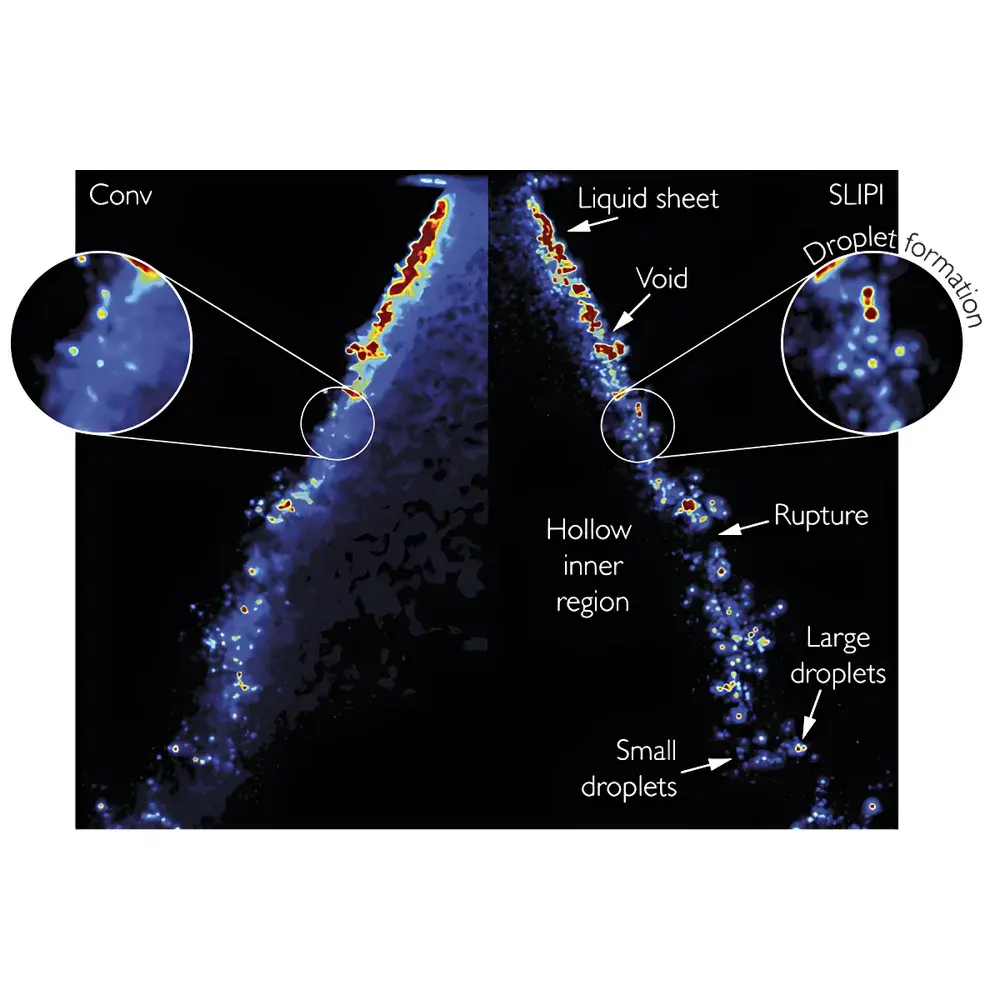
The LaVision SprayMaster SLIPI Dense Spray Imaging System is an advanced optical diagnostic platform engineered for quantitative, high-fidelity planar imaging of optically dense liquid sprays—such as those encountered in diesel injectors, gas turbine fuel nozzles, and pharmaceutical atomizers. Unlike conventional laser sheet imaging techniques that suffer from severe signal degradation due to multiple light scattering in high-droplet-concentration regions, SprayMaster SLIPI implements Structured Laser Illumination Planar Imaging (SLIPI), a physically grounded method that exploits spatial frequency modulation to discriminate singly scattered photons from multiply scattered background. By projecting a series of phase-shifted, stripe-patterned laser sheets and computationally reconstructing only the modulation-preserving component, SLIPI achieves enhanced contrast, improved depth discrimination, and reliable droplet sizing—even within the core of hollow-cone or impinging-jet sprays where optical density exceeds 103 droplets/mm3. The system operates on fundamental Mie scattering principles for particle sizing and supports dual-mode acquisition (Mie + LIF) for simultaneous morphology and composition analysis when seeded with fluorescent tracers.
Key Features
- Integrated SLIPI optical module with motorized, precision-aligned diffraction grating and phase-shifting actuation for automated stripe pattern generation and alignment verification
- High-repetition-rate pulsed Nd:YAG laser (532 nm standard; optional 266 nm UV for LIF excitation) synchronized to sub-nanosecond jitter with camera exposure
- Scientific-grade CMOS camera (12-bit dynamic range, global shutter, >10 kHz frame rate at full resolution) optimized for low-noise single-shot spray imaging
- Modular optical bench with kinematic mounts, translation stages (±50 mm, 1 µm resolution), and interchangeable lenses (f/2.8–f/5.6, 50–200 mm focal lengths)
- Real-time image preprocessing pipeline including background subtraction, flat-field correction, and SLIPI reconstruction (Fourier-domain demodulation)
- Compliance-ready architecture supporting audit trails, user access levels, and electronic signature protocols aligned with FDA 21 CFR Part 11 requirements for regulated R&D environments
Sample Compatibility & Compliance
SprayMaster SLIPI accommodates a broad spectrum of spray media—including hydrocarbon fuels (diesel, gasoline, biofuels), aqueous solutions (pharmaceutical suspensions, agrochemical formulations), and non-Newtonian liquids (polymer melts, slurries). It supports both free-running and triggered acquisition modes, enabling synchronization with engine cycles (via crank-angle encoder input), piezoelectric injector drivers, or external flow controllers. The system meets ISO 9022-14 (optical instrument environmental testing), conforms to IEC 61000-6-3 (EMC emissions), and is CE-marked for laboratory use in EU member states. For GxP-regulated applications, optional software modules provide full GLP/GMP traceability—including raw data immutability, metadata logging (laser energy, ambient temperature/humidity, calibration date), and version-controlled processing scripts.
Software & Data Management
The system is operated via DaVis 10.3+ software suite—a modular, scriptable platform developed by LaVision for time-resolved flow diagnostics. Key capabilities include SLIPI-specific reconstruction algorithms (3-phase and 4-phase variants), automated droplet detection via adaptive thresholding and watershed segmentation, and size distribution calculation using projected-area equivalent diameter (d32, d10, d90). All processed results are stored in HDF5 format with embedded metadata compliant with FAIR (Findable, Accessible, Interoperable, Reusable) principles. Batch processing pipelines can be exported as Python-compatible JSON configurations, facilitating integration into CI/CD workflows for automated validation reporting. Raw image sequences are archived with lossless compression; processed datasets support direct export to MATLAB, Python (NumPy/Pandas), and ASTM E2921-compliant CSV templates.
Applications
- Quantitative characterization of primary and secondary atomization in high-pressure common-rail diesel injectors under transient conditions
- Validation of CFD–spray coupling models (e.g., KH-RT, TAB, or wave breakup models) using experimentally derived Sauter mean diameter (SMD) and droplet number density maps
- In-process monitoring of nozzle wear effects on spray cone angle, penetration length, and local polydispersity
- LIF-based fuel/air mixing studies in pre-combustion chambers using acetone or TMPD tracers
- Development of inhalable aerosol formulations where aerodynamic particle size distribution (APSD) must be resolved across the respirable range (1–5 µm MMAD)
- Non-destructive quality control of industrial spray drying nozzles used in food, ceramic, and battery cathode material production
FAQ
How does SLIPI differ from conventional laser sheet imaging in dense sprays?
SLIPI uses spatially modulated illumination to suppress multiply scattered light—retaining only the modulation-carrying component from single scattering events. Conventional laser sheet imaging integrates all scattered intensities, resulting in blurred, low-contrast images in dense regions.
Can SprayMaster SLIPI measure velocity fields in addition to size?
Yes—when configured with double-pulse capability and PIV (Particle Image Velocimetry) optics, the system supports simultaneous SLIPI-based sizing and PIV-based velocity mapping using cross-correlation or spectral analysis methods.
Is calibration traceable to NIST or PTB standards?
All factory calibrations (pixel scale, laser sheet thickness, timing jitter) are performed using NIST-traceable reference targets and certified photodiodes; calibration certificates include uncertainty budgets per ISO/IEC 17025.
What maintenance is required for long-term stability?
Annual optical alignment verification and laser energy calibration are recommended; SLIPI grating modules are sealed and require no user servicing. DaVis software updates include backward-compatible firmware patches for all hardware components.
Does the system support real-time feedback for closed-loop spray control?
While primarily designed for offline analysis, the system’s API enables integration with LabVIEW or Python-based control systems for near-real-time (≤100 ms latency) parameter extraction and external actuator triggering.
Related Products



